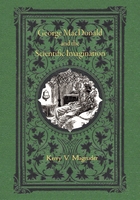
 Kerry V. Magruder, George MacDonald & the Scientific Imagination (Hamden, CT: Winged Lion Press, September 2026).
Use links below to order the paperback or hardback at a discount (US and UK only). On purchase pages there are also links to a free preview of the front matter, with advance reviews, and introduction. Also in US Amazon and Barnes and Noble (with free shipping). Also at Amazon in the UK, France, Canada, and elsewhere. To read the advance reviews with my responses, scroll down below.
TL;DR: Too many scientists and science educators feel lost in the wasteland of reductionistic science. I wrote this to help them renew their sense of wonder and to recognize that the natural sciences require the same degree of imaginative creativity as poetry, art, music, and literature. I hope that it may also encourage those who work in non-scientific fields by helping them to recognize that natural scientists, too, participate with them in a common quest of imaginative realism. All of this is summed up in MacDonald’s aphorism, “poetry includes science.”
First page:
Do science and the imagination have anything in common? Do scientists appreciate music, admire landscapes, and enjoy poetry? Do the arts matter for their science? Do we need to cultivate a scientific imagination? What did George MacDonald (1824-1905) mean by “poetry includes science”? Come with me on a journey to explore these questions.
Reflection upon the imagination leads us straight to the heart of two perennial questions for science:
1) Where do creative ideas come from?
2) With each new discovery, how does wonder deepen?
These two questions lead to a third:
3) Through the imagination, do we make contact with reality?
While some adopt the idea that science and the creative arts are two separate cultures, associating science with facts and imagination with fantasy, historical perspectives show that science and the imagination are interrelated. It is not just that connections between the arts and sciences have been deep and profound. More than that, the imagination lies at the heart of the natural sciences themselves. Within science, creative leaps of the imagination underlie unexpected discoveries. The imagination peers into the as-yet unknown and unseen to discern where the next discovery might be waiting. The imagination discloses the blind spots that hinder discovery. And an imagination that transforms the tedium and monotony of repetitive practices keeps wonder alive. This imaginative realism, as we shall call it, means that, rather than indulging an inward retreat from objective reality, a generative imagination makes contact with reality holistically, in multiple dimensions. These manifestations of the imagination — making discoveries in new dimensions and sustaining wonder — characterize creative activity not only in literature and the fine arts but also in the natural sciences.
In the 20th century the Inklings and their friends — C. S. Lewis, J. R. R. Tolkien, Owen Barfield, Dorothy L. Sayers, and their kindred forebear G. K. Chesterton, among others — expressed a profound imaginative realism that resoundingly affirmed the truth-bearing character of the imagination. More recently, the writings of Malcolm Guite in literature, Jeremy Begbie in music, and Makoto Fujimura in art, illumine how the imagination apprehends reality. In the same spirit this essay explores, with the help of MacDonald, how in the natural sciences we make contact with reality through the imagination.
Abstract:
George MacDonald’s embrace of the imagination as an instrument for apprehending reality heals a deep-seated cultural split between science and wonder. That split is characterized by two opposing kinds of realism: on one hand, a positivist realism or reductionism which reduces reality to nothing but what is evident to sensory perception, and, on the other hand, an imaginative realism which apprehends the as-yet unseen, unknown, and unfinished in-depth realities which lie beyond and beneath the surface appearances of things. With special attention to MacDonald’s novel Thomas Wingfold, Curate and 19th-century geology, this interpretative essay explores how MacDonald’s holistic integration of reality, given the perceptive and creative role of the imagination, applies to the natural sciences as well as to literature and the fine arts. The imagination is then given legitimate scope to play as the source not only of wonder but also of creative discovery within the very fabric of natural science. Without imagination, the sciences perish.
Table of Contents:
GEORGE MACDONALD & THE SCIENTIFIC IMAGINATION
- Author’s Invitation
- Intellectual Context
- Aristotle vs. Reductionism: The Wonder of Birds
- Charles Darwin: Functional Reductionism
- George MacDonald: Imaginative Realism
- Setting the scene: Thomas Wingfold, Curate
- The Unknown
- The Unseen and Unfinished
- The Imagination in 19th-century Geology
- The Unknown: Mary Anning
- The Unseen: James Hutton
- The Unfinished: Hugh Miller
- The Imagination in Science and Faith
- The Imagination in Science
- The Imagination in Faith
SUPPLEMENTARY ESSAYS
- Isaac Newton: Tensions became Dualisms
- “Poetry includes science”
- “Storytelling includes science”
- “Music includes science”
APPENDIX
- Reading MacDonald
END MATTER
- Discussion Questions
- Acknowledgments
- About the Author
- Bibliography
- Name Index
- Notes
An excerpt adapted from the “Poetry includes science” chapter is available at HopeWords Literary Journal. An excerpt adapted from “George MacDonald: Imaginative Realism” will appear in the next issue of the Wingfold journal, ed. Barbara Amell.
Advance praise, with responses:
This magisterial survey not only places MacDonald in the context of the developing science of the nineteenth century, but also shows him as a person in and through whom the necessary conversation between Science, the Arts, and Christianity was taking place. In a world in which the three great forces of Science, Art, and Religion seem fearful of one another, even hostile, we need to hear that conversation now even more than the Victorians needed it then. This is not just an historical survey, it’s a vital contribution to a current debate. Magruder draws fresh insights from MacDonald, insights about the role of the Imagination in all three spheres, the kind of imagination that does not lead us away from reality but rather takes us deeper into the heart of things. I strongly commend this book to anyone who longs for integration and hope in a world of disintegration and despair.
— Malcolm Guite, Life Fellow, Girton College, Cambridge; poet (David’s Crown; Love Remember; Sounding the Seasons; Waiting on the Word; Word in the Wilderness; The Word Within the Words; and others); author (Lifting the Veil; Faith, Hope and Poetry; Mariner; Galahad and the Grail; The Coming of Arthur; and others).
No author’s books have mattered more to sustaining my spirit over the last two decades than Malcolm’s. He would not remember this, but back in 2012, I was able to attend a service at St. Edward the Martyr’s in Cambridge where, as associate chaplain, he prayed for me. I am deeply grateful for his encouragement and for this review. It goes to the heart of what I was trying to do.

* * * *
“As a son of a scientist and as an artist, a work that connects science and imagination is a portal of creative refreshment for me. Kerry’s George MacDonald and the Scientific Imagination proved to be a treasure-filled map. This is a monumental work of integration, a deep well of resources for scientists and artists, historians and teachers alike. Kerry beautifully lays out MacDonald’s vast and soaring realms of imaginative realism to open our eyes and hearts toward the vista of wonderment.”
— Makoto Fujimura, artist and author of Art Is: A Journey into the Light; Silence and Beauty: Hidden Faith born of Suffering; and Culture Care: Reconnecting with Beauty for Our Common Life. Find Makoto’s essays at Substack.
As I read the writings of Makoto Fujimura, Malcolm Guite, and Jeremy Begbie, virtually everything they say about the imagination and creativity in art, literature, music, and theology also possesses a direct analogue in the natural sciences. My book is a little pebble of reflection on science tossed into that broad and rolling river.
I am so grateful for the times I have experienced Makoto’s art at his gallery, on exhibition, and in the very act of making at Fujifarm near Princeton. He has impacted me deeply, so I was honored when he wrote this review of my book.
Makoto read a draft in May 2025, and I particularly thank him for that conversation. Makoto, Haejin Fujimura, and David Kim offered encouragement and later invited me to participate in “To See a World in a Grain of Sand,” a retreat held by Goldenwood Institute in December, 2025. The retreat was devoted to the imagination and creativity in the arts and sciences. In a public event held on the campus of Princeton Seminary, David Kim moderated a conversation with Makoto and myself. The three of us discussed the relations between creativity in the natural sciences, as presented here, and creativity in the arts, as conveyed in Makoto’s book Art Is: A Journey into the Light. Participants in the retreat were given a draft of this essay, and I thank them for their valuable feedback.

* * * *
“Like awakening in the night to the scent of life-giving rain on a dry and weary land, the major theme of this book — poetry includes science — strikes the reader with unexpected hope. For far too long, we have lived as though scientific inquiry must be stripped of art, poetry, music, and story, as if imagination were an intruder rather than a companion to truth.
Dr. Kerry Magruder reminds us that this was neither always so — nor need it remain so. Drawing on a remarkably wide historical vision, he brings into conversation figures as diverse as George MacDonald, C. S. Lewis, and J. R. R. Tolkien alongside Copernicus, Kepler, Darwin, and Einstein. The result is not a forced synthesis, but a lively exchange across disciplines often presumed incompatible: poetry and physics, theology and philosophy, geology and narrative.
From Plato and Aristotle to Augustine and Newton, among many others, this book traces a long tradition in which imagination and reason were convivial fellow discoverers. What has science to do with imagination? In this engaging and accessible work, Dr. Magruder — under the guidance of that great master of imagination, George MacDonald — offers a compelling answer: everything.”
— Glenn Horn, philosopher, author L’histoire des idées à Paris.
Glenn Horn, who for many years provided intellectual walking tours of the Left Bank, spent hours with me walking the streets of Paris and talking about the scientific imagination expressed in each particular locale we passed. I’m grateful for his review of my book.
* * * *
“This book invites us to consider afresh the role of wonder in the pursuit of knowledge and the extent to which we already use imagination to move beyond what we see or otherwise sense — what we call facts — in our attempt to attain deeper levels of understanding. A timely and thought-provoking exploration of how we come to know the world, it encourages us to approach that task with curiosity, humility, and both scientific and theological reflection.”
— Marc Foggin, author “Thinking Like a Mountain: Exploring the Potential of Relational Approaches for Transformative Nature Conservation”; Honorary Research Associate, School of Geography and the Environment, Oxford University; International Director, Plateau Perspectives.
What does a relational and wonder-filled approach to science look like? A holistic approach in current mountain studies is J. Marc Foggin, Daniele Brombal, and Ali Razmkhah, “Thinking Like a Mountain: Exploring the Potential of Relational Approaches for Transformative Nature Conservation,” Sustainability 13 (2021) 12884. They write: “‘Thinking like a mountain’ rests on seeing the world as a mountain does — considering the whole environment (i.e., people and nature, and indeed people within nature) through the prism of place, with people, and seeing nature through longer time frames and with an appreciation for beauty in the great diversity and complexity of life.” Simply put, science need not reduce reality to abstractions in which there is no room for beauty, wonder, and meaning. I appreciate Marc’s review of George MacDonald and the Scientific Imagination.
* * * *
“Written with infectious joy, this book was like water for a part of me I didn’t even know was thirsty. My work is chiefly in finance, yet MacDonald’s vision of a world richer than the reductionism into which many of us have been baptized helped me see that imagination is not an escape from reality but a deeper way of apprehending it. By the final page, I found myself extending MacDonald’s insight: poetry includes finance, too. This is a book I will be sharing with friends for years to come.”
— Travis Lowe, financial services executive; ordained minister; cofounder of HopeWords; host of HopeWords and Lifting the Veil conferences. Find Travis’ essays at Substack and at HopeWords Literary Journal.
I first met Travis Lowe when he co-hosted Painters Prophets Poets in Oklahoma City in 2024. At that time I was writing George MacDonald and the Scientific Imagination. Given the magnitude of his generous intellectual hospitality and financial wizardry in devoted service of so many, one might be excused for overlooking Travis’ own essays. Yet he is a writer’s writer. Without fail, he writes with incisive perception and insight. He has a sure way with words and hearts, and exemplifies what it means to be a faithful friend. I appreciate Travis’ review of George MacDonald and the Scientific Imagination.
* * * *
“With this collection of thought-provoking essays, Kerry Magruder invites us into the world of 19th century intellect and author George MacDonald — a world where science and art, faith and curiosity, and acumen and awe can coexist in harmony. A consummate storyteller himself, Magruder weaves seemingly disparate subjects into a cohesive whole, proving himself a worthy guide and adept translator of MacDonald’s legacy for today. So that in the end, George MacDonald and the Scientific Imagination is not simply another book that tells readers what to think but one that offers a profound and beautiful example of how to think.”
— Hannah S. Anderson, author of All That’s Good: Recovering the Lost Art of Discernment; Humble Roots; Heaven and Nature Sing; Turning of the Days; and other books. Host of Painters, Prophets, Poets. www.sometimesalight.com. Find Hannah’s essays at The Dispatch and on Substack.
I first met Hannah Anderson when she co-hosted Painters Prophets Poets in Oklahoma City in 2024. At that time I was writing George MacDonald and the Scientific Imagination. Since then, I have come more and more to admire her honesty, humor, discernment, imagination, passion for beauty and truth, and personal authenticity. She has a profound gift of hospitality, expressed not least in her ability to converse with anyone and to bring out the best in the people she interviews. This year I cannot wait for her forthcoming multimedia project, Feast of Wonders, to see the light of day. I appreciate Hannah’s review of George MacDonald and the Scientific Imagination.

* * * *
“In our disenchanted age, it can be hard to imagine an age when a generative spirit of inquiry opened endless possibilities to the aspiring scientist. Yet the spark of magic that we associate with imaginative literature shares the same intellectual lineage as the history of science. Dr. Magruder has thrown back the curtains, and reopened the windows for a new age of scientific inquiry and wonder.”
— Father Nathan Carr, Headmaster, Academy of Classical Christian Studies, Oklahoma City; Vicar, St. John’s Episcopal Church, Oklahoma City; author Festive School: Restoring Joy, Liturgy, and Celebration in Christian Education.
As a founder of the largest classical school in Oklahoma, Father Nathan Carr brought to that endeavor, from the start, a vision of education as formation in imagination, joy, and love. The more I learn about his approach to education, which also characterizes his approach to ministry, the more he seems already to embody what I have tried to describe in George MacDonald and the Scientific Imagination. I appreciate Father Nate’s review.
* * * *
“At its heart, science is a desire to know reality as it truly is, and this requires a creative imagination. Through George MacDonald and the Scientific Imagination we taste what science was like, and might become again, when robustly integrated with the same imagination that we see everywhere expressed in poetry, music, and the creative arts. Science educators will benefit immensely.”
— Jason K. Brogden, Dean of Science Instruction and Director of Lynx Science Academy, Founders Classical Academies.
Jason Brogden is a dedicated science educator who brings to that task a rare combination of professional training in both theology and the history of science. I appreciate Jason’s review of George MacDonald and the Scientific Imagination.
* * * *
“As a long-time reader of MacDonald, I still found Dr. Magruder introducing me to new aspects of MacDonald’s works and sometimes to works hitherto unknown to me! As a molecular biologist I was pleased to find how approachable Magruder made the tales of discoveries in other scientific fields, like geology, astronomy, and paleontology. Whether you have only dabbled in MacDonald or science or are an expert in both, you will find many rich things to explore. Magruder helpfully has extracted and distilled the scientific concepts that pulse throughout MacDonald’s writings and provided them with ample context to help us not only understand, but actually see how throughout history the imagination and scientific inquiry have been inextricably related. Though the primary essay itself is full of rich historical asides and wonderful quotes, the reader is invited to delve deep with the aid of supplementary essays and copious endnotes. The spectacular illustrations reflect Magruder’s long experience as Curator of the History of Science Collections of the University of Oklahoma Libraries.”
— Baronger Bieger, Assistant Professor of Biology, John Brown University.
Baronger Bieger is a rising MacDonald scholar whose paper on MacDonald and evolution at the bicentenary conference at Wheaton in 2024 gave me much joy. More than that, Baronger has made it a practice to read MacDonald with science students. I am inspired by his integration of science and imagination in his work as a biologist and science educator. I appreciate Baronger’s review of George MacDonald and the Scientific Imagination.
* * * *
“Through George MacDonald’s integrative lens, Magruder recovers an understanding of science in which the imagination gives vision, direction, and meaning to scientific inquiry. His argument is buttressed by carefully curated period artwork, and extensive endnotes provide a trove of resources for further study. Magruder’s expertise and passion for the history of science make this essay a compelling read for scholars and general readers alike.”
— Michael Wayne Wilhelm, George MacDonald scholar and Chaplain, Cal Farley Boys Ranch, Texas.
I first came across Mike Wilhelm as the author of important articles about MacDonald that converge very closely with the theme of my book. But then I met him in person and discovered more about his life as a chaplain and mentor to troubled youth. His gentleness and deep wisdom embody MacDonald himself. So I very much appreciate Mike’s generous review of George MacDonald and the Scientific Imagination.
* * * *
“Dr. Kerry Magruder shares his deep knowledge of the history of science to illuminate the beauty and necessity of the imaginative faculty. Here is a type of acute wonder that most of us remember from our childhood — a time when everything was marvelous. This book takes us back to that sense of awe through compelling examples of the scientific imagination. He walks us through the journey of integrating imagination, science, history, and faith as a doorway to deeper wisdom. George MacDonald and the Scientific Imagination is a treasure of thoughtful essays with over 60 inspiring photos from the History of Science Collections at the University of Oklahoma Libraries. As a homeschool educator and college professor, I highly recommend this book for those who want to approach the complexity of Creation in light of imaginative realism.”
— Joyce McPherson, Covenant College; author of Universe of Wonder: The Story of Johannes Kepler and Spiritual Sight: The Story of George MacDonald.
Joyce McPherson captures whole worlds in her biographies of notable figures including Jane Austen, Kepler, and others. In her biography of MacDonald she shows that, with Thomas Chalmers, neither the latest discoveries in astronomy nor pre-human geological ages of the Earth were viewed as contrary to Christian faith. Here we enter the very milieu of MacDonald. A young MacDonald once stood on a kitchen table pretending to preach as grandly as Chalmers. As George was growing up, the MacDonald family read and admired Chalmer’s works. I appreciate Joyce’s review of George MacDonald and the Scientific Imagination.
* * * *
I would also like to thank Andrew Peterson who kindly encouraged my work. George MacDonald and the Scientific Imagination, like The Rabbit Room artistic and literary community in Nashville, seeks to integrate creativity in all of life. One of The Rabbit Room’s guiding principles is to avoid referring to “creatives” as if literature and the arts have a monopoly on the creative imagination.* My book is a tiny plea for a holistic conversation that regards the arts and the sciences as a seamless, integrated culture in need of and on its way toward the New Creation. If you are a scientist or creation worker of any kind, I recommend listening to Andrew Peterson’s music. My playlist of AP fav’s is more than 6 hours long! Here’s one example: substitute what you do for the word “poets” in “To All the Poets I have Known.” Does the song then work for astronomers, educators, farmers, health-care workers, or whatever you do? I think it may encourage you and renew your hope. That is also why I wrote this book.
* Andrew Peterson, Adorning the Dark: Thoughts on Community, Calling, and the Mystery of Making (Nashville, Tennessee: B&H Publishing Group, 2019), p. 168. Find all of Andrew’s books at Amazon, his musical oeuvre on streaming platforms, his Wingfeather Saga on the screen, and his writing on Substack.
“It is not the things we see the most clearly that influence us the most powerfully; undefined, yet vivid visions of something beyond, something which eye has not seen nor ear heard, have far more influence than any logical sequences whereby the same things may be demonstrated to the intellect. It is the nature of the thing, not the clearness of its outline, that determines its operation. We live by faith and not by sight.” — George MacDonald, A Dish of Orts, pp. 28-29.
Numerous overlaps or convergences are evident between George MacDonald and the writings of Thomas F. Torrance, James B. Torrance, and David W. Torrance. Among these are:
(1) the importance of developing a Christian theological instinct understood as a well-formed imagination or a disciplined intuition open to in-depth reality. Another is the ideal of
(2) knowing things according to “the nature of the thing,” kata physin. Both of these are suggested in the quotation above. Other major areas of agreement between them touched upon in this essay are
(3) semantic realism, which I refer to as imaginative realism (think of it as intuitive realism); and
(4) contingent order, including contingent history (or contingent freedom). In addition, MacDonald and the Torrances understood
(5) faith and reason as intimately related rather than as separate intellectual domains, and
(6) rejected natural theology as an independent or autonomous path to genuine knowledge of God.
Many have long enjoyed reading the Torrance brothers alongside MacDonald. Cf. George MacDonald: A Devotional Guide to His Writings, ed. Gary W. Deddo and Catherine A. Deddo, The Devotional Library (Edinburgh: Saint Andrew Press, 1996).
This book is the first volume of my aspirational larger project, Love and the Cosmos: Trinitarian Perspectives on Science with T. F. Torrance and C. S. Lewis and Their Friends. In subsequent volumes I hope to explore at greater length many of the themes introduced here.


Tried to buy from UK – as offered – but website would not let me change United States to UK
Jock, thank you for letting me know. I’ll relay this to the publisher.
UK discount links are now added at the top of the post.