Thanksgiving – family devotion

Index of Thanksgiving and Christmas holiday posts

Happy Thanksgiving!

Before or after watching A Charlie Brown Thanksgiving, discuss some scriptures about giving thanks:

1. Psalm 50:23. What may we do that will prepare our hearts to see God’s salvation revealed?

“He who sacrifices thank offerings honors me, and he prepares the way so that I may show him the salvation of God.”

2. 2 Corinthians 1:10-11. What results when God delivers us?

“We have set our hope that he will continue to deliver us, as you help us with your prayers. Then many will give thanks on our behalf for the gracious favor granted us in answer to the prayers of many.”

3. Romans 1:21. If we do not give God thanks, what is the condition of our hearts? What kind of conclusions then result from thankless thinking?

“For although they knew God, they neither glorified him as God, nor gave thanks to him, but their thinking became futile and their foolish hearts were darkened.”

4. Colossians 2:6-7. Did it seem “natural” to give God thanks when we first encountered Christ? Is it equally “natural” or a part of my lifestyle now?

“So then, just as you received Christ Jesus as Lord, continue to live in him, strengthened in the faith as you were taught, and overflowing with thanksgiving.”

5. 1 Thessalonians 5:16-18. In what circumstances are we to give God thanks?

“Be joyful always; pray continually; give thanks in all circumstances, for this is God’s will for you in Christ Jesus.”

(Cf. Romans 8:28; Habakkuk 3:16-19.)

6. Ephesians 5:19-20. How often are we to give God thanks? For what are we to give God thanks?

“Speak to one another with Psalms, hymns, and spiritual songs. Sing and make music in your heart to the Lord, always giving thanks to God the Father for everything, in the name of our Lord Jesus Christ.”

7. Philippians 4:4-7. In times of need, to deal with our anxiety, how can we express our thanksgiving?

“Rejoice in the Lord always. I will say it again: Rejoice! Let your gentleness be evident to all. The Lord is near. Do not be anxious about anything, but in everything, by prayer and petition, with thanksgiving, present your requests to God. And the peace of God, which transcends all understanding, will guard your hearts and your minds in Christ Jesus.”

8. John 11:1-45; especially verses 33, 35, 38, and 41.

  • For what did Jesus give thanks in this difficult circumstance?
  • Is this something for which we may likewise give thanks, no matter what the circumstance?
  • Can we give thanks and weep at the same time?
  • Why are we not to accept whatever comes our way stoically, or fatalistically; that is, why is it not a Christ-like practice to discipline ourselves so that we eliminate all desires and longings for things to be different than they are?
Posted in Family, Theology | Tagged , | Leave a comment

Thanksgiving as color vision

Index of Thanksgiving and Christmas holiday posts

Thanksgiving is a window to reality; our chief means of spiritual perception.

Trees, color

Imagine a country where everyone was gradually becoming color-blind (to borrow from H. G. Wells). As more and more people were born without the capacity to perceive colors, their shadows and shades of grey would appear to comprise a realistic picture of all reality. At first dim memories of distant experiences might persist, but colors would eventually be dismissed as wishful thinking, legends or superstition. In general usage, “red,” “yellow” and “green” would be reduced to common synonyms for “grey,” while scholars would begin to advance novel theories about the subconscious origin of color language. Most would come to regard those few who insisted upon the reality of colors as dangerously mystical or suspiciously mad and out of touch with reality.

Trees, black and white

The point of this parable is simple: When we neglect to give God thanks, our hearts become darkened, and we perceive everything in shades of grey. Our minds spin in futility, unable to grasp the reality of colors beyond our grasp. We live in unrecognized idolatry, failing to see or to trust in the reality and grace of God. Our beliefs about God become merely empty words (like “red”) without experiential meaning.

“For although they knew God, they did not honor him as God or give thanks to him, but they became futile in their thinking, and their foolish hearts were darkened.” (Romans 1:21)

According to Romans 1, we suppress the truth about God by refusing to give thanks. To have a thankless heart is to choose a futile mind, to darken our thinking with rebellion. Yet to give God thanks is to remember our Redeemer, and to clear our minds of idols in exchange for the vibrant colors of a greater reality.

“As the rain hides the stars, as the autumn mist hides the hills, as the clouds veil the blue of the sky, so the dark happenings of my lot hide the shining of thy face from me. Yet, if I may hold thy hand in the darkness, it is enough. For I know that, though I may stumble in my going, thou dost not fall.” (Gaelic prayer)

Fall colors

It’s not a choice between giving thanks and being realistic. To give thanks is not to retreat in a naive escape from the realities of this world, but to rid ourselves of the schizophrenic thinking of living in God’s reality without acknowledging God. Who perceives more truly the reality of an autumn scene – a color-blind man or the one who perceives the colored leaves and rightfully thanks God?

“He who sacrifices thank offerings honors me, and he prepares the way so that I may show him the salvation of God.” (Psalm 50:23)

According to Psalm 50, giving thanks opens our eyes to see God’s salvation. This is why thanksgiving is the hallmark of a life of love for God. In Luke 17:11ff., the one leper who responded with thanksgiving was healed of more than leprosy.

DranoThanksgiving is spiritual Drano, to open up our clogged thinking to see God, to cleanse our minds from idolatry. Just a little dose of it will open the drain clogged by pain, weariness, despair and fear. Thanksgiving is healing medicine, which frees us from narcissism – from self-centeredness – and restores our perspective of reality. Thanksgiving is taking off the dark glasses, allowing the Holy Spirit to give us new eyes with color vision.

To “give thanks in all things” is an exceedingly perplexing command; but more than a command, it is truly a promise of hope. For by beginning to give thanks we begin to recognize that God’s nature is unchanging, and that his almighty love – which raised us with Christ from the dead and turns even evil to good – is present among us even in (especially in) our places of pain and brokenness. By giving thanks we cease to order the world ultimately around ourselves, our needs, our crises, our concerns, and our limited perspective within the present moment. We encounter the mystery of God’s presence among us, even when his almighty love seems hidden from sight (Col 3:3), and we begin to view our circumstances with hope in the permanent good he has in store for us. Therefore evil remains evil; good remains good. We dare to weep intensely, without despair; we rejoice profoundly, without shallow optimism (Romans 12:15).

Grand Tetons, fall colors

“We praise Thee for the grace by which Thou dost enable us so to bear the ills of the present world, that our souls are enriched by a fuller experience of Thy love, a more child-like dependence on Thy will, and a deeper sympathy with the suffering and the sad.” (Scottish Prayer Book)

A habit of thanksgiving carries us beyond the limits of our subjectivity, washing narcissism down the drain. Thanksgiving orients us away from self-righteousness, self-condemnation, fear and despair, and toward God instead. A disposition readily to give thanks to God is likely the most obvious indicator of our spiritual vitality:

A quiet disposition and a heart giving thanks at any given moment is the real test of the extent to which we love God at that moment.” (Francis Schaeffer, True Spirituality)

There is perhaps no other practice so revealing to us of our spiritual condition than our alertness to perceive what good things God is doing and to readily give thanks to him for those things, regardless of circumstances.

When spiritually numb, we perceive a world cast in shades of grey. When we give thanks, we come alive in one suffused with vibrant colors.

Fall colors

Posted in Family, Theology | Tagged , | 2 Comments

Water cycle – globe model

Blue Planet

Nearly 3/4ths of the surface of our Earth, “the blue planet,” is covered with water. Water is characteristic of biological life in the universe as we know it.

To more clearly see how much water there is in the Earth, and thereby to reflect on how rapidly water moves through its cycle, imagine:

How much water would the Earth hold if it were the size of a globe?

In the past, many inquisitive writers tried to guess the total volume of water on the Earth, such as Athanasius Kircher, in his 1665 tome, Mundus subterraneus (more on Kircher):

Athanasius Kircher, Mundus subterraneus (1665)
In Kircher’s drawing, can you identify the Earth’s oceans? Subterranean water?

Similarly, science fiction writers have imagined both watery worlds and worlds without water, as any Star Wars fan knows well:

Is the Earth more like Naboo or Tatooine?
Naboo
Tatooine

The US Geological Survey maintains a page explaining how much water the Earth actually has, including excellent graphs to show where it is located in the oceans, glaciers and ice caps, groundwater and surface water (here). To model these statistics, obtain a globe, blue food coloring, beaker, graduated cylinder, and teaspoon.

Procedure

Fill a pitcher with water and color it with blue food-coloring. Set it beside an empty 500 ml beaker. Ask students in turn to pour into the beaker the amount of water they think the globe would hold. When several students have hazarded guesses, proceed to the next step.

In the handout below, enter the diameter of your globe. (The handout is in Pages format, and updates the global water volumes automatically. If you don’t have Pages, download the pdf with figures for a 12-inch diameter globe.)

Water cycle
Download Pages file or pdf.

Ask a student to fill the beaker with the total global volume of water for the globe. Hold it up and let everyone see it. How close is the result to the previous guesses?

Because it’s expensive to remove the salt from ocean water, take the beaker and pour enough water back into the pitcher so that all that remains in the beaker is the total global fresh water. Then remove the water in the ice caps to model the remaining water, and remove the ground water to model the surface water.

At some point you will need to pour the beaker water into a graduated cylinder instead, or use the rule of thumb that approximately 5 ml = 1 teaspoon. Anyone getting thirsty?

Ask students to comment on the significance of the total global water volume. In addition to inferences they draw about conservation and pollution, emphasize that the model is merely a static picture, frozen in time. One conclusion to draw is that water cycles rapidly on Spaceship Earth. Although rivers, and water running from our faucets in our homes, appear virtually inexhaustible, a finite amount of water is moving rapidly around and around through the water cycle. Matter cycles through any ecosystem like water circulates around the globe.

You cannot step twice into the same river, for fresh waters are ever flowing around you.” Heracleitos of Ephesos (fl. 475 BCE)

—–

Tip: This activity is an excellent follow-up to a water cycle bracelet activity, and works well at the introduction to the study of ecology, before discussing C, N and other matter cycles.

—–

See also:

Posted in Education, Nature | Tagged | Leave a comment

Thanksgiving – being now passed over the vast and mighty ocean

Index of Thanksgiving and Christmas holiday posts

If they looked behind them, there was a mighty ocean which they had passed...

“Here beginneth the chronicle of those memorable circumstances of the year 1620, as recorded by Nathaniel Morton, keeper of the records of Plymouth Colony, based on the account of William Bradford, sometime governor thereof:

So they left that goodly and pleasant city of Leyden, which had been their resting-place for above eleven years, but they knew that they were pilgrims and strangers here below, and looked not much on these things, but lifted up their eyes to Heaven, their dearest country, where God hath prepared for them a city (Heb. XI, 16), and therein quieted their spirits.

When they came to Delfs-Haven they found the ship and all things ready, and such of their friends as could not come with them followed after them, and sundry came from Amsterdam to see them shipt, and to take their leaves of them. One night was spent with little sleep with the most, but with friendly entertainment and Christian discourse, and other real expressions of true Christian love.

The next day they went on board, and their friends with them, where truly doleful was the sight of that sad and mournful parting, to hear what sighs and sobs and prayers did sound amongst them; what tears did gush from every eye, and pithy speeches pierced each other’s heart, that sundry of the Dutch strangers that stood on the Key as spectators could not refrain from tears. But the tide (which stays for no man) calling them away, that were thus loath to depart, their Reverend Pastor, falling down on his knees, and they all with him, with watery cheeks commended them with the most fervent prayers unto the Lord and His blessing; and then with mutual embraces and many tears they took their leaves one of another, which proved to be the last leave to many of them.

Being now passed the vast ocean, and a sea of troubles before them in expectations, they had now no friends to welcome them, no inns to entertain or refresh them, no houses, or much less towns, to repair unto to seek for succour; and for the season it was winter, and they that know the winters of the country know them to be sharp and violent, subject to cruel and fierce storms, dangerous to travel to known places, much more to search unknown coasts.

Besides, what could they see but a hideous and desolate wilderness, full of wilde beasts and wilde men? and what multitudes of them there were, they then knew not: for which way soever they turned their eyes (save upward to Heaven) they could have but little solace or content in respect of any outward object; for summer being ended, all things stand in appearance with a weatherbeaten face, and the whole country, full of woods and thickets, represented a wild and savage hew.

If they looked behind them, there was a mighty ocean which they had passed, and was now as a main bar or gulph to separate them from all the civil parts of the world.”

Source: WSJ; see also “An English Thanksgiving, 1942.” For more information about the history of the Thanksgiving holiday, see the following websites: Scholastic’s First Thanksgiving, Pilgrim Hall Museum, and an article from the Christian Science Monitor.

Posted in Family | Tagged , | 1 Comment

Living books

My Side of the MountainIn a recent post, Laura lists some of the books and resources they’ve been using this year. She mentions that they have been reading My Side of the Mountain and some other books this year. Check out her post here; and take a look at the Biology Resources widget in the lower left margin of her blog.

What living books have you been reading to bring extra “life” into your study of biology this year?

In the comments, if you wish, tell us what you’ve liked about any living books you’ve been reading! Maybe some of us have been reading the same books, or we’ll want to read the ones you’ll recommend here.

Posted in Education, Nature | Tagged , | Leave a comment

Even to the least of these

“God must be extraordinarily fond of beetles.” (Charles Darwin)


Sometimes God shows his divine nature, with great eloquence, through the small things in his creation.

Posted in Education, Nature | Tagged , | Leave a comment

John Halford on a visit to a planetarium

John Halford on the Planetarium

This brief video from GCI is hilarious – I think you’ll agree it’s well worth 2 minutes of your time, especially if you knew me when I was a planetarium director. I can tell several stories of what happened when the stars started moving, but this one trumps them all. Enjoy!

Posted in Humor | Leave a comment

As Good As It Gets

Sunday night the blue S-10 pickup pulled into our driveway from Albuquerque, bearing my nephew James on his way home to Missouri. We miss James a lot, for many reasons, one being that because of his work he’s not frequently able to join with family for holiday gatherings. Yet to our delight, he stayed with us for a couple days, and we showed our appreciation by hauling him around in ye ole Brat and by various other indulgences.

On Monday, Stephen, Rachel, Susanna and Candace took him hiking in the Wichita Mountains.

Wichita Mtns

Wichita Mtns

On Tuesday morning, after a tour of the Collections, Susanna showed him around the Sam Noble Museum of Natural History, where she worked as a teen volunteer this past summer.

Natural History Museum

Tuesday afternoon, Hannah gave us a tour of the Harn Homestead living history museum, where she is completing an educational internship this semester.

Harn homestead

Finally, after touring the Oklahoma City Bombing Memorial and Museum, we headed home for a wonderful home-cooked family meal and an evening of conversation together.

James, we’re so thankful to have experienced this time together. You always have a place here. Our door is always open. We miss you again already.

“May the road rise up to meet you, may the wind be ever at your back. May the sun shine warm upon your face and the rain fall softly on your fields. And until we meet again, May God hold you in the hollow of his hand.”

—–

More pics of James’ visit here (these are just from my camera; we’ll add a few more later).

Posted in Family | 3 Comments

Reading Karl Barth: Preparing to read the Church Dogmatics

In a previous post, I explained why someone might choose to read through the Church Dogmatics. This brief note is for those who are persuaded that a commitment to read it through over the course of several years will be personally worth the effort. Yet reading the Church Dogmatics is not as simple as hopping on board a train to the next city, but rather more like embarking upon an expedition across a continent. How, then, might one prepare for the journey? Here are a few tips:

  1. Watch one or more of the following 30-minute videos that introduce Barth’s theology and reply to some common evangelical criticisms.
  2. Read a short introduction to Barth.
  3. Read a short essay by Barth.
  4. Choose a walking companion who knows the trail – a reading guide to the Church Dogmatics – so that you won’t lose the forest for the trees. Reading companions like the following two titles offer insightful overviews of major sections proceeding through the Church Dogmatics. They will help you appreciate the significance of each part without losing sight of the whole:

    If you’re committed to reading the Church Dogmatics, having these two volumes on hand for reference, section-by-section, is a no-brainer.

  5. Examine the Church Dogmatics: choose your edition of the Church Dogmatics, become familiar with its overall structure, and learn the difference between the large and small print. (If reading every word seems too daunting, then for some sections, in a pinch, you can always skip the small print and/or just rely upon the short discussion in the reading guide.)
  6. Before trying to read through the entire Church Dogmatics from page 1 to the very end, dip into it in various places, reading several short excerpts on topics of particular interest to you (see Baxter Kruger’s starting point suggestions). Think of these excerpts as dipping one’s toes into a pool to see if the water is warm, before taking the plunge headfirst into deep water. Or, as examining some of the stained glass windows of a major cathedral, which only whets your appetite to view the entire building and comprehend its overall structure. Or, as drilling some pilot wells here and there to prove the vastness of the oil reservoir beneath.
  7. You’ll need some bookmarks. 🙂
  8. Choose one or more introductions to Barth which, without being reading guides, nevertheless provide a welcome orientation to Barth’s theology. Examples are the works of Torrance, Hunsinger and Busch included in the short list of Barth intro’s. Think of them not as trail guides walking with you step-by-step (i.e., Bromiley and Mangina), but as ranger-naturalists offering frequent trailhead briefings at various points along the route.
  9. Find some patient, inquisitive, non-argumentative friends to read through the Church Dogmatics with you.
  10. Consider the possibility of Reading Barth/CD in a year. This isn’t as crazy a method as it sounds; we think it’s ambitious and humble at the same time.
Posted in Theology | Tagged | 28 Comments

Reading Karl Barth: Select Short Works

For Karl Barth’s mature theology, one must turn to the Church Dogmatics. Yet tackling the Church Dogmatics is more like undertaking a continental expedition than setting off for a weekend vacation. Therefore, even for those with minimal interest in the development of his thought or the history of 20th-century theology, it’s helpful to read some of Barth’s shorter works to obtain a sense of his writing style, modes of thinking, major themes, and chief concerns. So consider choosing one of the following shorter works to read first, to help you get your bearings before plunging into the Church Dogmatics.

  • Karl Barth, “The Strange New World within the Bible” (1916), in Karl Barth, The Word of God and the Word of Man, trans. Douglas Horton (Gloucester, Mass.: Peter Smith, 1978), pp. 28-50.
    • The Bible is like a mirror in which we see only ourselves and our little gods unless by God’s grace we dare to recognize the coming of the kingdom of God.
    • Barth, Strange New World

  • Karl Barth, “The Humanity of God” (1956), in Karl Barth, The Humanity of God (Westminster John Knox Press, 1960), pp. 37-65.
    • In part because Barth includes some reminiscences about changes in his thinking from his earlier writings, this is an excellent short essay to read first to get to know Barth.

  • Karl Barth, “Evangelical Theology in the 19th Century” (1957), in Karl Barth, The Humanity of God (Louisville, KY: Westminster John Knox Press, 1960), pp. 11-33.
    • Read this little essay to appreciate how Barth’s theology represented a rejection of 19th-century liberal theology.

  • Karl Barth, Christ and Adam: Man and Humanity in Romans 5 (New York: Harper, 1957).
    • Barth, Christ and Adam

  • Karl Barth, “The Proclamation of God’s Free Grace” (1947), in Karl Barth, God Here and Now (London and New York, Routledge, 2003), pp. 34-54.
    • “God Himself, the one true God, who spoke to the prophets and the apostles, is free grace. And therefore because free grace is a joyous thing, the proclamation for which God commissioned the prophets and apostles, the proclamation of the Christian Church, is gospel, joyous news.”
    • “Because it is free grace, the proclamation of the Church cannot deal with any characteristics, capacities, points of contact, and the like which might be credited on the human side, or with any human potentialities or merits which should be taken into consideration.”

  • Karl Barth, “Gospel and Law,” in Karl Barth, Community, State, and Church (Gloucester, Mass.: Peter Smith, 1968), pp. 71-100.
    • For Barth, grace is not an exception to law; rather, law can only be rightly understood within the framework of grace.
    • Barth, Gospel and Law

  • Karl Barth, “To you is born this day a Saviour” (Christmas 1954), in Karl Barth, Deliverance to the Captives (London: SCM Press, 1961), pp. 20-27.
    • To explore how any theologian has come to grips with the doctrine of grace, watch how he preaches to inmates – see my previous post on Columbo. While Professor of Theology at Basel University, Barth regularly preached to men and women in the Basel prison.

  • Karl Barth, Anselm: Fides Quarens Intellectum (1960).
    • For Barth, any discipline is properly “scientific” not because it achieves certainty on the basis of indisputable logical propositions, but because it adheres to a methodology appropriate to its subject matter. For theology, that method is fides quarens intellectum, “faith seeking understanding.”

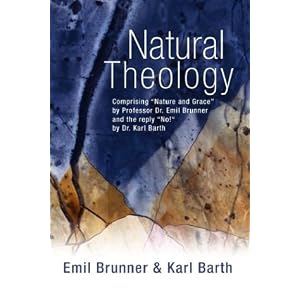
  • Nein!Karl Barth, Nein! (1934); trans. “No! Answer to Emil Brunner,” in Emil Brunner and Karl Barth, Natural Theology, trans. Peter Fraenkel (Eugene, OR: Wipf and Stock Publishers, 2002), pp. 65-128.
    • “Natural theology is always an answer to a question which is false…”
    • Although the Church Dogmatics has much to add about Barth’s theology of creation, this early essay is essential reading for those interested in the development of Barth’s views of nature and grace, natural theology, revelation and methodology, the implications of a theology of grace for epistemology, or Barth’s opposition to the theological premises of both Protestant scholasticism and Roman Catholicism.
Posted in Theology | Tagged | 27 Comments

Susanna at 15

Susanna in Middle EarthOh, Susanna, has it been 15 years already?

When you were born, I sang “First Lullaby” to you in the delivery room, mangling the French, I’m sure. You can’t remember that, of course, but I’ll never forget it.

Instead of passing out cigars, we handed out Here She Is chocolate bars – much healthier than smoking, since chocolate comes from the cocoa bean, and everyone knows beans are vegetables. Besides, you still need to eat plenty of chocolate to keep those big eyes brown.

Here She Is

Vital statistics

You’re a cutie now, as you were a cutie then, when we dressed you up as a Scottish wee lass:

Scottish Susanna
Scottish Susanna, 1996

Susanna, I’ve put a selection of photos of you here. 🙂

There are so many others, though, so this gallery is missing some of my favorites and I’ll add more to it from time to time.

Happy birthday!

Love, DaddyO

Posted in Family | 2 Comments

Onward into light

Rachel, thank you for sharing your wonderment at nature, with a daily stream of beautiful nature photos!

Rachel giving the bear the right hand of fellowship

Lion hug

Here’s the story behind the lion hug:

Posted in Family, Nature | Leave a comment