Willis Creek News

Jonathan on Governor

In the great tradition of frontier printers, my nephew Jonathan is starting a newspaper! Actually, it’s a blog about the homestead, Willis Creek Ranch, entitled Willis Creek News. The first post, “Horse Trails,” shows how fun and interesting this will be to follow. I’m really looking forward to reading every issue. Thanks, Jonathan!

I’ve put a link to Willis Creek News in the right margin for future reference, under “Family and Friends.”

Posted in Family | Leave a comment

People are at the center – the Curator

Sara Groves, Invisible Empires“Are you and I an aberration
flickering upon the screen
sending out our best transmissions
waiting in our velveteen…
Tell me you can really see me…
And I don’t know where we are
but we’re passing through these wires
Walking through the streets
of invisible empires…”

Eugene Peterson, A Long ObedienceThis morning my email inbox contained a news release for Sara Groves’ new album, Invisible Empires. She quotes Eugene Peterson’s wonderful book on the Psalms, A Long Obedience:

“People are at the center of Christian work… We travel light. The character of our work is shaped not by accomplishments or possessions but in the birth of relationships.” (Peterson, on Ps. 127)

Peterson’s insight holds true for any kind of work, and for any traveler in this world.

This afternoon I came across a poem by Miller Williams entitled “The Curator,” which is a moving depiction of Peterson’s insight. Although set in an art museum rather than a library, the ethos and sensibility is much the same whether one cares for books or other objects. We curators pour our lives into acquiring the skills to appreciate the items we collect, and we commit our hearts to their preservation. But all that would be nothing without communicating them somehow to others, without establishing a personal connection with other people in which we then share an understanding of the meaning of the collection. I love the books I work with; yet my motivation lies even more in coming to see the personal experiences of the author’s world “behind the book” and connecting that with the ways people now experience the books in their own lives because of what I do. Collected objects are physical and tangible, but the personal relationships across time and space engendered by that common experience are more real still. Williams’ poem about the Curators of an art museum in Leningrad during the German advance in World War 2 makes this clear.

“Maybe this was a way to forget the war
a little while. Maybe more than that.
Whatever it was, the people continued to come.
It came to be called The Unseen Collection…”

Read the poem.

Debra Dean, The Madonnas of LeningradDavid pointed me to a book, The Madonnas of Leningrad by Debra Dean (review), which juxtaposes two phases in the life of one of the museum workers: first, her memories of giving tours of the museum’s collections during the German approach to Leningrad, and second, her much later descent into Alzheimer’s, with its memory loss and consequent sundering of many meaningful relationships and personal connections.

“She is leaving him, not all at once, which would be painful enough, but in a wrenching succession of separations. One moment she is here, and then she is gone again, and each journey takes her a little farther from his reach. He cannot follow her, and he wonders where she goes when she leaves.” (Dean)

We travel light, indeed. The weight of glory lifts us upward.

“The slow erosion of self has its compensations. Having forgotten whatever associations might dull her vision, she can look at a leaf and see it for the first time. Though reason suggests it otherwise, she has never seen this green before. It is wondrous. Each day the world is made fresh again, holy and she takes it in, in all its intensity, like a young child.” (Dean)

If the doctrine of the Trinity means anything, it is this: People and relationships remain at the center of reality, no matter what.

“Don’t say: ‘We have come now to the end.’
White shores are calling
You and I will meet again.’ (Into the West.)
Posted in Art-Music-Lit | 3 Comments

Karl Barth on horses

“a really good horseman cannot possibly be an ungodly person”
– Karl Barth, Church Dogmatics III.4, p. 352.

Some people would be startled to find this superlative assertion in the major work of the 20th century’s most significant theologian.

No one in my family.

I’m in a 5-year commitment of reading through Karl Barth, Thomas Torrance and George MacDonald. In the last few days I’ve happened upon the above saying by Barth; found a page in Rolland Hein’s biography of MacDonald saying that riding horses was MacDonald’s favorite outdoor activity (p. 154), and heard Robert Walker, a relative of TF Torrance, say that TFT also loved horses. How cool is that?

Watch the following video (from 6:30 to the end) to see some of the horses involved in my Dad’s life:

Dad Governor

Click the photo of Marvin below to read more on the theology of horses:

Marvin Mann

Chester, I’m also remembering what Laura said about your horse-related ministry to children. Can’t wait to hear more.

Posted in Nature, Theology | Tagged , | 3 Comments

Glimpses of beauty

I love my daughter Rachel’s blog, Onward into light. It’s a daily dose of beauty: photos that point to joy beyond the walls of the world, quotations that awaken the longing for love that lies hidden in all our hearts. Rachel, wherever you are, there in your presence, rays of the Beauty from which the universe arises shine out and light the darkness of our world. Thank you, Rachel, for sharing yourself with us.

Onward Into Light

Posted in Family | 2 Comments

End of an era – thank you, Steve

End of an era

MacDailyNews:

“The end of an astonishing era and the beginning of a new one.

Thank you, Mr. Jobs for everything you have done in an amazing, legendary career. What you have engineered will go down in history as one of the greatest success stories of all time.

Good luck to Mr. Jobs, Chairman of the Board, and to Mr. Cook, Apple Inc.’s new CEO!”

Steve Jobs and his wife after his final keynote, June, 2011

Steve, you have inspired me without ceasing since that spell-binding commercial during the Super Bowl in 1984. At the time I was a high school science teacher telling my students that their lives would be changed by the coming of the Information Age. In that commercial I saw it writ large. I can’t remember anything about the game itself, but I have never forgotten that compelling manifesto which proclaimed that the computer revolution is always meant to be for the people rather than the machine, for humanity rather than technique, personalizing rather than enslaving, uplifting rather than demoralizing:

1984 hammer

Steve, you changed the world. You threw the hammer. You created the future. You transformed my life. Thank you.

—–

Updates:

—–

Steve Jobs, CEO:

  • 1976: Apple – personal computing for people (Apple II, 1976); mouse, windows and graphical user interface (Mac, 1984).
  • 1985: NeXt – the NeXTSTEP operating system, the basis of what would become OS X and iOS. (The WWW was invented on a NeXt computer.)
  • 1986: Pixar – the most technological creative company.
  • 1997: Apple – the most creative technology company (iMac, MacBooks, iPod, iPhone, iPad).
  • Jobs pioneered the three major advances of my lifetime in user interfaces: mouse and windows in the 1984 Mac; gesture in the iPhone and iPad as well as Mac OS Lion; and natural voice (Siri’s artificial intelligence in iOS 5).

Here’s Jonathan Mann, from Song for the Day, on Steve Jobs (from a previous post):

More from Jonathan Mann.

Previous post: Apple’s Core Passion.

Posted in Apple | 6 Comments

Academia in a nutshell

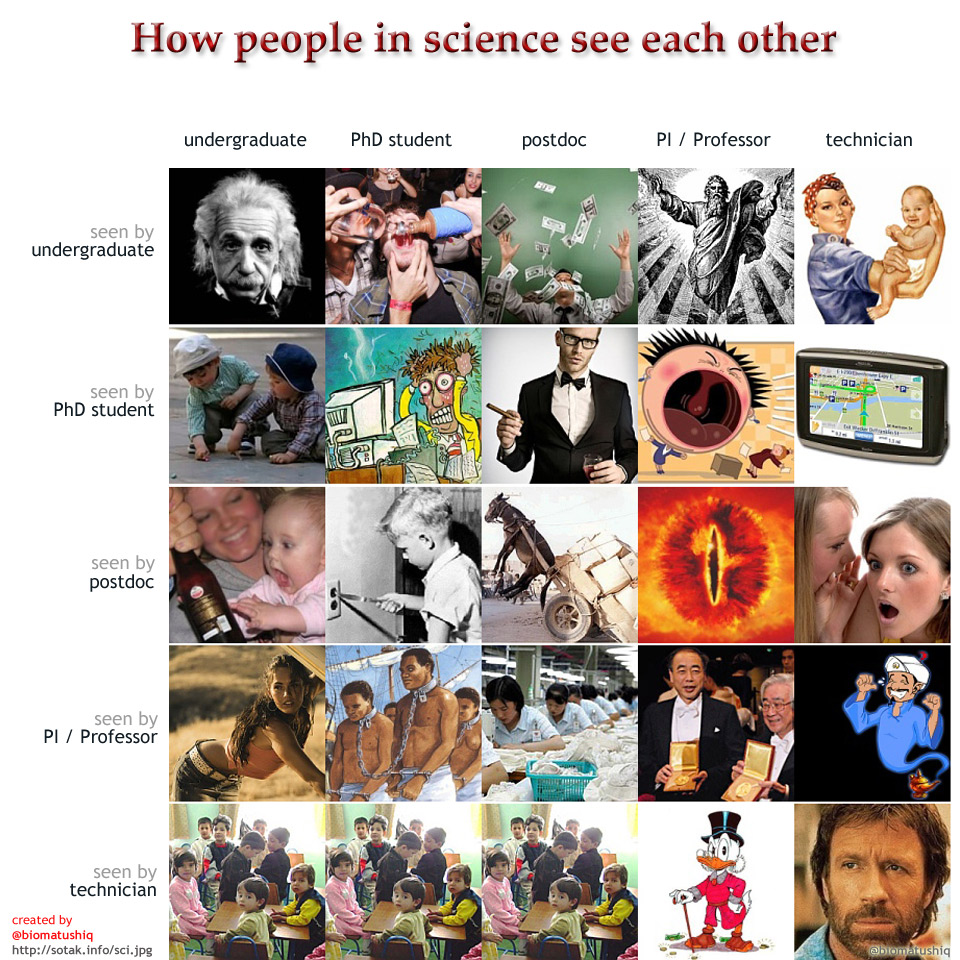
The more I look at this matrix by Matus Sotak the funnier it is:

How people in science see each other, Matus Sotak

Start with how everyone sees themselves, shown in the diagonal from upper left down to lower right. Then look in the 2nd column to see how everyone views the PhD student, and the 4th column to see how everyone views the professor.

Posted in Education | Tagged | 2 Comments

Happy birthday, Daddy!

My sister Laura created this moving video to celebrate Dad’s birthday earlier this month:

Dad Governor

Read more on Laura’s blog.

Dad, I love you! Thank you for all these wonderful memories. Watching the video twice in a row brought a lump to my throat and tears to my eyes. We are so rich with memories. Can’t wait to join you for the horse ride next month.

Laura, this is absolutely wonderful! Thank you! I’ll watch it often.

Posted in Family | 1 Comment

Feast of Middle-earth

Holidays

This past Saturday, Hannah and Susanna, with much help from many friends, hosted a Feast of Middle-earth for about 30 friends of theirs who are lovers of J.R.R. Tolkien.

Feast of Middle-earth, 2011
Fellowship of the Feast (photo by Joshua Martin)

A Feast of Middle-earth offers a wonderful opportunity for a festive, end-of-summer occasion. We’ve organized one 5 times over the years, and Candace and I have enjoyed it every bit as much as our kids. Activities past or present have included:

  • Names in Elvish: everyone gets a name tag with their name translated into Quenya.
  • name tag

  • Dress in costumes!
  • Costumes

  • Outdoor games such as “Catch the Dragon’s tail” or “Bill Ferny’s Apple throwing contest.” In the former, about ten people get in line with hands on the waist of the person in front. The last person in line tucks a handkerchief in his back pocket. At the signal, the dragon begins to chase its tail like a puppy – the first person in line tries to catch the handkerchief. The people toward the front try to help the head catch the tail, the people toward the back try to help the tail escape, but no one can let go of the waist of the person in front of them. When the dragon “head” catches the handkerchief, the “head” becomes the new “tail” and the person who was second from the front becomes the new “head.” For extra fun, create two or more dragons and they all can catch any dragon’s tail, including their own. You can imagine many similar outdoor fun games!
  • Dancing in Elvish and Hobbit styles.
  • Sword fighting lessons and tournament.
  • Archery instruction and target practice.
  • Display Tolkien memorabilia of all kinds, and share our own Tolkien-inspired art and crafts.
  • Tolkien Trivia group contest.
  • Scavenger hunt – think up riddles about Middle-earth places for groups to solve, and then each group will search for clues at the places in the yard or house decorated in that manner.
  • Prancing Pony
    The Prancing Pony. Rachel drew this sign for a Middle-earth Feast scavenger hunt back in 2002, I think. Here’s the clue that led people to this sign during that scavenger hunt: “Beds for four, and stabling for five ponies, if that can be managed.”

  • Storytelling: Rebecca read dramatically the lay of Beren and Luthien this year.
  • Storytelling

  • Singing and music: Sarah played an original hammered dulcimer composition. Other songs: Donald Swann song cycle “The Road Goes Ever On and On”; “Smaug the Magic Dragon” from The Tolkien Scrapbook edited by Alida Becker; “Bilbo’s Last Song” by Stephen Oliver.
  • The Feast itself offers many opportunities to get creative with mushrooms, lembas, rabbit stew, etc. Thanks to Brian for bringing the delicious stag venison this year – or was it oliphant?
  • In the Rivendell Library, Middle-earth residents may browse at their leisure, look up old lore, and research at will – even perhaps find long-forgotten clues to the history of the ring.
  • Rivendell Library

    History of the Ring

But this year, Hannah made the mistake of asking me to give the opening prayer, and so the professor in me came up with a liturgy to be read responsively. She gave me the opening, and I took it! (Download a pdf.)

Feast Middle earth liturgy2

My prayer is in green, interspersed with related quotes from Tolkien. I expected a few groans at its length, but everyone was utterly polite and I think some even liked it!

In any case, it helped to justify the laying out of Tolkien’s works for perusal in Rivendell Library (our living room), where we kept a playlist in iTunes running all evening so we could listen to Tolkien himself reciting poems and stories from his writings.

Preparing Gandalf
Preparing Gandalf

Gandalf prepared
Gandalf the wise. Photo by Joshua Martin.

Ladies of Middle-earth
Ladies of Rohan and Rivendell. Photo by Joshua Martin.

Legolas fits his bow.  Photo by Joshua Martin.
Legolas fits his bow. Photo by Joshua Martin.

Baby Oliphant
Baby Oliphant (sign by Susanna)

Decoration with Christmas lights
Decorate the yard with Christmas tree lights. Photo by Joshua Martin.

Many more great photos are in Joshua Martin’s Facebook album, “Feast of Middle-earth.”

Posted in Art-Music-Lit, Family | Tagged , | 6 Comments

Monkey business

Orang iPad

Steve Jobs:

“I’ve said this before, but thought it was worth repeating: It’s in Apple’s DNA that technology alone is not enough. That it’s technology married with liberal arts, married with the humanities, that yields us the result that makes our hearts sing. And nowhere is that more true than in these post-PC devices. And a lot of folks in this tablet market are rushing in and they’re looking at this as the next PC. The hardware and the software are done by different companies. And they’re talking about speeds and feeds just like they did with PCs. And our experience and every bone in our body says that that is not the right approach to this. That these are post-PC devices that need to be even easier to use than a PC. That need to be even more intuitive than a PC. And where the software and the hardware and the applications need to intertwine in an even more seamless way than they do on a PC.”

———-
Update 5/9/2012: Orangutans at Miami Zoo use iPads to Communicate

Posted in Apple | 2 Comments

Charles Darwin, soil ecologist

Originally posted at ouhos.org, the now-discontinued blog of the OU History of Science Collections. Neither this post nor any of its content should be taken as an official communication of the University of Oklahoma.


Darwin@the Library info | Exhibit brochure (pdf)

The last work Darwin published is one of his least-known, but his study of mold and earthworms drew upon his broad interests. Far from being small and insignificant creatures, Darwin argued, earthworms turn over the soil in vast quantities, creating a suitable habitat for the growth of plants. Drawing upon some of his early geological work in the production of soils, this work represents a founding exemplar of quantitative ecology.

Like Darwin’s other books, it also contains interesting visual representations — for example, a tower of earthworm casts and diagrams showing the importance of mold in forming soil.

Charles Darwin, Formation of Vegetable Mould, Through the Action of Worms, 1881

Charles Darwin, Formation of Vegetable Mould, Through the Action of Worms, 1881

Read more about this book at Wikipedia.

Darwin@the Library info | Exhibit brochure (pdf)

Posted in History of Science | Leave a comment

Charles Darwin, Botanist

Originally posted at ouhos.org, the now-discontinued blog of the OU History of Science Collections. Neither this post nor any of its content should be taken as an official communication of the University of Oklahoma.


Darwin@the Library info | Exhibit brochure (pdf)

Charles Darwin regarded natural selection as a “universal law of nature.” Its comprehensive scope led him to investigate the natural world with a breadth of vision that encompassed both plants and animals. Darwin’s last several books were detailed botanical studies, as the immense variety and complexity of the plant world offered Darwin ideal opportunities to extend his theory of natural selection.

In a pioneering study of insectivorous plants, Darwin explored the adaptations by which plants are nourished in impoverished soils. He pointed out that the Sundew secretes a digestive fluid similar to an animal’s.

Charles Darwin, Insectivorous Plants, 1875 Charles Darwin, Insectivorous Plants, 1875 Charles Darwin, Insectivorous Plants, 1875

Darwin’s study of the movement of climbing plants, first published in the Linnean Society journal in 1865, appeared in book form in 1875. Darwin experimented with a variety of factors affecting plant growth and the movement of roots, vines and flowers. He demon-strated the importance of light sensitivity, which enabled a plant to move by elongating the stem on the side farthest from the light.

Darwin published two books on plant fertilization and the different forms of flowers that appear on the same species. These studies suggested that cross-fertilization produces more vigorous offspring than self-fertilization.

Charles Darwin, The Different Forms of Flowers on Plants of the Same Species, 1877 Charles Darwin, The Different Forms of Flowers on Plants of the Same Species, 1877 Charles Darwin, The Different Forms of Flowers on Plants of the Same Species, 1877

In 1880 Darwin continued his investigation of plant movements. As was his custom, he employed a wide variety of visual diagrams throughout the book. In the image below left, Darwin plotted the motion of a single leaflet — one of nearly a hundred such depictions in this work. In the chart below center, one line shows a change in temperature and the other shows the angular movement of a leaflet. In the illustration below right, the Cassia plant extends its leaves during the day and folds them up at night.

Charles Darwin, The Power of Movement in Plants, 1880 Charles Darwin, The Power of Movement in Plants, 1880 Charles Darwin, The Power of Movement in Plants, 1880

Come see these works and others in the current exhibit, Darwin@theLibrary!

Darwin@the Library info | Exhibit brochure (pdf)

Posted in History of Science | Leave a comment

Harry Potter and the Deathly Hallows

“Self-sacrificing love is the greatest power in the universe.” J.K. Rowling

Jerram Barrs on Harry Potter:

Jerram Barrs

Jerram Barrs reflects on the Harry Potter books at greater length in “Harry Potter and his Critics,” an audio download and pdf from Covenant Seminary’s Resources for Life.

—–

PS: Dust off your Latin with Harrius Potter et Philosophi Lapis!

Posted in Art-Music-Lit | Tagged | Leave a comment