Anna Comstock

Unit 1: Getting our bearings. Length: 3 days (not necessarily in a row).

Anna Botsford Comstock

Anna Botsford Comstock played a prominent role in the nature study movement to reform science education in the early 20th century, particularly through her book, Handbook of Nature Study.

Continuous in some ways with natural history, nature study rejected a preoccupation with taxonomy and systematic classification – and a concomitant dry and recitation-oriented style. In contrast, nature study emphasized instead a holistic and environmental approach that strove to understand each animal and plant in the context of its habitat. Nature study rejected an artificial, systematic sequence of instruction that would start with the most simple organisms and move toward the more complex. Rather, nature study favored beginning with familiar living things in the student’s locality, within the reach of direct, immediate experience. Children were encouraged to carefully observe and interact personally with nature on a regular basis under the motto “study nature, not books.” In nature study, pupils could engage the world around them in a manner that was filled with meaning, consistent with the imagination and fine arts, not simply in terms of disciplinary science training. Field trips and the preparation of collections by students who acquired their own specimens, cultivation of school gardens, visits to zoos, public lectures, illustrated nature books, field guides, public museums, and university extension programs at land grant universities all helped to spread the ideals of nature study. Nature study was congenial with a rural setting, and encouraged efforts to conserve wilderness, natural areas and public parks. The influence of the nature study movement is evident today in extracurricular programs such as scouts, kindergarten “show and tell,” conservation and environmental organizations, and not least, among homeschoolers. (Source: Kohlstedt, Teaching Children Science.)

Together read Comstock, Handbook of Nature Study, Ch. 1, “Teaching of Nature Study.” As you go, discuss what nature study is, and why one would use nature study for biology. You don’t have to read all of it, but pick out the sections that interest you. You might want to note the following:

  • Nature study for the child (p. 1);
  • Nature study and teaching (p. 3);
  • the vastness of the ____________ (p. 4);
  • Nature study and science (p. 5);
  • Nature study _____  _____ drill (p. 6);
  • Observe for the purpose of better understanding _____________ (p. 8);
  • Nature study indoors (pp. 8-10);
  • The _______ as a supplement to Nature Study (p. 11);
  • Life and Death (p. 12);
  • The Field Notebook (p. 13);
  • Field Excursion (p. 15);
  • Correlation of Nature Study with: Drawing, Geography, History, Arithmetic, Gardening, Agriculture.
  • The chief aim: to encourage ___________ more than to give _____________ (p. 24).

In the comments or by email, share any thoughts you have about Anna Comstock, nature study, nature walks, and nature journals. Has Comstock influenced your approach to homeschooling? How are her ideas relevant to your study of biology this year?

—–

Optional links:

Posted in Education, Nature | Tagged , , | Leave a comment

Roger Tory Peterson

Unit 1: Getting our bearings. Length: 3-4 days (not necessarily in a row).

Roger Tory Peterson, Field Guide to BirdsOne of the best entrées into the living world around us is watching birds. Birds are so very much alive, and their presence is a vital part of the character of any habitat. Our birdwatching guide this year is Roger Tory Peterson, who has done more to encourage awareness and understanding of birds than anyone else in modern times. Thumb through the Peterson field guide to birds and take it with you on a walk. Keep it handy near your best bird-watching window. Get to know it by using it. Just dive in and explore.

Note that there’s a “Life List” near the back to keep a record of the birds you see.

At some point, watch 6 brief videos that will help you appreciate the Peterson field guide. Start with these two biographical videos about Peterson, available on YouTube or iTunes, entitled “Foremost Naturalist” (10 mins) and “Almost like resurrection” (11 mins).

On a tutorials page, Houghton Mifflin offers four brief videos to introduce the Peterson field guide. Each video is less than 10 mins. Watch the videos for “How to Identify Birds,” bird “Topography,” “Songs and Sounds,” and “Range Maps.” Download these into iTunes if you wish, or just watch them on YouTube. After watching these videos, you’ll be much more efficient in using the field guide.

Discuss ways you might use the Field Guide in your nature journal. If you like, brainstorm some ideas in the comments to this post, or come to class next time prepared to share a few of your ideas.

—–

Optional links:

Posted in Education, Nature | Tagged , , , , | Leave a comment

Charlotte Mason

Unit 1: Getting our bearings. Length: 1 day.

“Never be within doors when you can rightly be without.” – Charlotte Mason

To learn a little about Charlotte Mason (1841-1923), an English educational reformer whose ideas encouraged a nature study approach to science instruction, watch this video about her life, works and ideas, and the digitization of the Charlotte Mason Collection (8 mins):

Mason argued that the best science education is not derived from scientific textbooks, nor does it consist in memorizing long lists of abstract facts, arranged systematically, which can be repeated on multiple-choice tests. Rather, one should begin with direct experience of nature in all its concreteness and familiarity. Older children should be outdoors during school time at least one full afternoon each week to experience nature in one’s own locality – back yard, community, park or countryside. Common plants and animals such as squirrels, trees, insects and birds, in nearby habitats such as forests, meadows, ponds and creeks or simply outside the window, offer inexhaustible opportunities for learning.

Three habits Mason encouraged as essential to nature study are going on nature walks, keeping a nature journal, and reading living books:

  1. Nature walks: Spend at least one class time a week in outdoor discovery and observation. Find object lessons, explore nature’s teachable moments, free from any obligation to gain exhaustive knowledge in a systematic way.
  2. Nature journal: Create a journal to record your experiences with nature in a way that is meaningful to you, whether via nature walks, field trips, lab activities together, experiences with pets or family trips, etc. Note your most interesting observations, keep a calendar of your first-finds for each season, discover relationships between living things and their surroundings, and draw connections between what you see and ideas you’ve learned. Include whatever you like, whether poems, quotations, stories, drawings, descriptions, anecdotes, diary entries, interesting observations, or object rubbings and pressings. The nature journal will not be corrected or graded. But warning: it may become a habit for life. 🙂
  3. Living books: Read real books, fiction or nonfiction, rather than textbooks that dispense information in a manner that makes the material dry and forgettable. What books have you read about nature that live in your memory and will remain meaningful to you for the rest of your life? What are some living books that you might read this year? Do any of the following titles intrigue you or arouse your interest: Julie of the Wolves, A Zoo in My Luggage; My Side of the Mountain; No Job for a Lady; Cry of the Kalahari; Golden Shadows, Flying Hooves; Pilgrim at Tinker Creek; All Creatures Great and Small… what titles would you put on your list? (Note: Our singing through the lessons of Lyrical Life Science does not quite make it count as a living book, but it’s not a typical textbook, either, and I hope the songs may well stay with you throughout your life.)

In the comments or by email, share any thoughts you have about Charlotte Mason, nature walks, nature journals, and living books. Has Charlotte Mason influenced your approach to homeschooling? How are her ideas relevant to your study of biology this year?

I came across Charlotte Mason in the first book about homeschooling I ever read, before we had children and even before I was married: Susan Schaeffer Macaulay, For the Children’s Sake (Crossway Books, 1984). I recommend reading her description of science as it would be taught in light of Mason’s ideas: “Knowledge of the Universe,” pp. 133-139.

—–

Optional links:

Posted in Education, Nature | Tagged , , , | Leave a comment

Last Child in the Woods

Unit 1: Getting our bearings. Length: 1 day.

Watch two videos about Richard Louv, learn about his book and the impact of his ideas on science education.

richardlouv.com, Last Child in the WoodsRichard Louv, Last Child in the Woods: Saving Our Children from Nature Deficit Disorder:

“In this influential work about the staggering divide between children and the outdoors, child advocacy expert Richard Louv directly links the lack of nature in the lives of today’s wired generation — he calls it nature-deficit — to some of the most disturbing childhood trends, such as the rises in obesity, attention disorders, and depression…. Last Child in the Woods: Saving our Children from Nature Deficit Disorder has spurred a national dialogue among educators, health professionals, parents, developers and conservationists.”

Talk about Louv’s ideas together and comment below or in email, if you like, on how Louv’s ideas might align with your approach to studying biology this year.

—–

Optional links:

  • Louv’s website: the Resource guide contains some great suggestions!
  • If you’re interested, buy the book at Amazon ($10)
  • There are many videos and audios by Louv or about his book online (search for them if you want more). Here’s one, an Audio presentation (1 hr, 38 mins), recorded on September 24, 2008 at Cornell’s Statler Auditorium.
Posted in Education, Nature | Tagged , | Leave a comment

The Brat will be OK

Brat3

Here’s how I found our beloved 25-year-old Subaru Brat this morning when I went out to drive to work. (The white specks on the roof and hood are pieces of glass, like those on the ground.) Someone had the audacity to come down the driveway last night to where the Brat was parked right outside our front door. They broke the driver’s side window to steal two black bags that I had left inside overnight – my laptop was safely indoors, thankfully! Tomorrow, Metro Glass will replace both the driver’s side window and the front windshield (cracked during the hail storm last June), so the Brat won’t be out of circulation very long. It will be back to its usual grand self in no time!

For some inexplicable reason, they did not take the audio cassettes of Louis L’Amour stories, read by Willie Nelson.

Posted in Family | 4 Comments

Life and Works of Galileo

The Life and Works of Galileo: A Guided Tour from Kerry Magruder on Vimeo.

This is a presentation I made at NASA-Langley about the collection of first edition copies of Galileo’s works held in the OU History of Science Collections. It has also been presented at Fermilab, and various university astronomy-physics programs such as Florida State, Michigan State, and New Mexico. The hour-long video uses Galileo’s printed books as the basic framework for telling the story of Galileo’s life and work. As you watch the presentation, consider which of Galileo’s books will be next on your personal reading list!

Download documents related to this talk:

Misc:

Posted in History of Science | Tagged | 5 Comments

Copernicus and His Revolutions

Copernicus and His Revolutions from Kerry Magruder on Vimeo.

This video surveys the background and work of Nicolas Copernicus, leading up to his De revolutionibus (1543) and its initial reception.

It is NOT recommended for watching in a single session, due to its compact and very dense exposition. Divide it into about 3 episodes. Total length: about 75 mins.

Script, discussion questions, instructor notes, and true/false questions: download pdf. My related websites:

Written and produced by Kerry Magruder. Not polished, but hopefully better than a PowerPoint.


See an update, Copernicus and the Motion of the Earth.

Posted in History of Science | 2 Comments

Stars over Ancient Babylon

Stars over Ancient Babylon from Kerry Magruder on Vimeo.

Join the ancient Babylonian astronomer Kidinnu for a survey of the origin of mathematical astronomy in Ancient Mesopotamia. Babylonian astronomers were sources for Greek astronomy. Without the Babylonian contributions, later Greek astronomy such as we find in Hipparchos (150 BC) and Ptolemy (150 AD) would not have been possible.

Written and produced by Kerry Magruder, narrated by Candace Magruder. Not polished, but hopefully better than a PowerPoint. I apologize for the poor audio narration – Candace and I recorded it in the wee hours one morning to get it ready in time for my class that week.

Interpretation: Questions for discussion (brief video).

Script, discussion questions, instructor notes, and true/false questions: download pdf.

Related pages on my history of science survey course website are:

Posted in History of Science | 2 Comments

Getting started – Biology

In 2011-12 we’re going to adopt a nature study approach to biology! We’ll meet on Monday evenings, 7-8:30 p.m., beginning Sept 12. Occasionally, we’ll fall back to either Friday morning or Saturday morning, particularly when there are field trips.

I’d like to encourage all the moms to stay on any evening you wish – either in the family room as a participant, or to lounge in the library and just eavesdrop, whatever you like. But please plan on participating fully the first night. One of the things we’ll do the first night is talk about field trips, so please think about any field trips you would like to suggest or organize and bring them up for discussion. 🙂

Here are the books to order, just as a reminder:

Note: Lyrical Life Science, vol. 1, has been updated recently. Here’s the webpage description and place to download the update:
http://www.lyricallearning.com/vol1download.html

The Lyrical Life Science books, songs and workbooks pack an amazing amount of content into a digestible and concise format, so I hope that your students will find them fun and enjoyable. I’m looking forward to the concert that we’ll have each Monday night to begin our session! This concert will consist of whatever new song they’re learning as well as the previous song. Moms are certainly encouraged to stay for that! And to have your student audition the song for you regularly as they’re learning it during the week. Should be fun. 🙂 And after the Monday night “concert,” we’ll have a chance to discuss any questions students have about the Lyrical Life Science content before going on to the main activity for the night.

The other main part of the Monday night sessions, besides Lyrical Life Science singing and discussion, will be activities or labs. This year, and next year’s chemistry class, will count as a high school laboratory science class. Often in the fall semester we’ll be using the microscope as a focal point of our lab, associated with Pond Life as a guide to the microscopic critters.

Students will also share their nature journals. The nature journals are even more important to the course than the Lyrical Life Science. The nature journals count as labs in themselves, but they are less structured than most labs and there are very few strings attached. Their chief purpose is to ensure that each student is finding ways to actually experience the living world during the week. Our approach to biology is based on ecology, natural history and habitats, which are all accessible in concrete ways in familiar surroundings. So entries in the nature journal can take the form of anecdotes about animal life, behavior and care (domestic dogs/cats or backyard birds/squirrels or wild animals). Birdwatching will definitely be a frequent topic of discussion on Monday nights, since I’ll try to use birds whenever possible to illustrate biological concepts that we discuss. But during the week, Comstock’s Handbook of Nature Study will also provide lots of ideas for nature journal entries, because it gives questions to think about or to look for in relation to many common animals, plants and habitats. So I want our kids to become quite familiar with Comstock as well as whatever field guides you happen to have lying around. Yet the nature journals can be even more personalized than this: they can include drawings, poetry, photographs, etc., so if your student wants to do a creative media project, blog or scrapbook involving living things, then that can be carried out as part of the “nature journal.” It doesn’t have to be words written by pencils on wood-product paper. And entries don’t have to be uniformly “scientific” in style – a nature journal is interdisciplinary and creative. What counts is that each student is finding meaningful and significant ways to experience, appreciate and understand the living world.

And then there will be weeks when we don’t meet on Monday nights, and I hope that on those weeks, one or more of the moms will organize Friday morning or Saturday morning field trips. There are all kinds of places to visit, including Ranger programs at Lake Thunderbird or 1,000 Hills, the water treatment plant, the Osteology Museum, the Sam Noble Museum, Zoo, History of Science Collections, and parks and places wherever you might happen to be traveling or visiting or camping during the year! Field trips will help our students recognize the great appeal and wonder of the living world all around us this year. Share your field trip ideas!

Thanks so much for joining Susanna and me in doing life science this year. 🙂

Posted in Education, Nature | Tagged , , , , | Leave a comment

Shape of the Earth

Shape of the Earth from Kerry Magruder on Vimeo.

Join several students on a time-travel tour, guided by the medieval physicist Nicole Oresme, as they survey ideas about the shape of the Earth. In the process, the students discover that the real “flat Earth myth” is not a mistaken medieval notion, but a modern prejudice!

Script, discussion questions, instructor notes, and true/false questions: download pdf. Two of my related websites:

Written and produced by Kerry Magruder. Not polished, but hopefully better than a PowerPoint. I apologize for my terrible French.


Update: An updated version is posted here. It is higher resolution and has some additional content, but it’s not nearly as entertaining nor as cheesy. Take your pick.

Posted in History of Science | 1 Comment

Reading Karl Barth: Church Dogmatics

This page: | Why read? | editions | structure | starting points | style |

Intro

This post is for the person who is thinking about reading Barth’s Church Dogmatics. I’ll briefly mention some reasons to read it, note the two excellent English editions now available, describe its overall structure, and relay a suggestion of some passages to dip into first to gain an overall feel for Barth’s distinctive theological mode and writing style.

Why read Barth’s Church Dogmatics?

Karl BarthWhen I began my graduate studies in the history of science back in the 1980’s, the distinguished Curator of the OU History of Science Collections wagged his finger at the five of us who were first-year students at the time, enrolled in his early modern science course, and admonished that we would never be able to understand the rise of early modern science unless we read two theological works: Augustine’s City of God and Calvin’s Institutes. I took him seriously at his word, reading both over the next year or two, along with most of Aquinas’ Summa Theologica as well. If he were alive today, I’m sure he would agree with me that to understand the relations between science and religion from the Enlightenment through the 20th century, one must add Barth’s Church Dogmatics to that short but essential reading list.

By any account, Karl Barth (1886-1968) was the most significant and influential theologian of the 20th century, described by Pope Pius XII as the most important theologian since Thomas Aquinas. The Church Dogmatics, over 30 years in the writing, represents the mature form of his own Reformed theology. And it is even of much broader interest than that, for it also reveals his extensive personal interaction with theological currents of his day and throughout the history of the church, from the patristic and medieval periods up through Enlightenment, 19th- and early 20th-centuries, spanning Orthodox, Roman Catholic, Lutheran and various other perspectives. The massive excursus sections of the Church Dogmatics (see below) offer an unparalleled entrée into the history of theology and a point of departure for ecumenical discussion.

It is no wonder, then, that Thomas F. Torrance regarded Barth’s effect upon modern theology and philosophy as a Copernican Revolution.

Of course, it should go without saying that no one reads the Church Dogmatics expecting Barth to show us all the answers. There are no Barthians, in the sense of theological disciples who agree with all or nearly all that he said. Rather, we read Barth because he opens up a vast landscape in which we can carry on theological conversations with renewed vigor, insight, imagination and clarity. This lies at the root of his historical significance. To attempt to think theologically in our age without engaging Barth is like trying to understand ancient theology without Augustine and Athanasius, medieval theology without Aquinas, and Reformation theology without Calvin; or even to carry on astronomy today with a geocentric cosmology.

| Why read? | editions | structure | starting points | style |

Which edition should I buy?

Barth’s 13 volumes of Kirchliche Dogmatik, published from 1932 to 1967, were translated into English under the editorial leadership of Thomas F. Torrance and G. W. Bromiley (Edinburgh: T&T Clark, 1936-1977). This edition is long out of print, although used volumes can be obtained one at a time from Amazon and other booksellers. Yet it has never been easier to read the Church Dogmatics because of the recent release of two affordable editions!

1. The first choice is the Hendrickson reprint of the Torrance-Bromiley translation: Church Dogmatics, 14 Volumes. Hendrickson Publishers (2010). Hardcover. $129.99 from CBD (+ $50 shipping). Read CBD’s helpful blurb. The Hendrickson product page lists the contents of each volume.

Karl Barth, Church Dogmatics, 14 vols., Hendrickson Publishers, 2010 hardcover

2. A second option is the publication of a Study Edition: Church Dogmatics, 31 Volumes. Continuum International, T&T Clark, with assistance from the Center for Barth Studies at Princeton Theological Seminary (2009). Paperback, high quality, sewn binding. Available individually for $35/ea., or as a set for $1095; from CBD, Amazon, or more affordably from Alibris and other sellers (who perhaps snapped up extra copies when the set was initially sold by CBD at prices under $500). Read the publisher’s product description. The Study Edition is also available online and in a 2004 edition for Logos software (review; I hope it comes soon for Accordance!).

Karl Barth, Church Dogmatics Study Edition, 31 vols. softcover

The Study Edition offers a tremendous advantage for students over the Hendrickson reprint: Barth’s frequent quotations of phrases and passages in Greek, Latin, French and German are translated into English in footnotes appearing at the bottom of each page, for the benefit of readers who are not fluent in these languages.

Because the paperbacks are divided into 31 volumes (instead of 14), each one is slim and light enough to easily slip into a backpack or satchel.

Not sure whether to buy the whole set just yet? Here’s a link to the first volume of the Study Edition at Amazon ($28). When you are ready to purchase the entire edition, you can always give away the first volume to a friend to help them “test the waters” and see if they want to plunge in for themselves. 🙂

Buying the printed set rather than individual volumes includes free access to pdfs of prefaces (by Barth and the translators) and indices (request downloading access here). Why these were omitted from the print volumes of the Study Edition is a mystery; the publisher should make them available as free downloads to purchasers of individual volumes, if not to the general public.

Regardless of which edition you choose, you’ll need some good bookmarks!

Karl Barth bookmarks

| Why read? | editions | structure | starting points | style |

Church Dogmatics – What’s the overall structure?

Karl Barth stampBarth planned the Church Dogmatics as a work in 5 volumes, each devoted to one major Christian doctrine:

  1. Revelation
  2. God
  3. Creation
  4. Reconciliation
  5. Redemption

Volume-Parts: Barth did not live to complete the volume on Redemption, so only 4 “volumes” were published in all, as listed below in Roman numerals. As they were completed, each “volume” proved too long to publish in a single tome, so they were issued in separately-bound “Parts,” indicated below as a point followed by an Arabic numeral. Thus, “CD II.1” indicates the Church Dogmatics, Volume II, Part 1, which would be the 3rd volume in the Hendrickson reprint edition. (In this and what follows, refer to the outline below.)

Paragraphs: Each Part of the Church Dogmatics consists of one or more chapters (not indicated below). Each chapter is subdivided into so-called “paragraphs,” indicated by the sign §. “Paragraphs” are typically several dozen pages in length – they are long but self-contained thematic sections, not what is normally meant in English by the word “paragraph.”

So CD I.1 consists of 12 paragraphs (see outline below). Barth introduces each paragraph with a pithy summary called a Leitsatz (a guiding principle or thesis). For example, paragraph 8 is entitled “God in His Revelation,” and its Leitsatz is:

“God’s Word is God Himself in His revelation. For God reveals Himself as the Lord and according to Scripture this signifies for the concept of revelation that God Himself in unimpaired unity yet also in unimpaired distinction is Revealer, Revelation, and Revealedness.”

Karl Barth, drawingParagraph 8 unpacks every phrase of this Leitsatz, comprising pages 295-347 of the first volume of the Torrance-Bromiley edition.

Pagination: When citing Barth in English, use the page numbers of the Torrance-Bromiley edition (example: CD I.1, p. 321).

  • The Hendrickson reprint preserves the Torrance-Bromiley volume divisions and pagination – the 14 original volumes are each indicated below by an upper-case “V” in parentheses (V#) for each Part.
  • The Study Edition indicates Torrance-Bromiley page numbers in the margins.

Paragraph 8 occurs somewhere in the middle of the first volume of the Hendrickson reprint edition, but at the beginning of the second volume of the Study Edition because the latter breaks apart the Parts into separate volumes, as indicated below by a lower-case “v” in parentheses (v#). So CD III.4 is found in volume 8 of the Hendrickson reprint, or in volumes 19 and 20 of the Study Edition.

Excursus: Excursus (sing. and pl. forms are both “excursus”) appear in smaller print, and may be a few lines or run to multiple pages in length. In the excursus, Barth engages other theologians and philosophers, interacts with an astonishing range of figures in the Christian tradition, and exegetes scripture. One may follow the thread of Barth’s argument even if one skips the excursus, but doing so will severely distort one’s understanding of Barth’s method, and his approach to scripture and intellectual history, as well as cause one to miss out on his sense of humor (much like those whose understanding of Calvin becomes distorted when based only upon the Institutes, to the exclusion of his commentaries).

Outline: Karl Barth, Church Dogmatics

——–
Key:
Volume #: Title

  • Volume.Part (original tome # = Hendrickson reprint volume = V#)
    • §Paragraph range… (Study Edition volume = v#)

——–

Volume I: The Doctrine of the Word of God (2 Parts)

  • I.1 (V1)
    • §1-7 The Word of God as the Criterion of Dogmatics (v1)
    • §8-12 The Revelation of God: The Triune God (v2)
  • I.2 (V2)
    • §13-15 The Revelation of God: The Incarnation of the Word (v3)
    • §16-18 The Revelation of God: The Outpouring of the Holy Spirit (v4)
    • §19-21 Holy Scripture (v5)
    • §22-24 The Proclamation of the Church (v6)

Volume II: The Doctrine of God (2 Parts)

  • II.1 (V3)
    • §25-27 The Knowledge of God (v7)
    • §28-30 The Reality of God I (v8)
    • §31 The Reality of God II (v9)
  • II.2 (V4)
    • §32-33 The Election of God I (v10)
    • §34-35 The Election of God II (v11)
    • §36-39 The Command of God v12 (v12)

Volume III: The Doctrine of Creation (4 Parts)

  • III.1 (V5)
    • §40-42 The Work of Creation (v13)
  • III.2 (V6)
    • §43-44 The Creature I (v14)
    • §45-46 The Creature II (v15)
    • §47 The Creature III (v16)
  • III.3 (V7)
    • §48-49 The Creator and His Creature I (v17)
    • §50-51 The Creator and His Creature II (v18)
  • III.4 (V8)
    • §52-54 The Command of God the Creator I (v19)
    • §55-56 The Command of God the Creator II (v20)

Volume IV: The Doctrine of Reconciliation (4 Parts)

  • IV.1 (V9)
    • v21 §57-59 The Subject-Matter and Problems of the Doctrine of Reconciliation.
      Jesus Christ, the Lord as Servant I
    • §60 Jesus Christ, the Lord as Servant II (v22)
    • §61-63 Jesus Christ, the Lord as Servant III (v23)
  • IV.2 (V10)
    • §64 Jesus Christ, the Servant as Lord I (v24)
    • §65-66 Jesus Christ, the Servant as Lord II (v25)
    • §67-68 Jesus Christ, the Servant as Lord III (v26)
  • IV.3.1 (V11)
    • §69 Jesus Christ, the True Witness I (v27)
  • IV.3.2 (V12)
    • §70-71 Jesus Christ, the True Witness II (v28)
    • §72-73 Jesus Christ, the True Witness III (v29)
  • IV.4 (V13)
    • The Christian Life (Fragment), The Doctrine of Baptism (v30)

Index with Aids for the Preacher (V14, v31)
Keep this volume handy: in addition to name, subject and scripture indices (revised and corrected in the Study Edition), it contains a selection of 800 extracts from the Church Dogmatics arranged according to the German Evangelische Kirche schedule of passages for Sunday preaching.

Karl Barth

Here is a more detailed table of contents, including all chapter and paragraph titles, from the Foundation for Reformed Theology.

| Why read? | editions | structure | starting points | style |

Church Dogmatics – Where do I start?

Karl Barth, compositeFor advice to the beginner on reading the Church Dogmatics, see the works listed in my previous post, “Reading Karl Barth: Short Introductions.” I’ve found them all very helpful, but it’s also important to dive in and begin to gain a sense of Barth’s distinctive mode of writing first hand. Toward that end, Baxter Kruger suggests – at the end of his book, The Great Dance – reading the following sections to start with:

  • CD I.2, pp. 172-202: “The Miracle of Christmas.”
  • CD II.2, pp. 3-93: “The Problem of a Correct Doctrine of the Election of Grace.”
  • CD III.1, pp. 3-41: “Faith in God the Creator.”
  • CD III.1, pp. 330-344: “Creation as Benefit.”
  • CD IV.1, pp. 3-21: “God with Us.”
  • CD IV.1, pp. 22-54: “The Covenant as the Presupposition of Reconciliation.”
  • CD IV.1, pp. 157-211: “The Way of the Son of God into the Far Country” (on Christ in our place as the Prodigal Son).
  • CD IV.1, pp. 211-283: “The Judge Judged in our Place.”
  • CD IV.2, pp. 36-116: “The Homecoming of the Son of Man.”
  • CD IV.2, pp. 378-483: “The Sloth and Misery of Man.”

Depending on your interests, these are a great place to start. Perhaps every reader would recommend a different set of favorite sections. My own interest in Karl Barth’s theological method and his rejection of natural theology makes CD I.1 and II.1 of prime interest, for example.

Yet for any reader, Church Dogmatics reading companions like the following two titles offer specific guidance on where to find topics of high potential interest:

Or better yet, why not start a reading group with some friends, meeting to discuss the Church Dogmatics roughly monthly over the course of 3-5 years?

—–

| Why read? | editions | structure | starting points | style |

Interested but undecided?

Then allow me one more opportunity to arouse your interest in the Church Dogmatics with a few words about the beauty of Barth’s writing style. The CD is long and dense, but not as intimidating as one might think. One reason for this is because Barth’s writing style (not merely the conclusions he reaches) nurtures a personal approach to God that is rare in academic writing (perhaps unequaled since Augustine). Barth listened intently to Mozart almost every day he sat down to write. Robert Palma has written in Karl Barth’s Theology of Culture*, that:

“Mozart’s music contains sounds which rightly disclose and signify God’s grace and providence, the truth concerning his creation, the harmony of creation with its Yes and No, and the creation’s response to God… It would seem that Barth could hear the sound of God’s grace in the free and joyful quality of Mozart’s music, a quality which would seem to presuppose that God affirms his good creation and that all is finally well.”

Barth wrote*:

“In face of the problem of theodicy that pressed upon Europe when God was under attack for the Lisbon earthquake, so Mozart had the peace of God that transcends all the critical or speculative reason that praises and reproves… He had heard and causes those who have ears to hear, even today, what we shall not see until the end of time – the whole content of providence. As though in the light of this end, he heard the harmony of creation to which the shadow also belongs, but in which shadow is not darkness, deficiency is not defeat, sadness cannot become despair, trouble cannot degenerate into tragedy and infinite melancholy is not ultimately forced to claim undisputed sway. Thus the cheerfulness in this harmony is not without its limits. But the light shines all the more brightly because it breaks forth out of the shadow. The sweetness is also bitter and cannot therefore cloy. Life does not fear death but knows it well….”

These few sentences from Barth offer a glimpse, I hope, of a theologian who writes with an open-ended style, akin to Mozart, with sentences “rolling like great ocean waves … through the volumes of the Church Dogmatics” (T.F. Torrance*). Torrance concludes an article on beauty in theology with these words:

“For Karl Barth, theology is itself a kind of intellectual music, a beautiful science in which the message of God’s love is expounded in the doxological modalities of rational worship, and the joy and freedom of his grace are hymned on earth in forms that echo the liturgy of heaven, which he liked to think of more in terms of the music of Mozart than of Bach. As Barth once said, while the official music in heaven will doubtless be Bach, the angels will be found playing Mozart among themselves.”

*Source: Thomas F. Torrance, “The Transfinite Significance of Beauty in Science and Theology,” in L’Art, la Science et la métaphysique, ed. Luz García Alonso, Evanghelos Moutsopoulos, Gerhard Seel (Peter Lang, 1993), pp. 393-418.

| Why read? | editions | structure | starting points | style |
Posted in Theology | Tagged , , , | 49 Comments

The Great Storm is Over

  • Words and music by Bob Franke The Great Storm Is Over - Christine Lavin Presents - Follow That Road
  • John McCutcheon, Water from Another Time The Great Storm is Over - Water from Another Time
  • Peter, Paul and Mary, In These Times How Can I Keep From Singing? / The Great Storm Is Over - In These Times (Remastered)

The thunder and lightning gave voice to the night,
The little lame child cried aloud in her fright,
Hush little baby, a story I’ll tell,
Of a love that has vanquished the powers of hell.

CHORUS:
Alleluia, the great storm is over,
Lift up your wings and fly!
Alleluia, the great storm is over,
Lift up your wings and fly!

Sweetness in the air and justice on the wind
Laughter in the house where the mourners have been
The deaf shall have music, the blind have new eyes
The standards of death taken down by surprise.

Release for the captives, an end to the wars
New streams in the desert, new hope for the poor,
The little lame children will dance as they sing,
And play with the bears and the lions in spring.

Hush little baby, let go of your fear,
The Lord loves his own and your mother is here,
The child fell asleep as the lantern did burn,
The mother sang on ’til her Bridegroom’s return.

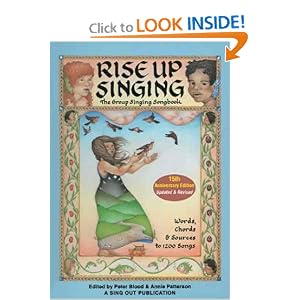
Rise up SingingOver the last year or so, after my family was privileged to see John McCutcheon in concert, this song has become one of my new favorite hymns. Lyrics and chords are found in Rise Up Singing, a songbook we have enjoyed since the girls were young (cf. Rise Up Singing demos by Matthew Vaughn).

Posted in Art-Music-Lit | Leave a comment