Christmas Poetry

Index of Christmas posts | Christmas Nights at Home


Read aloud: Favorite poems

“Welcome, all wonders in one sight!
Eternity shut in a span,
Summer in winter, day in night,
Heaven in earth, and God in man!
Great little One, whose all-embracing birth
Lifts earth to Heaven, stoops Heaven to earth.”

Richard Crashaw, “In the Holy Nativity of our Lord”

Update: See Poetry for Christmas and Easter

Posted in Family, Holidays | Tagged | Leave a comment

Christmas Read-alouds, Anthologies, Essays, Reflections on the mystery

Index of Christmas posts | Christmas Nights at Home


“Our culture is celebrating a giddy, overhyped pseudo-Christmas while we are attempting the more serious task of observing a holy Advent, but the reason the cultural messages are so powerful is that our human yearning is so real, and so profound.” (Feasting on the Word, cited below)

L'Engle and Shaw, WinterSongThe following works each contain marvelous, shorter readings on various topics ideal for a quiet evening at home alone, and to read aloud together.

Posted in Family, Holidays | Tagged | 1 Comment

Favorite Christmas Recordings

Index of Christmas posts | Christmas Nights at Home


George Winston, December (Windham Hill)Excluding classical, ones I feel like I can’t miss, in alphabetical order:

  • The Arcadian Wild, Happy Golden Days
  • Steve Bell, The Feast of Seasons (lyrics)
  • Steve Bell, Keening for the Dawn (includes poetry by Malcolm Guite) (background)
  • Mary Chapin Carpenter, Come Darkness, Come Light
  • Bruce Cockburn, Christmas
  • Connie Dover, The Holly and the Ivy
  • Buddy Greene, December’s Song
  • Sara Groves, O Holy Night
  • Kathy Mattea, Good News.
  • John McCutcheon, Winter Solstice
  • Loreena McKennitt, A Midwinter Night’s Dream; forthcoming 2022: Under a Winter’s Moon.
  • Sarah McLachlan, Wintersong
  • Fernando Ortega, Christmas Songs
  • Andrew Peterson, Behold the Lamb of God (online concert version too!)
  • Thom Schuyler, Precious Child (hard-to-find, but worth the search)
  • John Michael Talbot, Birth of Jesus
  • George Winston, December
  • Celtic Christmas, vol. 2, and the many other Windham Hill Celtic Christmas albums…

Favorite classical:

  • Cambridge Singers and John Rutter, Christmas Star
  • The King’s Singers, Christmas
  • Canadian Brass, Noel
  • George F. Handel, The Messiah. My favorite version is the recording by the Academy of Ancient Music, with Christopher Hogwood. Read aloud the scriptural texts to Part 1, “The Messiah Comes” (save Parts II and III for Lent and Easter listening): Isaiah 40:1-5; Haggai 2:6-7; Malachi 3:1-3; Isaiah 7:14; 40:9; 60:1-3; 9:2,6; Luke 2:8-14; Zechariah 9:9; Isaiah 35:5-6; 40:11; Matthew 11:28-30. GCI has a brief intro and listener’s guide.
  • J. S. Bach, Magnificat
  • Bach, Christmas Oratorios
  • Bach, Jesu, Joy of Man’s Desiring
  • Welcome All Wonders! Christmas at Washington National Cathedral.
  • Tchaikovsky, The Nutcracker Suite
  • Menotti, Amahl and the Night Visitors

Other family favorites:

Mary Chapin Carpenter - Come Darkness, Come Light

  • Enya, And Winter Came
  • Barenaked Ladies, Barenaked for the Holidays. Their rendition of “God Rest Ye Merry Gentlemen” is fantastic!
  • Vince Guaraldi Trio, Charlie Brown Christmas
  • Riders in the Sky, Christmas the Cowboy Way. I enjoy this, but one can listen to it one time too often.
  • Willie Nelson, Christmas
  • Amy Grant, Home for Christmas (esp. “Breath of Heaven”).
  • Steven Sharp Nelson, Christmas Cello. And more recently, the Piano Guys, A Family Christmas. If you haven’t heard of the Piano Guys, check out their Star Wars parody, Cello Wars.
  • Point of Grace, A Christmas Story
  • Veggie Tales, A Very Veggie Christmas
  • James Taylor at Christmas
  • Michael Card, The Promise
Posted in Family, Holidays | Tagged | Leave a comment

Favorite Christmas songbooks

Index of Christmas posts | Christmas Nights at Home


Sing: Favorite Christmas songbooks and books about carols

Posted in Family, Holidays | Tagged | Leave a comment

Family Christmas Activities at Home

Index of Christmas posts | Christmas Nights at Home


Ann Hibbard, Family Celebrations

  • Ann Hibbard, Family Celebrations. This book, now out of print, is well worth any effort required to obtain a used copy. Hibbard provides patterns to make a felt Advent “road to Bethlehem” banner which we’ve used every year since our eldest daughters were toddlers. Christmas for us wouldn’t be the same without it, as the following photos from yesteryears suggest.

    Rachel with the Advent banner
    Rachel with the Advent banner

    Hannah and Rachel wearing ornaments from the Advent banner
    Hannah and Rachel become the Advent banner


    “Come Lord Jesus, Light of the World” – Lighting the Advent wreath

  • For more ideas, see Ann Voskamp, The Greatest Gift (2013); cf. her upside-down Christmas tree.
  • Catholic Supply offers a great selection of nativity sets for kids, nativity costumes, etc.
  • The Saint Nicholas Center offers a treasure-trove of information about Saint Nicholas, as well as activities and games for kids. (See my posts on gifts: meteorites, magi.)

Rachel with a nativity set
Rachel and Hannah with a nativity

Posted in Family, Holidays | Tagged | Leave a comment

Favorite Family Christmas Storybooks

Index of Christmas posts | Christmas Nights at Home


Read aloud: Favorite storybooks

The Huron CarolListed in no particular order.

  • J.R.R. Tolkien, Letters from Father Christmas. We read aloud from this throughout the season. We have several copies so that everyone can examine Tolkien’s own detailed illustrations.
  • Henry Van Dyke, The Story of the Other Wise Man, illustrated by J.R. Flanagan (1907). Wonderful evocation of the world of the magi and the meaning of our quest. Read on or near Epiphany.
  • Henry Van Dyke, The Lost Word (The De Vinne Press, Charles Scribner’s Sons, 1898). Evokes the world of Constantine and Chrysostom. Read between Thanksgiving and Christmas. See this post.
  • Henry Van Dyke, The Mansion (Harper and Brothers, 1910). Reminds me of the classic Christmas movie It Happened on 5th Avenue.
  • Henry Van Dyke, The First Christmas Tree (Charles Scribner’s Sons, 1897). Evokes the world of Boniface and the conversion of the Germanic peoples.
  • George MacDonald, “The Gifts of the Child Christ.” Cf. this post: “It is a poignant tale of how we are here to learn to love, how suffering and grief may be redeemed toward that end, and how Christmas-time may help us in that ongoing task.”
  • Eve Bunting, Night Tree; and Mary Ray, Christmas Farm. Read one or both of these aloud the night before you set up or go pick out the tree.
  • Dandi Mackall, Legend of St. Nicholas. This is a great family read-aloud for December 6, the feast of St. Nicholas.
  • John McCutcheon, Christmas in the Trenches. This book places one of McCutcheon’s songs from his wonderful Christmas album into illustrated form. See my post Peace, 1914-2014.
  • Earthrise: A Christmas Eve read-aloud.
  • Frances Tyrrell, The Huron Carol. This beautifully illustrated edition brings one of my all-time favorite carols powerfully to life. Listen to Bruce Cockburn’s rendition, which includes verses sung in both French and Huron.
  • Susan Wojciechowski, Christmas Miracle of Jonathan Toomey. One of our favorite read-alouds! Perfect for a night when the focus is on the nativity set, perhaps Christmas Eve, before the Jesus figure appears in the manger on Christmas morning.
  • Jane Donovan, Winter’s Gift. A country story of hope reborn.
  • Margery Williams, The Velveteen Rabbit. See also the wonderful 30-minute video featuring music by George Winston, narrated by Meryl Streep.
  • The Cinnamon Bear (audio recording). Because of Dan Barrett, our kids grew up listening to this early radio saga on our long holiday trips home. Thanks, Dan!
  • Charles Dickens, A Christmas Carol. This may take two or three sittings to complete.
  • Charles Schultz, A Charlie Brown Christmas. It’s great to have a storybook version of this wonderful classic TV special.
  • The Friendly Beasts, illustrated by Tomie dePaola.

    Candace reading The Friendly Beasts to Rachel and Hannah
    Candace reading The Friendly Beasts to Rachel and Hannah

  • Little Golden Books: Uncle Mistletoe; Santa’s Workshop; The Night Before Christmas and The Biggest, Most Beautiful Christmas Tree.
  • American Girls Collection: Hannah loves the Christmas stories of all the American Girls books, but particularly Kirsten’s Surprise, which includes a story of St. Lucia’s day she still fondly recalls for its portrayal of a Swedish caring family. She also enjoys Felicity’s Surprise (Colonial), Josefina’s Surprise (American Southwest), and Samantha’s Surprise (Victorian).
  • Robert Frost, Stopping by Woods on a Snowy Evening (magnificently illustrated by Susan Jeffers).
  • Jan Brett, The Twelve Days of Christmas. Jan Brett must have a couple dozen books we enjoy at Christmas, each illustrated in her hallmark style featuring meticulously detailed depictions of wintry scenes. This one illustrates the song — we sing it every morning, adding one verse each day, throughout the 12 days. Other Brett favorites include Trouble with Trolls; Christmas Trolls; Three Snow Bears; and Wild Christmas Reindeer.
  • O’Henry, Gift of the Magi. Perfect for reading aloud on one of the 12 nights of Christmas, as Epiphany draws near.
  • Madeleine L’Engle, Dance in the Desert. A story of the Holy Family’s flight into Egypt; read aloud near Epiphany.
  • Kate Douglas Wiggin, illustrated by Alice Ercle Hunt, The Romance of a Christmas Card (1916).
  • David Rubel, The Carpenter’s Gift: A Christmas Tale About the Rockefeller Center Tree (2011), illustrated by Jim LaMarche. A heartwarming tale of ordinary kindness in the Great Depression.
  • Ruben Saillens, adapted by Leo Tolstoy, retold by Mig Holder, Papa Panov’s Special Day (1988), illustrated by Tony Morris. A moving story of how Papa Panov unknowingly finds Jesus in his town on Christmas day.
  • Gloria Houston, The Year of the Perfect Christmas Tree (1988), illustrated by Barbara Cooney. Another heartwarming story.
  • Geraldine McCaughrean, Father and Son: A Nativity Story (2006), illustrated by Fabian Negrin. A beautiful meditation of Joseph as he stays awake by the manger through the night.
  • “The Empty Cup,” by Opal Menius; “The Littlest Shepherd,” by Dorothy Boulware; “My Son,” by Armand Currie; in Stories for Christmas, ed. Mary Virginia Robinson (1967).
  • Tasha Tudor, ed., Take Joy! (Philomel Books, 1966)
  • Norman Rockwell’s Christmas Book.

It has been Santa’s custom to present the family with a new illustrated Christmas storybook each year.

Posted in Family, Holidays | Tagged , , , , , | 1 Comment

Favorite family Christmas movies

Index of Christmas posts | Christmas Nights at Home


Links are to the Internet Movie Database:
Muppet Christmas Carol

  • Miracle on 34th St. (1947); see comments in a previous post.
  • Muppet Christmas Carol (1992); Michael Caine. This wonderful adaptation is not too scary for young kids, but still true to Dickens. The word “classic” must have been invented for Dickens’ Christmas Carol; no Christmas would be complete without this profoundly moving story of hope and joy. The soundtrack of this film is wonderful as well. No other adaptation of Dickens even comes close for us.
  • The Bishop’s Wife (1947); Cary Grant, Loretta Young, David Niven. After watching this one (and It’s a Wonderful Life), talk about the role of angels in the nativity accounts; then celebrate with “angel” carols: Angels We have Heard on High; Hark, the Herald Angels Sing; It Came Upon the Midnight Clear; O Come, All ye Faithful, etc. Discuss the positive emphasis of these two movies on the significance of persons in history (including guardian angels). Also discuss their mixture of angel folklore with biblical teaching about angels.
  • It’s A Wonderful Life (1946, Frank Capra); Jimmy Stewart, Donna Reed, Lionel Barrymore. This is my all-time favorite movie, but it’s not for every child – two of our daughters didn’t enjoy it until at least their mid-teen years. We certainly did not make them watch it. The idea of not-being is creepy, but this is the kind of hope-affirming movie that grows on one. The movie ends with Auld Lang Syne. This final scene, along with the movie’s message of hope and friendship (“No man is a failure who has friends”), makes it perfect for watching on New Year’s Eve.
    • Joseph Tkach offers three 2-minute meditations on It’s a Wonderful Life: Part 1, Part 2, Part 3.
    • Jimmy Hawkins recounts some wonderful stories about the making of It’s a Wonderful Life: Wonderful Memories of It’s a Wonderful Life Wonderful Memories of It's a Wonderful Life (Unabridged) - Jimmy Hawkins (with a companion scrapbook).
  • White Christmas (1954); Bing Crosby, Danny Kaye, Rosemary Clooney. No wonder my daughters grew up with a love of dancing! “Oh, the theater, the theater….” And: “Snow, snow, snow….” Year after year, “White Christmas” remains the most popular song ever recorded. Excellent movie to watch when you’re snowed in.
  • The Snowman (1982); based on a storybook by Peter Auty, David Bowie and Raymond Briggs. The story is achingly beautiful, as is “Walking in the Air,” a magical song that contains the only spoken words of the imaginatively-crafted film (. The sense of longing evoked by this film makes it quite appropriate for Advent, a similar time of longing. The boy’s joy in the snowfall expresses the openness of his imagination to a world of beauty and relationship, for which he longs. The scarf reminds him that the reality for which he longs remains real, however elusive it may seem in this world. Those unwilling to grieve are unable to long for eternal joy. For our tender daughters, I would note the film’s implication that Santa lives in the heaven for snow-people at the North Pole, which turned their sorrow to a constructive imaginative effect. Perfect on a snowy evening after making a snowman outside.
  • Charlie Brown Christmas (1965). Not only is this a classic, with a heartwarming story and excellent soundtrack, but it’s a great way to read aloud Luke’s account of the nativity. (See also the Digital pop-up for iPad.)
  • The Nativity Story (2006). We appreciate the realistic setting of this movie, despite the forced comedic interludes with the magi. It’s a great conversation starter for discussing what Mary and Joseph’s life together was like, especially their journey to Bethlehem. This movie’s realistic portrait of ordinary life in Nazareth, with all the resulting complications Mary and Joseph must have experienced, makes the nativity story feel real.
  • Little Women (1994). See here and here.
  • Veggie Tales, The Toy That Saved Christmas
  • Margery Williams, The Velveteen Rabbit; narrated by Meryl Streep. As appropriate for Christmas as for Easter.
  • The Lion and the Lamb (VHS); narrated by Christopher Reeve and Amy Grant.
  • Christmas in Connecticut (1945); Barbara Stanwyck, Dennis Morgan, Sydney Greenstreet. The DVD contains “Star in the Night,” a heart-warming, Oscar-winning short video set in the old West inspired by the story of the magi. I look forward to “Star in the Night” and make a point to watch it each year. And now it’s on youTube.
  • It Happened on 5th Avenue (1947): I can’t believe we have missed this one all these years! Thanks to Laura for showing it to us at her home this Christmas (2011). It’s now one of my favorites. Indeed, it reminds me of The Mansion by Henry Van Dyke; cf. Favorite Christmas Storybooks.
  • Christmas Lilies of the Field (1979): Thanks to Robin and Karen for sending us this little gem, showing Billy Dee Williams in pre-Star Wars Christmas mode.
Posted in Family, Holidays | Tagged | Leave a comment

Why?

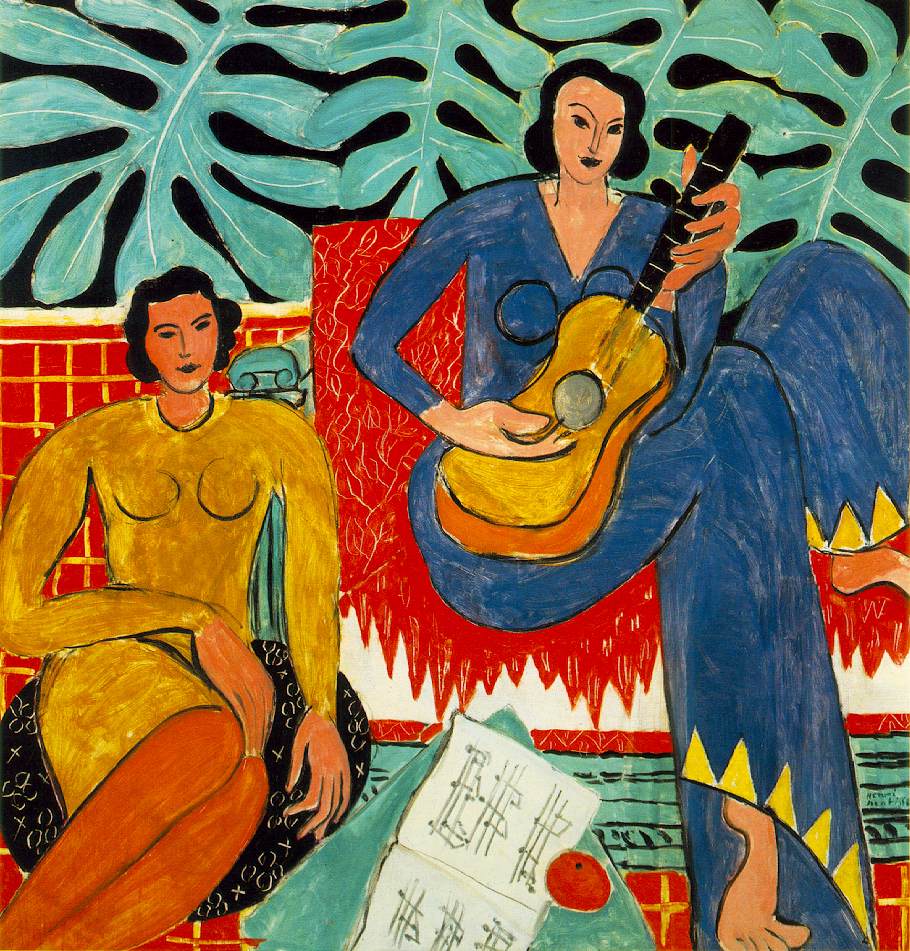
Georges Rouault and Henri Matisse were both asked on separate occasions whether, if they were stranded on a desert island with no hope of rescue or of ever being discovered, would they continue to paint?


Henri Matisse, La Musique (1939);
Albright-Knox Art Gallery, Buffalo, NY

Matisse answered no.


Georges Rouault, The Old King (1937);
Carnegie Museum of Art, Pittsburgh Pennsylvania

Rouault answered yes.

—–

—– Update, Sept 16 —–

Dyrness’ magnificent study of Rouault’s work has been one of my favorite books since I came upon it as an undergraduate in a course on the history of 20th century painting, and I have kept a framed print of “The Old King” in my home or office for at least 30 years. Personal reflection on his art has made Rouault seem like a life long friend and companion.

I’m traveling now and away from my books, but I seem to remember that Rouault continued by saying, “no, for I would have need of that mode of expression” – or something similar (words which perhaps display some degree of affinity with Expressionism). In theological terms, this would be a sense of calling. In the context of schooling, it’s the same point I was making by quoting Yeats here about the aim of education being to light a fire. In regard to life goals, it’s like another of Yates’ poems “To a friend whose work has come to nothing,” which advises,

“Be secret and exult, for of all things that is most difficult.”

Why keep painting? For the same reason one would ever begin painting in the first place. Why keep on doing anything?

I have often thought of Rouault’s answer as a helpful way to reflect on one’s academic aims, one’s calling, or one’s life goals. If we would not keep on doing it were no one to ever pay attention, maybe it’s not the thing we should be doing anyway. Let’s “live like we’re dying.” There must be an inner fire, a drive that does not derive from external recognition, a passion arising from the heart of who we are.

I was prompted to make this post because I quoted this anecdote to a friend earlier this week in a conversation over coffee, in hope that it might encourage her in her resolve to write more consistently. Rouault’s answer is applicable to any calling, whether I am wondering why I should paint, why I should write, why I should go or not go to college, why I should get up in the morning or do anything at all. I also linked to this post from my About page, regarding why I started this blog.

It’s roughly the same point made by C.S. Lewis in “Learning in Wartime,” where he explained to young scholars during WW2 why they should continue with their studies.

Bottom line: If you find yourself in a position where you are wondering why you should do something, or keep on doing it, perhaps the contrast between Matisse and Rouault may help you decide.

Posted in Art-Music-Lit | Tagged , , | 4 Comments

Athanasius Kircher, Mundus subterraneus (1665)

Originally posted at ouhos.org, the now-discontinued blog of the OU History of Science Collections. Neither this post nor any of its content should be taken as an official communication of the University of Oklahoma.


We have recently made available, in its entirety, high resolution images of the most lavishly-illustrated treatise on the Earth in the 17th century:
Athanasius Kircher, Mundus subterraneus (1665). (Gallery; cf. two-page spreads.)

Athanasius Kircher, Mundus subterraneus (1665), title page

Athanasius Kircher, Sphinx (1676), illustrationThe range of interests displayed by Athanasius Kircher (1602–1680) is staggering, even in a century renowned for universal scholarship. Despite failed attempts to decipher Egyptian hieroglyphics, he was a master of a dozen European and Oriental languages. His forty-odd works include studies of the tower of Babel, ancient Egypt, China, mathematics, music, cosmology, optics, magnetism, and medicine. Both highly praised and an object of ridicule, these works served many seventeenth-century scholars as a ready-reference library on virtually any scientific topic.

Athanasius Kircher, Mundus subterraneus (1665), portraitA Jesuit at the Collegio Romano, Kircher became curator of the university’s museum which housed natural history objects sent to Rome from missionaries around the world. The lavish illustrations of Kircher’s works made each volume a virtual museum, an iconographic encyclopedia of creation designed to aid the reader’s contemplation and devotion as well as understanding.

Two richly-embellished global sections in the Mundus subterraneus depicted the interlaced systems of air, fire, and water within the Earth. Here’s one of the two:

Athanasius Kircher. Mundus Subterranus. (Amsterdam, 1665)

Executed in an exuberant Baroque style, the dramatic sections manifest Kircher’s global vision in a uniquely memorable way. Yet the sections were not printed at the front of the two folio volumes, nor were they displayed in an unusually prominent position; rather, they are found in the midst of a miscellany of regional marvels known through a combination of classical reports, travel accounts, and Kircher’s own observations during field expeditions to nearby sites in southern Italy. Numerous small-scale sketches throughout Mundus subterraneus illustrate particular surface features and geographical configurations of interest, such as the appearance of hot springs and cold springs in close proximity, or the accounts of the Andes received from missionaries in South America.

Athanasius Kircher. Mundus Subterranus. (Amsterdam, 1665)

Kircher’s global sections are composites of these regional marvels. Both the regional sketches and the global sections suggest the kinds of underground structures one might suppose in order to explain the surface phenomena observed in particular places around the world.

In the Phlegraen Fields (below), Monte Nuovo had formed overnight in 1538, giving vivid demonstration of the power of subterranean fire.

Athanasius Kircher. Mundus Subterranus. (Amsterdam, 1665)

Kircher emphasized investigations on a regional scale, suggesting that every aspect of the geocosm depicted in the sections was manifest in this single specific region of the Earth:

“Having a very earnest desire, a long time, to understand the Miracles of Subterraneous Nature…. I found such a Theater of Nature, displaying herself under wonderful variety of things, as I had with so many desires wished for. [Seeing] what ever thing occurs, in the whole body of the Earth that is wonderfull, rare, unusual, and worthy of Admiration, I found contracted here, as it were, in an Epitomie, by a certain industry of wise and sagacious Nature.”

Kircher included sketches of active volcanos such as Etna, Vesuvius, and Stromboli described on the basis of first-hand observations. During a sea-voyage to Naples in 1638, Kircher witnessed smoke plumes, tidal waves, and the tragic loss of the city of San Eufémia. From the simultaneity of volcanic eruptions, Kircher inferred a network of subterranean communications. A personal account of this experience appears in the “Praefatio” of Mundus subterraneus. Thus, the first double-folio illustration in Mundus subterraneus is not one of the global sections, which are the most dramatic and memorable illustrations, but a huge depiction of Vesuvius included in the same preface:

Athanius Kircher. Mundus Subterranus. (Amsterdam, 1665)

With Vesuvius still smoldering, Kircher hired a local guide to ascend with him to the top for the sake of first-hand investigation, and dared to have himself lowered into the crater in a harness to take temperature measurements. It is no wonder that Kircher used Vesuvius as his Typus Montis.

Kircher supposed that chambers within the cavernous Earth called geophylacia were created when the dry land was raised above the sea on the third day of creation. Three types of geophylacia imprison air, water, or fire within the Earth; he called these air-houses, water-houses, and fire-houses respectively aerophylacia, hydrophylacia, and pyrophylacia, which are often found in various relations. Another kind of storehouse contains seminal principles responsible for the growth of minerals and earths in passages beneath the ground.

Athanasius Kircher, Mundus Subterraneus, v1 (Amsterdam, 1665)

The second global section (below) depicts the subterranean circulation of fire through various fire-houses or pyrophylacia. The Earth is shown as a furnace of activity, pulsing with subterranean drama beneath the surface world of human habitation. Volcanic plumes embroil the borders with a vivid demonstration of the powerful effects of fire. Thick, turbulent smoke overflows the crust of the Earth, which is shown with a greatly exaggerated vertical scale. Fire is “the life of the Macrocosm, as spiritous blood is of the Microcosm.” The largest pyrophylacium at the center of the Earth (A) is hell, in Kircher’s geocentric cosmos the farthest point from heaven and the prison-house of sinners. Purgatory might be a lesser one nearer the surface (B). In the sulfurous environs of the Phlegraen Fields, monks living in a monastery reportedly heard beneath their feet the groans of sufferers in Purgatory. Were pyrophylacia not providentially circumscribed by water, the entire sublunar realm would burn.

Athanasius Kircher. Mundus Subterranus. (Amsterdam, 1665)

The fire-ducts (C) give rise to hot springs and minerals. Volcanos provide air to the geocosmic circulation and, like alchemical spiracles or chimney furnaces, offer an outlet for fumes rising from the fires. The mountains like bones of the Earth provide a secure skeletal structure. Kircher even suggested that the geographical orientation of mountain chains was ordered, in that they tend to run north-south and east-west.

Athanasius Kircher. Mundus Subterranus. (Amsterdam, 1665)

According to Kircher, hydrophylacia lie at the cavernous roots of mountains such as the Alps (below) and the Andes (shown earlier) where they provide the source of springs and rivers.

Athanasius Kircher. Mundus Subterranus. (Amsterdam, 1665). Athanasius Kircher. Mundus Subterranus. (Amsterdam, 1665)

Many rivers flow in subterranean channels for all or some portion of their course to the sea.

Athanasius Kircher. Mundus Subterranus. (Amsterdam, 1665) Athanasius Kircher. Mundus Subterranus. (Amsterdam, 1665).

Ocean whirlpools, such as the marvelous Norwegian maelstrom, mark the submarine entrances of passages which siphon water from the sea back to the mountainous hydrophylacia.

Athanasius Kircher. Mundus Subterranus. (Amsterdam, 1665)

Polar views depict the two greatest whirlpools through which water descends into the Earth (note the mountain chains depicted as running east-west in the northern continents). All of these features are represented in the first composite global section shown above, depicting the circulation of water.

Myriad subterranean channels keep the water in constant circulation through the Earth, nourishing the growth of minerals and communicating with surface seas and lakes. Water descends to hydrophylacia near the fiery core, providing needed fuel to sustain the subterranean fires. By means of the pumping of the tides which acts like bellows, water in the channels ascends to reservoirs in high mountains. From these it emerges as rivers and springs and returns to the ocean once again.

Fiery exhalations create the winds that keep the seas in motion. Thus

“Water, Fire; Fire, Water; mutually, as it were, cherish one another; and by a certain unanimous consent, conspire to the Conservation of the Geocosm, or Terrestrial World.”

Prompted by his first-hand observation of volcanic phenomena, interpreted in correlation with travel accounts and literary reports, Kircher’s Theory of the Earth (for so it was regarded by many later writers) was a natural expression of his Jesuit instincts for the integration of new observations within the framework of ancient texts. Kircher’s work shows that Theories of the Earth were not uniformly Cartesian in their cosmology nor simply an outgrowth of the mechanical philosophy. Kircher’s Theory of the Earth was nurtured by his geocentrism because Kircher viewed the Earth as a noble object of study: in defense of Jesuit tradition, the best complement to his enthusiastic tour of the Tychonic heavens in Itinerarivm Exstaticvm was an equally rewarding and more extended sojourn through the subterranean world.

—–

  • This essay is excerpted and adapted from: Kerry V. Magruder, “Theories of the Earth from Descartes to Cuvier: Natural Order and Historical Contingency in a Contested Textual Tradition” (University of Oklahoma dissertation, 2000), pp. 527-538.
  • These are just a few of the images in Mundus subterraneus; we’ve just scratched the surface. See Kircher’s complete Mundus Subterraneus (1665) in the Online Galleries.
Posted in History of Science | Tagged | Leave a comment

Happiness is…

Happiness is Apple squared
Happiness = Apple x 2

Thank you, David, for bringing me happiness today! These are now among my prized possessions, thanks to one of the kindest, gentlest men I know. David, come and sit with me and we’ll enjoy a cup of coffee while we watch our favorite old Apple commercials together!

Posted in Apple | 1 Comment

Thank you, Celtic Praise Troupe!

Yesterday for Septemberfest, inside the Oklahoma History Center with the Winnie Mae overhead and the dome of the Capitol building in the background outside, the Celtic Praise Troupe danced its last performance with three of the original members: Katie, Rachel and Hannah.

Tumblr lrcd3qeTls1qjq7m8o3 1280
Celtic Praise Troupe, Septemberfest 2011 (photo by Stephen Folmar)

The 45-minute program included, among others, Gaudete (iTunes), a joyous Christmas madrigal; Walk On (iTunes), with its funny little foot wiggle near the end (cf. the 3:28 mark on this recital video); Give Me Your Eyes (iTunes) (recital); Faithful (iTunes); and instrumental pieces by Rachel and Hannah on hammered and mountain dulcimers.

Hannah Rachel

The Troupe’s performance of Gaudete awakens the joy of countless generations. Through the rhythms of the music and their motions, I sense the presence of many generations, from witnesses of the birth of Christ to the madrigal performers of the Renaissance, joining with us in the communion of saints to celebrate our hope today.

IMG 3025

The Troupe has been dancing Faithful, a celebration of providential deliverance and thanksgiving, since fall of 2004. Whenever I hear this song, I will always remember the sight, for a brief moment during the chorus, of my daughters making the sign of the cross.

Sooner Celtic Praise Troupe, Septemberfest 2011
Celtic Praise Troupe, Septemberfest 2011 (Photo by Stephen Folmar)

Your dancing is Celtic knotwork in motion, joy made visible. The most beautiful lacework from the Book of Kells has leapt into the air, whirling along with your lively rhythms in a blur of moving feet, swirling skirts and flashing smiles.

As father of two of the three dancers who participated in their last performance today, I want to say thank you, Celtic Praise Troupe, for the years you have given us. Thank you for the untold joy you have brought to us!

You are beautiful.

Each one of you is precious to us. You have brought joy beyond words into my life. I am a rich man to have been privileged to watch you over the last eight years, since your first performance in a freezing drizzle in March of 2004 for the Bricktown St. Patrick’s Day parade. Thank you for your weekly toil, for what must be thousands of exhausting hours of practice, in preparation for hundreds of performances at churches and schools, arts festivals, senior citizen centers, parades and special events.

Thank you, my dear daughters, Rachel, Hannah and Susanna, for the joy of a lifetime you have compressed into a short span of years and presented to me through your dance. I will never forget the beauty of your dance. Thank you, Sarah Decker, for your devotion to these girls, to God and to dance, for your amazing choreography, and for the love of God that pours from you through your mentoring of these young women and through their dancing. I will never forget the frequent sound of your voice asking the dancers, “Why do we dance?” and hearing an immediate chorus of young voices in response, “to praise God!” Thank you all for dancing as a way of life rather than for competition; dancing for joy rather than for honor or fame; dancing to praise God, to encourage others and to share his love with the world rather than for personal gain.

Dance is, to me, the most moving of all art forms. Music shapes time and imbues it with meaning; dance adds visible shape and motion that brings the beauty of music to life, embodied in all of you. No sickness, injury, phase of life or power in heaven or on Earth can ever take this experience away from you. It is who you are, and who you shall ever be.

We have been told that Aslan assured some young people that “Once a king or queen of Narnia, always a king or queen of Narnia.” So, once a dancer in the presence of God, always a dancer in the presence of God. Yesterday you danced to a song asking God to give you his love for humanity, to show you how he sees the world. Your dancing itself is one answer to that song, for your dancing has disclosed a preview in miniature of life – of your life and theirs. Life is a dance, choreographed by a loving providence, a shape of love and beauty revealed in the pattern of our lives. You will always participate in beauty, a gift of God’s grace to you, prefigured in every moment you have danced with the Troupe. The dance has only just begun.

Dance as we now experience it is an eschatological vision, a revelation of the future, an unveiling of heaven, a moment of heaven on Earth. Dance is, in miniature, your life, our lives together, the whole tapestry of history, and the entire life of the cosmos. We have entered a Great Dance, along with every creature of heaven and Earth.

The Great Dance points us to God.

“Yahweh your God is in your midst, a Victorious Warrior. He is mighty to save. He will rejoice over you with shouts of joy. He will renew you by his love. He will dance over you with shouts of joy, as on a day of festival.” (Zephaniah 3:17)

Triquetra - symbol of the Trinity, that God is love.At the Prodigal son’s homecoming, he was met by a dancing God, a rejoicing Father inviting him to enter into his own joy. For the secret of this Great Dance in which we find ourselves is that it overflows from the very life of God. The love of the Triune God is the fountain of the Great Dance, its unceasing source and power. The triquetra (right), symbol of the Trinitarian communion of love, represents the reality in which every dance participates. The Great Dance will never end; rather, as we journey on and the Great Dance continues, we will experience more and more the life and love of God, and enter the very source from which all dance flows, cascading down with divine energy from sphere to sphere into the farthest reaches of the universe and enfolding all our lives together in eternal joy.

Your love for others is a dance of beauty in this turning world. This is not the end; it is only the beginning.

—–

Related posts:

Posted in Art-Music-Lit, Family, Theology | Tagged , , | 6 Comments

Biology – Sample weekly schedule

Frazzled?

Lesson plan:
Plan your typical weekly schedule: A sample schedule would be 4 periods a week, in addition to our joint meetings on Monday nights:

  1. Monday night class, 7-8:30 pm
  2. Tuesday, 1 hr: Begin learning Lyrical Life Science song; begin reading LLS chapter.
  3. Wednesday, 1 hr: Practice LLS song; complete LLS chapter and workbook.
  4. Thurs (or Fri): Do a nature walk (and create an entry in your nature journal).
  5. Fri (or Thurs): 1 hr: Continue working in your nature journal. To do this, use resources that will vary from week to week, often including one of the following: Comstock’s Nature Study or Pond Life, writing or drawing, or anything necessary to explore something of special interest, perhaps prompted by the recent nature walk.

For each unit I’ll post on this blog a list of assignments in a lesson plan like the one above, but not everyone has to do all the assignments – what’s listed in “lesson plans” is just a guide, and you can make changes that fit your family schedule, interests and life. Don’t miss out on special opportunities that present themselves unexpectedly. No two families – and no two kids – need to do exactly the same thing. Adapt my suggestions to your own family goals for science this year. But my advice is: never omit the nature walk each week in order to complete some other assignment listed in the lesson plan!

Schedule tips:

  • Reserve one class period each week for going outdoors on a nature walk.
  • On weeks when there is a song to learn from Lyrical Life Science, typically allow 2 class periods per week to read the chapter and complete the workbook.
  • In addition, if you begin learning the Lyrical Life Science song on Tuesdays, immediately after Monday night classes, and allow some time to listen to it and sing along with it every day, this will give you the most days to learn it before the next week’s class. Practice the LLS song whenever you get in the car to go anywhere. 🙂
  • If there are two days for LLS and 1 day for a nature walk, use the remaining day for the nature journal, and for reading Comstock, Peterson, Pond Life or other resources. It’s more important to spend time on the latter than to complete the LLS chapter or workbook. Sometimes learning the song will be enough, so don’t let LLS take over the schedule and displace the other things.

Here’s what to expect on Monday nights:

  1. We’ll start off by singing the Lyrical Life Science song together that we’ve been working on that week (if any).
  2. Then we’ll proceed to a lab activity. BUT: on the first Monday each month, instead of a lab activity, kids will have the opportunity to share any entries in their nature journals that they wish to “show and tell.”
  3. We’ll discuss any questions that arise from the readings for the week.

The meetings will last about an hour and a half, from 7-8:30 p.m. Moms are encouraged to stay and participate, or to eavesdrop on the goings-on from the library.

Who is the teacher? Answer: this year, everyone is a teacher! Each kid and each Mom will play an active teaching role. Kids will teach some Monday nights when there are topics that excite them. Moms will need to consult with kids during the week as they complete their “assignments,” to adjust and adapt them if desired. I also thank you for organizing any field trips you wish to lead on weekends or other occasions. We’ll keep track of these, and of other opportunities, on the calendar, which can be viewed by clicking the “calendar” link in the Tags area of the right margin.

Share

  • Send me any web urls for your own blogs or websites (if you have them) and for any other favorite websites of places we might visit or that offer interesting resources. I will add them to the links in the right margin of this blog.
  • Please share with me any of your favorite books, resources, stories, quotes or poems about biology and science pedagogy.
  • Share your thoughts with all the other Moms and kids frequently, either by group emails or by commenting on this blog. BTW, I will not include our kids’ full names on this blog.
Posted in Education | Tagged | Leave a comment