Karl Barth’s Church Dogmatics (CD) is without doubt the most significant work of Christian theology of the 20th century. But at 8 million words and more than 12,000 pages in English translation, it’s a bit hard to wrap one’s head around. For the CD, “volume” is a tricky word. In the photo of the Princeton Study Edition at right, CD vol. 1 on Revelation is shown in beige covers; CD vol. 2 on God is orange; CD vol. 3 on creation is pink; CD vol. 4 on reconciliation is blue; with indices and helps in the final green cover. (Cf. my previous post on the structure of the CD.)
Marty Folsom (drmartyfolsom.com) is producing for Zondervan Academic a handy guide for each major “volume” of the CD. True to the title, Karl Barth’s Church Dogmatics for Everyone, these guides enable readers to enjoy the kaleidoscope of the CD without getting lost or too overwhelmed to see the beauty of Barth’s vision. I highly recommend them for first-time readers, for non-theologians, for anyone. Marty has a real skill for inviting readers to enter into Barth’s rich paths through the deep forest of the mystery of God without losing sight of the forest for the trees. He is a Barth whisperer.
Marty is a true interdisciplinary scholar. One striking dimension of the books is Marty’s consistent concern throughout to show the applicability of theology to other disciplines. As part of this, he recruited a who’s who roster of scholars to write “very short essays” on the value of each CD volume for other fields. For example, there’s an essay by Jonathan Lett on “The Value of CD 3 for Science.” Each essay is titled “The Value of CD #[1, 2, 3, or 4] for… [Biblical Studies, Systematic Theology, Pastors, Mental Health, Spiritual Formation, Missions, the Arts, Science, etc].” These collections of essays are a remarkable endeavor in their own right, and they illustrate the generous hospitality of the author behind the books themselves.
Three volumes are already out, covering the first three volumes of the CD on the Word of God (CD 1), God (CD 2), and Creation (CD 3). Marty’s guide to Volume 4, on Reconciliation, will come out next year. Barth’s “volume” on Reconciliation is bound in ten blue volumes in the paperback edition shown above. Each of Mary’s books is a master class of compression, a succinct orientation and welcoming invitation. They are like enjoying a spell on the front porch before going inside for the extended family feast.
In a recent John H. Pickford Symposium, “Theology on Fire,” at Northwest College and Seminary, Marty presented “Karl Barth’s Gift to the Church,” a wonderful overview and sense of what these guidebooks are about. In the video, Marty’s talk begins at 0:04:30 and concludes at 1:10:00. Responses and discussion follow. One would be hard put to find a more accessible orientation to the entirety of Barth’s Church Dogmatics than this lecture! If you want more, check out Marty’s conversations about each volume published so far on the Onscript podcast: Vol 1 (Word); Vol 2 (God); and Vol 3 (Creation). Then read Marty’s books, and start looking for your own set of the CD.
I’m grateful to Marty for inviting me to contribute the very short essay on science for volume 4. Reconciliation is not often taken into sufficient account when we think about science and religion. At more than 3,000 pages, Barth’s “volume” on Reconciliation seems like a tall order to expect the non-theologian interested in science and religion to read. But it’s worth it. Although I have only 1,200 words, my chief goal is to prompt scientists who are Christians to begin to think about integrating their theology and science, which is an almost inconceivable challenge. Not to provide answers, just to help them start wondering if it might be possible and perhaps wishing it were so, and therefore, to begin asking questions.
In what follows, I have posted some supplemental information which complements the essay as it appears in published format. The text below is not intended to be read on its own, apart from the printed essay. I incorporated some of this material in a presentation at the Loch Tay Torrance retreat in November 2025 (see paper here).
In CD 4, Barth integrates creation and reconciliation, so that creation (the subject of CD 3) is not interpreted in isolation apart from a holistic understanding of Christian belief. He also speaks of a second kind of integration: that between theology and the sciences. Barth spoke of the “integration” of great and little lights in CD 4.3.1 pp. 156-157; here’s a key sentence:
“The positive thing which takes place in the confrontation of the little lights of creation with the great light of its Creator is that they are not passed over or ignored, let alone destroyed or extinguished, but integrated in the great light.”
I think of each integration — of creation and reconciliation, and of theology and the other sciences — not as occurring on the same level, like two sides of a zipper, but as superimposed views, like binoculars or those old ViewMaster slides.
In elaborating on this challenge of integration, I wrote in the paper:
“The challenge of integration requires us to reflect carefully on how theological themes may apply to our work, without abrogating our fidelity to the practices of our scientific community. Indeed, theological themes have shaped science throughout its history. Three examples worth prolonged pondering are the cross and the mandate to enter into the suffering of creation in order to recover whatever has been marred in the fall; the Resurrection and the beauty of creation evidenced in the history of human anatomy; and the new creation and the rise of historical science in geology, biology, and cosmology (not to mention stories of human relationships with horses). From explorations in the history of science, Christian scientists may perhaps discern not a few clues for living as faithful members in both communities.”
At this point, the following paragraphs were cut from my original essay to get it down to the word limit:
Three historical examples prompt our own reflections about how the cross, Resurrection, and new creation may shape or intersect with our science:
1. Cross: The Plague and the Groaning of Creation
Jesus wept at the brokenness of creation, and in the cross he gathered into himself all of its pain and marring by evil.(17) The cross became the turning point, opening the way toward the new creation.(18) We who follow in the way of the cross now enter into the suffering of all creation. Contrary to Paley and most modern natural theology, what is, is not right. Nature at present is not normative, but in need of redemption. We see nature in light of the Cross. Romans 8:18-25 captures both our hope and our tension in living in the already and not yet of the redemption Jesus has won for us.(19) We join in the groaning of creation, with the first fruits of the Spirit, participating in the work of Jesus Christ, the Prophet, Priest, and King of Creation. In Christ, the whole creation will be liberated from its bondage to decay to share in the freedom of the children of God.
We see this theme in the history of science when Francis Bacon argued that just as faith is known by its works, so true knowledge must be known by its fruits: “not an opinion to be held, but a work to be done.”(20) Through the fruits of scientific inquiry, we seek to restore what was lost at the Fall, or at least to mitigate its harmful consequences.(21) This is not merely intellectual history, but has obvious practical implications for scientists. Bacon, like many, believed that cures for most or all diseases lay hidden in the natural resources of the world. It was part of the divine calling of physicians to find those cures, develop them, and then use them to care for others. Contrast the gulf between Bacon’s vision of the Christian mandate with Albert Camus, who sadly concluded that to fight the plague one must fight also against the god of nature. In contrast, Christian scientists have divine marching orders to fight the plague, to protect the environment, and to push back against evil wherever it impinges upon any aspect of God’s good creation, knowing that we are participating in the work of God which has triumphed in the cross and Resurrection and will be fully revealed in the new creation.(22) When we join in AIDS or COVID healthcare initiatives, work to recover from natural disasters such as the North Carolina floods or California wildfires, seek to mitigate the harmful effects of volcanic eruptions, droughts, earthquakes, or habitat destruction, we are participating in the redemptive suffering of Christ. Jesus weeps and the Spirit groans, as we work in Christ through the Spirit, not without hope.
2. Resurrection: Anatomy and the Beauty of Creation
We see one example of faith in the Resurrection applied to science in the study of human anatomy in the wake of its widespread disparagement in Roman culture. In the Middle Ages, universities revived the practice of human dissection which had been prohibited by the Romans due to ethical concerns and taboos about contact with the dead. Why were the Roman taboos broken? What caused such an immense cultural shift? While numerous factors were at play, we cannot ignore the effects of widespread belief in the Resurrection of Christ. The Resurrection transformed cultural attitudes toward the human body, creating a posture of triumphant confidence in the coming new creation. Apart from faith, it is difficult to comprehend either the development of human anatomy or the rise of the veneration of relics of the saints. Both alike reflected belief in the Resurrection. The confident investigations of human anatomists like Charles Estienne (1545) and Andreas Vesalius (1543) incorporated beautiful, artistic anatomical illustrations in their works.(23) In such art, going well beyond any merely utilitarian function, the Roman taboos are left far behind. The beauty of anatomical art proclaims that death has lost its sting. When Melanchthon reformed the curriculum of the Lutheran universities, he commended study of Vesalius as the most suitable replacement for Aristotle. Human anatomy took its place in undergraduate study, the culmination of a cultural transformation echoing the Resurrection and anticipating the new creation.(24) While many cultures and traditions affirm the goodness and beauty of creation, this example illustrates how the Resurrection does so in spades.
3. New Creation: The Historical Sciences and the Future of Creation
We see faith in the new creation applied to science whenever historical perspectives on nature arise. For Barth, the story from creation to new creation manifests divine freedom to love in covenant faithfulness. Barth helps us apprehend that natural science works under a criterion of love, anticipating the new creation, working not only toward the restoration of all things, but also toward their eschatological fulfillment in the love of Christ.(25) We groan in hope for more than a restoration of what was lost. We groan for a consummation that transfigures creation.(26)
To return to Bacon, in The Great Instauration (1620), Bacon wrote that love compels the scientist more than the quest for power.(27) Although Bacon was not always consistent, he urged the pursuit of scientific knowledge in order to love and serve others, to anticipate the loving purposes that will be fulfilled in the new creation.
In contrast, pagan perspectives of time tended to be cyclical, a deterministic wheel of fate and fortune driven by a combination of chance and necessity in which only the universal matters. For Christians, belief in the entire sweep of covenant history, centered on the cross, Resurrection, and consummation, meant that there is more to temporal succession than endless cycles of fatalistic events.(28)
The biblical vision of redemption and future consummation provided geologists, naturalists, and cosmologists with an invitation to explore changes in the heavens and the Earth over time. When science was liberated from purely necessitarian and cyclical thinking, the results were profound. The first fruits of this transformation were expressed in geohistory and then evolutionary biology, even before the field theories of Maxwell and Einstein and the Big Bang cosmology of LeMaître and Hubble. The rise of the historical sciences in geology, biology, and cosmology is one of the most exciting stories of modern science and goes to the heart of a Christian influence upon the natural sciences.(29) In contrast to an eternal or unchanging universe, might nature herself have a history? If so, where has creation come from? Where will it all lead? Does it lead to a future in which the love of God achieves his purposes for creation? In this hope, the Christian scientist may anticipate the new creation and act as if it is already here in the already and not yet of our present time.
Finally, as scientists and creation workers we are called to see our work being accomplished through the Spirit and not through our own autonomous efforts.(30) The new creation is a fully Trinitarian act, involving the cross, Resurrection, and parousia of Christ and the work of the Spirit between the times. The new creation does not arise ex nihilo, but from the resurrection of the old. As the Spirit hovers over the waters, the scientist and creation worker are already tending the new creation arising hiddenly within and beneath the old.(31)
Through science and various other forms of creation work, we express gratitude and love for what God has made as we pledge ourselves in hope for its future. The veterinarian gives voice to the horse’s praise. Through the geologist, the very rocks cry out. The astronomer gives voice to the heaven’s praise. For all eternity, the river biologist will give voice to the fish and algae’s praise. For Barth, we are sent out for the sake of the world, the cosmos, and by implication, for the rocks, stars, horses, birds, fish, and algae.(32) Here and now, science is one of the ways of loving the creation that God loves. Through natural science and creation work, we are participating in the mission of God.
In the new creation, when full redemption has come, most of us probably imagine that there will be work for theologians, pastors, musicians and poets. But what about scientists and creation workers? Will geologists have work to do in the new Earth? Will we still need veterinarians and those who care for animals? Physicians, ecologists, gardeners, and farmers? Bird watchers and astronomers? Creation workers of all kinds?
(The printed essay then resumes from this point and concludes with some wonderful quotes from Barth, Bertrand Russell, and Thomas F. Torrance.)
———–
Notes
(17) CD 4.1 p. 231: “On that one day of suffering of that One there took place the comprehensive turning in the history of all creation—with all that this involves.” Or, CD 4.1 p. 311: “Where are the tears wiped away, and no more death, the pain removed, the sorrow stilled, the hurt healed, not to speak of the silencing of the groaning of non-human creation?” Jesus at the tomb of Lazarus wept for all creation. All the more so did he weep for all creation on the cross. CD 4.2 p. 293.
(18) CD 4.1 p. 231: “He is the righteousness which dwells in the new heaven and the new earth (2 Pet. 3:13)…. We wait for Him when, placed in Him and with Him at this turning-point of the times, we wait for this new heaven and new earth…. It made His day—the day of the divine judgment—the great day of atonement, the day of the dawn of a new heaven and a new earth, the birthday of a new man.”
(19) “I consider that the sufferings of this present time are not worth comparing with the glory about to be revealed to us. For the creation waits with eager longing for the revealing of the children of God; for the creation was subjected to futility, not of its own will but by the will of the one who subjected it, in hope that the creation itself will be set free from its bondage to decay and will obtain the freedom of the glory of the children of God. We know that the whole creation has been groaning in labor pains until now; and not only the creation, but we ourselves, who have the first fruits of the Spirit, groan inwardly while we wait for adoption, the redemption of our bodies. For in hope we were saved. Now hope that is seen is not hope. For who hopes for what is seen? But if we hope for what we do not see, we wait for it with patience.” (Romans 8:18-25 NRSV). Cf. Barth: “This must be the starting-point for all the detailed questions to which we can only allude in the present context. Wherever man exercises his lordship over the animal, and especially across every hunting lodge, abattoir and vivisection chamber, there should be written in letters of fire the words of St. Paul in Rom. 8:18f. (relevant, as I see it, in spite of A. Schlatter) concerning the “earnest expectation” (ἀποκαραδοκία) of the creature—for what?—for the “manifestation of the children of God,” and therefore for the liberation of those who now keep them imprisoned and even despatch them from life to death. The creature has become subject to ματαιότης (vanity), not ἐκοῦσα (willingly), nor according to its own destiny, but because of man, its subjugator. And it, too, is determined for liberation from the δουλεία τῆς φθοράς (bondage of corruption) together with the liberation of the children of God, so that for the moment it groans and cries with us in the birth-pangs of a new aeon.” CD 3.4.3, p. 355.
(20) Francis Bacon, The Great Instauration (1620), p. 16. See Charles Webster, The Great Instauration: Science, Medicine, and Reform, 1626-1660 (London: Gerald Duckworth & Co. Ltd., 1975) and Peter Harrison, The Fall of Man and the Foundations of Science (Cambridge: Cambridge University Press, 2007).
(21) This criterion sets definite limits on the utilitarian ambition of his unfortunately better-known phrase, “the effecting of all things possible,” as he put it in New Atlantis (1626).
(22) This is not intellectual theory removed from experience; I once asked a dear biologist friend whether he could justify, on the basis of his ecological pantheism, cutting down a tree to keep his son warm on a cold night, even if their survival depended upon it. After a long moment of silent deliberation, he answered that, rationally, he could not. Neither Camus’ existentialism nor my friend’s ecological pantheism offer a humane answer for medicine in a time of pandemic, for the environmental crisis, or for the problem of evil.
(23) Charles Estienne, De dissectione partium corporis humani (Paris, 1545) and Andreas Vesalius, De humani corporis fabrica (Basel, 1543).
(24) Caroline Walker Bynum, The Resurrection of the Body in Western Christianity, 200-1336 (New York: Columbia University Press, 1995) and Sachiko Kusukawa, The Transformation of Natural Philosophy: The Case of Philip Melanchthon (Cambridge: Cambridge University Press, 1995).
(25) The Direction of the Son CD 4.2 p. 293: “They are surrounded by the ἀποκαραδοκία (sufferings of the present time), the earnest expectation, of all creation, of the whole non-Christian world which does not yet know of the atonement accomplished for it in Jesus Christ, a world which as Paul saw it seems to have included all creatures, even the non-human.” … “In this history God Himself is at work in His own most proper cause—the cause in which it is a matter of the purpose and meaning of all creation and the attainment of His will with it.” And The Praise of Works KD IV.2 p. 660: “It is, of course, a work which embraces all creation, heaven and earth and all that therein is.” And The Basis of Love CD 4.2 p. 853: “For what does it mean when we are told in Col. 1:12f. that the Father has set us in the kingdom of ‘the Son of his love’; the same Son who is described in v. 15f. as ‘the firstborn of all creation,’ in whom, by whom and to whom all things in heaven and earth were created, who was before all things and in whom all things consist?” And The Basis of Love CD 4.2 p. 853: “It needs only the proclamation that it has taken place, and the final revelation of its meaning and significance for all creation in all the developments and dimensions of its temporal existence.”
(26) The Task of the Community CD 4.3.2 p. 910: “He is in the deepest sense the reformation, i.e., not merely the restoration but the disclosure or manifestation of the purpose and glory of all creation.”
(27) “Lastly, I would address one general admonition to all; that they consider what are the true ends of knowledge, and that they seek it not either for pleasure of the mind, or for contention, or for superiority to others, or for profit, or fame, or power, or any of these inferior things; but for the benefit and use of life, and that they perfect and govern it in charity. For it was from lust of power that the angels fell, from lust of knowledge that man fell; but of charity there can be no excess, neither did angel or man ever come in danger by it.” Francis Bacon, The Great Instauration, 1620. “Instauration” refers to the future restoration of all things.
(28) The doctrine of creatio ex nihilo was an outworking of the Incarnation.
(29) The literature on the rise of the historical sciences is vast. For a general background on divine freedom in nature and the history of nature, one might begin with Margaret J. Osler, Divine Will and the Mechanical Philosophy: Gassendi and Descartes on Contingency and Necessity in the Created World (Cambridge: Cambridge University Press, 1994). For the specific example of geology, which arose first, begin with Martin J. S. Rudwick, Bursting the Limits of Time: The Reconstruction of Geohistory in the Age of Revolution (Chicago: University of Chicago Press, 2005) and Martin J. S. Rudwick, Worlds Before Adam: The Reconstruction of Geohistory in the Age of Reform (Chicago: University of Chicago Press, 2008).
(30) We “walk not according to the flesh but according to the Spirit” (Romans 8:4 NRSV). The Promise of the Spirit KD IV.3.1 p. 317: “Why is it that we and all creatures have still a long way to go to the home to which we belong, to the time when we shall enjoy our eternal life on the new earth and under the new heaven, to the investing of our corruptibility with incorruption?” … “He is marching from its beginning in the revelation of His life to the end of His not yet accomplished revelation of the life of all men and all creation as enclosed in His life, of their life as the new creation on a new earth and under a new heaven.”
(31) Union with Christ entails that the kind of New Creation we are contemplating begins as a re-creation from within space and time. Just as in the Incarnation, Jesus transformed human nature from within, so in the same way, we participate in the Resurrection of Christ as the Spirit is now working to heal, re-order, and transform creation from within. In one sense, the re-ordering of creation comes from outside, as this re-engineering is not the emergence of something Nature could achieve on its own. But in a more profound sense, the re-creation comes from within, for God is creating not from nothing, ex nihilo, but re-creating through the risen humanity of Jesus Christ. Jesus and the Spirit are transforming us into the Firstfruits, the beginnings, the advance party, of the New Creation (compare James 1:18). The transformation through Christ in the Spirit is a creature-affirming, personalizing process, which establishes rather than diminishes the creature. He is not transforming us with a heavy hand, by decree or law, nor dehumanizing us in the process. It is not an imposition of power from above, but a re-creation of order from within. Grace in action is re-ordering our world, gently, patiently, from the bottom up, from the inside out. And although we groan together yearning for the full future redemption, the Firstfruits of His Resurrection spill over from the individual Christian and the Christian community to the rest of creation.
(32) CD 4.3.2 p. 872. If we love someone, we will long for a future in which they will experience a fullness of well being, and we will want them to live forever in that dynamic condition of well-being.
(33) CD 4.3.2, pp. 811-812. Emphasis added. See also the “Transfiguration of Creation” icon created by Aidan Hart for Point Loma Nazarene University, San Diego, on display since October 2025 in the lobby of the university’s Ryan Library.
(34) Bertrand Russell, “A Free Man’s Worship,” Why I am not a Christian and Other Essays on Religion and Related Subjects (London: George Allen and Unwin, 1957), pp. 104-116. “A Free Man’s Worship” was first published in The Independent Review 1 (December, 1903): 415-424.
(35) Thomas F. Torrance, Space, Time and Resurrection (Edinburgh: Handsel Press, 1976), p. 105.
To conclude a paragraph asserting that “the gospel of reconciliation enlarges our perspective with the new creation,” I make what will seem to many as an outrageous statement: “Nothing in science makes sense except in light of the cross, Resurrection, and new creation.” The footnote reads: “I make this provocative affirmation in the spirit of Theodosius Dobzhansky, ‘Nothing in Biology Makes Sense Except in the Light of Evolution,’ The American Biology Teacher 35, no. 3 (1973): 125-129. Dobzhansky (a practicing Christian) obviously did not mean that nothing in biology was ever understood before the rise of 20th-century evolutionary theories.” If I were not already well over my word-limit, I might have added a clarification along the lines of something like this: Just as the theory of evolution establishes integrating dimensions of depth and relation among all the disparate aspects of biology which cannot be unseen once they are disclosed in all their coherence and beauty, so the gospel of reconciliation and the new creation, once seen, cannot be unseen, because of the astonishing new depth and unexpected dimensions its hopeful perspective provides the Christian scientist. The Christian scientist who fails to practice science in light of reconciliation and the new creation is missing out in a way analogous to the biologist working before 1859 without a relational understanding of the history of life. (At this point, the essay moves on to the “almost inconceivable challenge” of integration, asking: “What does this mean for the scientist and creation worker today?”)
The few words of this post and my published essay barely scratch the surface of the value of Barth’s CD 4 for science. These abbreviated reflections come from my own personal vantage point as a historian of science and a lifelong student of science (bio). In the history of science, plenty of attention has been devoted to science and religion, but not so much to Barth. When I began graduate study at the University of Oklahoma in the Department of the History of Science, the venerable professor teaching my first seminar shook his finger at us, admonishing that to understand the Scientific Revolution we all must read Augustine’s City of God and Calvin’s Institutes. I agreed, and did so. But the same is true for Barth. Reading Nein! is not enough; I’ve benefitted greatly from diving deeper into Barth’s Church Dogmatics and now recommend it to any graduate student interested in science and religion. Barth’s rejection of natural theology by no means implies his irrelevance for a theology of nature or for the natural sciences.
Quotations from the Church Dogmatics were omitted from the published essay except in a few cases. Contact me if you want to read the fuller draft before the quotations were deleted.
My gentle giant cousin, Charles III, passed away last week. He could play the piano so beautifully. He rarely spoke, but the music poured forth his whole life. One of my early memories of him is when all us cousins were playing football. I must have been 10 or 12 at the most. I remember he simply picked me up by the back of my belt and there I was running in mid-air, until he carried me over to our “sideline” and dropped me out of bounds. That’s how he politely declined to engage in the violence of the sport, lucky for me.
Candace and I watched the livestream service together this morning, and we so wish we could have driven up to Des Moines to join the family there in grieving and giving thanks for Charles’ miraculous, beautiful story. We choked back tears start to finish. The beautiful music throughout. Chris reading the opening scripture. And Joel’s words were a culmination to the beauty of the symbolism and music and meaning of the service. I’m so thankful for the faith of my family, and overjoyed to hear any telling of Charles’ story, and the last months of his pilgrimage here. Now Uncle Charles and Aunt Ilene have welcomed him home, and I imagine him playing piano with Grandma Jewell.
The family have made available some of Charles’ music: Spotify. Apple Music.
“Oh, that my words were recorded, that they were written on a scroll, that they were inscribed with an iron tool on lead, or engraved in rock forever! I know that my redeemer lives, and that in the end he will stand on the earth.… in my flesh I will see God; I myself will see him with my own eyes — I, and not another. How my heart yearns within me!” (Job 19:23-27)
“Why did not somebody teach me the constellations, and make me at home in the starry heavens, which are always overhead, and which I don’t half-know to this day?” — Thomas Carlyle
Old books offer us the opportunity to recover meaning in what we do. The night sky is filled with hundreds of stories which remind us that a knowledge of the heavens has always been part of what makes us human.
What memories do you have of watching the stars? What stories do you like to tell about the night sky?
Hevelius star atlas. 2nd “Golden Atlas.” Includes three books, usually published separately: (1) Uranographia, or Firmamentum Sobiescianum sive Uranographia (“The Firmament of King Sobiesci, or Map of the Heavens”; Gdansk, 1690); bound with (2) Prodromus Astronomiae (“Preliminary Discourse for Astronomy”; Gdansk, 1690); bound with (3) Catalogus stellarum fixarum (“Catalog of the Fixed Stars”; Gdansk, 1687). Can you find the title pages and frontispieces for each of these three books?
In a public presentation, Starstruck Tonight, Candace and I describe most of the astronomical works on display in this section, along with poetry and literature about the night sky.
The Sky Tonight:
The images that fuse the beauty of modern deep space photos with historic star atlases may all be downloaded at my website skytonight.org. Information about each atlas is available under the “Sources” tab. Constellation images are found under the Constellations tab, etc.
Leonard Digges, addition by Thomas Digges. Leonard Digges, A prognostication euerlasting of right good effect…; Lately corrected and augmented by Thomas Digges his sonne (London, 1605).
Johann Kepler, Mysterium cosmographicum (Tübingen, 1596).
Andreas Cellarius, Harmonia macrocosmica seu atlas universalis (Amsterdam, 1708). First edition: Atlas Coelestis (Amsterdam, 1660/61). This 1708 edition includes the frontispiece and all of the plates of the 1660 edition.
Delamarche orrery (Paris).
“Einstein,” in Steve Jobs, Think Different (1998). Leaflet.
Background video: Many of these examples are discussed in the music section of my video lecture “Interdisciplinary Relations.”
Background: See the brief “Music of the Spheres” overview in Appendix 2 of my PDF essay on “George MacDonald and the Scientific Imagination.” (Blog post; to be published Sept 2026 by Winged Lion Press.)
kerrysloft.com: my personal blog; search for any names or topics.
kerrymagruder.com: my professional blog (under construction). See the “videos” tab. It also has a bio page.
lynx-open-ed.org: When you see references to “lynx-open-ed.org,” those resources will eventually reappear at kerrymagruder.com. The Lynx Open Ed website crashed and no longer exists. I am slowly reconstructing it at kerrymagruder.com but right now only the videos section is useful.
repository.ou.edu: Many of the books displayed are digitized and available in the library’s open access online library.
Become a researcher at the OU History of Science Collections:
You are welcome to come back as a researcher. You do not need to be an academic scholar. There is a registration process. After that, the books will be brought to you in the Reading Room. It’s good to request the books in advance so they can be pulled and waiting for you. All this is explained on the web page for the History of Science Collections. Go to the University of Oklahoma Libraries website (libraries.ou.edu) and navigate to the page for the History of Science Collections. There you can register online, request the books you want to see ahead of time, and ask any questions you have for Collections staff. And then come and sit with the books.
In this latest episode of his YouTube series, “A Spell in the Library,” Malcolm reads and muses upon “The Healing of Harms,” the final chapter of The Silver Chair. The passage includes a poignant scene where Jill and Eustace find themselves walking in Aslan’s country, after the aged King Caspian’s death: “Then they saw that they were once more on the Mountain of Aslan, high up above and beyond the end of that world in which Narnia lies. But the strange thing was that the funeral music for King Caspian still went on, though no one could tell where it came from.” The sorrow of the music brought tears to their eyes, even in the presence of the beauty of Aslan. Later they watched Caspian rise from the river into new life, at Aslan’s call, resurrected in a new creation.
In recent years, we have sorrowed and rejoiced in the passing of so many whose lives and homes have been centers of our common gatherings and joys throughout our lifetimes. On the Comstock side, Candace’s parents Junior and Phyllis Comstock, Aunt Bernidene, Uncle Charles, and many others, old and young (Emily, Lorie, Jeff). On the Magruder side, the five Magruder siblings and all their spouses except one, and several others. My parents Jack and Sue Magruder. Charles and Eileen Magruder, Steve, Charles III. Marjorie and Ernest Glass. Carolyn Baughman. Mitchell Magruder. Joe and Dorothy Potter. Charlie and Aleta Fountain. Dale and Joyce Brimer. And several from my own generation and younger still. Friends we have known from early in our lives are beginning to part from us also (Lee).
Time is precious. They loved us well. Their loss is as inexpressible as the joys remembered. The New Creation feels more like the home we long for now.
As we have carried these griefs and sorrows, I have found consolation in Malcolm Guite, Love Remembers: 40 Poems of Loss, Lament, and Hope. I prize all of Malcolm’s books, but this one is special — like David’s Crown, do not miss this. As with his superb anthologies on Advent and Easter, this book features poems by a variety of contributors: Wordsworth, Tennyson, Dante, Shakespeare, Donne, Shelley, Thomas Hardy, Luci Shaw, Scott Cairns, George Herbert, Holly Ordway, Christina Rossetti, and N.T. Wright, among others. With a few pages of reflection, Malcolm opens our hearts to the meaning of each poem and each poet’s story. The poems and reflections are grouped into the categories of “before and beyond the threshold of death”; “the shock of loss”; “loving lament,” the “bitter-sweet experience of loving through sorrow”; “remembrance of things past,” when “everything reminds us, painfully or poignantly, of the beloved”; “letting go”; and finally “receiving,” when the “veil lifts, we glimpse the goodness of things deepened and sharpened by sorrow.”
Malcolm cautions that these are not phases of grief. And true, indeed, in my experience they are shuffled all about and I found myself reading them in any order, and repeatedly. In the first six months after my father died last fall, no matter how I was feeling, there was always one that matched what I needed… one short chapter that was not too burdensome for a weary evening. This is a book I will live with, returning to often amidst life’s sorrow and beauty, until I myself awake in Aslan’s Mountain.
“But if you believe that the Son of God died and rose again, your whole future is full of the dawn of an eternal morning, coming up beyond the hills of this life, and full of such hope as the highest imagination for the poet has not a glimmer of yet.” — George MacDonald, Proving the Unseen, p. 9.
Update: (The following paragraph is a composite of part of what I’ve written to two friends when sending them a copy of the book.) Malcolm’s poetry has sustained me through the last 15 years to the degree that I consider him a pastor. All of his poetry books. Over the last year, this one has kept me going, after the loss of my parents in recent years. I hope the poems and reflections in it will be a consolation to you, too. I have lived with this book in hand this past year, and expect to do so again for a few years, if not perpetually, whenever I, too, feel existential grief or simply the gaping hole of their physical absence. I don’t think we get over grief; it just becomes interleaved with remembrances of joy, like one of those honey pastries from the Middle East — baklava. Or the coffee and deliciousness of tiramisu, my favorite desert. My phone rotates wallpapers of my Mom and Dad (and others of us, especially Candace and Ethan). But that is only one way of many that they are still with me. I depend on their affirmation and encouragement all the more, despite the poignant loss of the ability to sit beside them or give them a call. Several times a week I find myself instinctively thinking I want to call them, before a split-second later remembering that while they can hear me, I cannot hear them. Yet we are still together in the invisible yet real “communion of the saints.” I do believe they are with us and helping us and we are not left on our own in the family of God. I am so glad that they now understand our lives completely and (I believe) see the goodness we can’t imagine that lies ahead. We cannot wound them with our sorrows. To know that they can share our sorrows but with hope undiminished is better, in one way, than if they were still here.
“You shall not wrong or oppress a resident alien, for you were aliens in the land of Egypt.” (Exodus 22:21)
“You shall love the alien as yourself, for you were aliens in the land of Egypt: I am the LORD your God.” (Leviticus 19:34)
The Immigrant Legal Resource Center (ILRC) offers downloadable Red Card templates to print off and hand out to educate your immigrant friends about their rights. The National Immigration Law Center (NILC) offers know-your-rights flyers with practical guidance. Both are in English and Spanish. Why not post them in your neighborhood, church, grocery store, and institutional bathrooms?
Update: After writing the above, a pastor friend here in Oklahoma replied:
“We are aware of the red cards and the fliers, but the way ICE is working there is nothing that can be done. They ignore the cards, they take the people regardless of what they say, book them and tell them that they will need to say that to the judge, which they will never get to talk to. By the time someone gets a lawyer to help the detainee, they are already gone, in a bus to Houston. They are not listening to anything one has to say in self defense.”
So awful! A travesty of outrageous injustice and rampant lawlessness. I’m grieved by the sheer lack of mercy and violence of it all. We have lost our communities. May God bring relief to all the vulnerable. May he raise up his people to cry out on their behalf as he cried out on the flight to Egypt.
“We think of him as safe beneath the steeple,
Or cosy in a crib beside the font,
But he is with a million displaced people
On the long road of weariness and want.
For even as we sing our final carol
His family is up and on that road,
Fleeing the wrath of someone else’s quarrel,
Glancing behind and shouldering their load.
Whilst Herod rages still from his dark tower
Christ clings to Mary, fingers tightly curled,
The lambs are slaughtered by the men of power,
And death squads spread their curse across the world…”
–Malcolm Guite, “Refugee”
Complete poem with a reflection and a recording of Malcolm reading.
Update: Malcolm comments on a wondrous example of understanding overcoming enmity. This short reading from the Lord of the Rings may help us learn to see the immigrants among us as our neighbors and worthy of our love. May we all become like Galadriel in this moment:
The Connects 2025 program is now available! See the final schedule, with presenters, descriptions, and links to abstracts, at the Connects website: https://connects.geosociety.org/program
The HPG Division is sponsoring the following sessions morning and afternoon Sunday, Monday, and Tuesday. The luncheon is between the two sessions on Monday. Also remember to stop by our booth in the Exhibit Hall, where we’ll have some merch for sale and some stickers to give away.
Tuesday, morning and afternoon: Pardee Day 3. Geoheritage Without Borders: International Perspectives on the Conservation and Celebration of Geodiversity. Room: Stars at Night Ballroom.
Posted July 14 on the discussion board for members of the History, Philosophy, and Geoheritage Division (HPGD) of the Geological Society of America (GSA).
We hope you are making plans to come to San Antonio for the annual Connects meeting October 19-22. With the fusion of history, philosophy, and geoheritage into the Division there will be much energy and enlightening conversation!
Five topical sessions are listed below. In addition to those, there will be a Pardee session devoted to Geoheritage (Tuesday, 21 October, P3). We will announce a student luncheon with an award ceremony and a business meeting shortly.
Abstracts must be submitted before August 5th, but why not now?
We hope you will present a paper in one or other of the sessions listed below, so make plans now to come to the meeting and submit an abstract asap!
Kerry Magruder, for the HPG Division Board
Topical Session 85: Crossing Borders in the History and Philosophy of the Geosciences
Session Advocates: Kerry Magruder, David Spanagel, Rex Hanger, Christopher Hill, Patricia Coorough Burke
Description: Presentations explore how the geosciences cross borders, whether disciplinary, geographical, national, political, institutional, social or philosophical in nature, including women and minorities in geology, international and interdisciplinary collaborations, connecting the field and lab, colonialism, social aspects of geological maps, etc. (To submit abstract, search for “85” or use the tag Primary Discipline: History and Philosophy of Geology)
Topical Session 86: Crossing Boundaries: Histories of Geoheritage
Session Advocates: Kerry Magruder, Rex Hanger, Renee M. Clary, Stephen K. Boss, Christopher Hill, Patricia Coorough Burke
Description: Presentations explore the range of meanings of geoheritage from a variety of perspectives that cross boundaries, whether historical, disciplinary, geographical, national, political, institutional, or philosophical in nature. Papers may address geo-sites and geo-collections which are contested, marginalized, or unjustly forgotten. (To submit abstract, search for “86” or use the tag Primary Discipline: History and Philosophy of Geology)
Topical Session 180: Philosophy of Extreme Events and Landscape Evolution on Earth and Other Planets: Thinking Geologically in the Spirit of Victor Baker
This session highlights Victor Baker’s contributions to Earth-based and planetary research on catastrophic events in shaping landscapes and the role of outrageous hypotheses in scientific inquiry. Presentations explore these transformative influences on understanding surface processes. (To submit abstract, search for “180” or “Baker”)
This special session will bring together researchers whose work intersects with or has been inspired by Professor Baker’s wide-ranging contributions. Presentations will highlight: Paleoflood Hydrology and Flood Geomorphology: Advances in flood hazard analysis, paleohydrological methods, and Quaternary geomorphology. Ongoing work examining catastrophic flooding events on Earth and their implications for understanding Earth’s climate and geomorphological evolution. Planetary Geology and Comparative Planetology:Investigations into surface processes and geomorphic features on Mars, Venus, and other planetary bodies. Connections between terrestrial analog studies and planetary exploration missions. History and Philosophy of Geology: Explorations of the historical development of geological thought, including the role of catastrophic events in shaping landscapes. Philosophical perspectives on scientific inquiry, including the nature of hypotheses, theories, and interdisciplinary research methods.By merging insights across these thematic areas, the session will reflect Professor Baker’s holistic approach to geology-linking observational data, modeling techniques, and theoretical frameworks to enrich both Earth-based and planetary research. We aim to feature a combination of invited and contributed talks that showcase current innovations and highlight the continuing influence of Baker’s scholarship. Professor Victor R. Baker-Regents Professor of Hydrology, Geosciences, and Planetary Sciences at the University of Arizona-has been a pioneering force in advancing multiple fields of geoscience during his nearly six decades of GSA membership (49 years as a GSA Fellow). His influence spans research topics ranging from paleoflood hydrology (a field he helped define), flood geomorphology, and planetary geology, to the philosophy and history of Earth and planetary sciences.Professor Baker’s interdisciplinary insights have profoundly expanded our understanding of how catastrophic floods shape landscapes on Earth, Mars, and Venus, as well as how geological thinking intersects with broader scientific and philosophical realms. He served as President of the Geological Society of America (1998) and chaired three GSA Divisions-Quaternary Geology and Geomorphology (1987), Planetary Geology (1986), and History and Philosophy of Geology (2010)-while also holding prominent roles in the American Association for the Advancement of Science and the International Union for Quaternary Research. Among his numerous GSA recognitions are the 2024 establishment of the Victor R. Baker Graduate Student Research Grant Award, designation as the 2012–2013 Inaugural GSA Distinguished International Lecturer, and the 2010 Distinguished Career Award from the Quaternary Geology and Geomorphology Division. Given his prolific scholarly output (over 1,100 scientific contributions) and international recognition, this session will celebrate Professor Baker’s enduring impact on geoscience, provide a platform for reflecting on emerging research that builds on his foundational work, and inspire future directions in geology’s integration of physical, planetary, and philosophical perspectives.
Topical Session 87: One Century of Oil and Gas in the Permian Basin
Times, colleagues, tools, and technology have all changed over the past 100 years. The professionalism and comradery of geologists in the Permian Basin remains. Historical perspectives to help innovate for the future. (To submit abstract, search for Primary Discipline: History and Philosophy of Geology). (To submit abstract, search for “87” or use the tag Primary Discipline: History and Philosophy of Geology)
Session Advocates: Francesco Gerali, Daniel Minisini, Julie Bloxson
The Permian Basin (an area that covers just 86,000 square miles – 220,000 km2) first boosted and then dramatically influenced the United States’ hydrocarbon supply starting the 1920s. Since the 1990s, it has been the epicenter and crucible for research and development of those unconventional technologies and new geological knowledge instrumental to sustain and implement the today level of hydrocarbon production. Knowledge and understanding of the history of the Oil & Gas industry are essential to analyze and interpret the energy transition process with due maturity and awareness. The history of oil is not just “a look at the past”: it is part of the training path of the energy and environmental science professionals ready to face emerging global challenges.
Topical Session 32: New approaches to old fossil collections
Material collected during the early history of paleontology conserves deep time ecosystems and remains available for study. We invite presentations of new analyses and interpretations of well-studied collections in the context of the broader history of the discipline. (To submit abstract, search for “32” or “old fossil”)
Session Advocates: William Matthaeus, Bryton A Smith, Ingrid Romero, Jonathan P. Wilson, Scott Wing
Paleontology is more than two hundred years old, and much of the material collected during the field’s early history remains available for study in museum collections. These collections conserve the ground truth of deep time ecosystems. They also represent an enormous and often irreplaceable investment because the fossil sites can no longer be collected. As theory and technology advance, new analyses of these invaluable collections become possible and offer insight into the history of life on Earth as well as the history of paleontology as a discipline. In this session, we invite presentations that describe innovative approaches to gathering data from old fossil collections, particularly those of historical and scientific significance. While focusing on novel methods and results, we encourage presenters to briefly contextualize their work with the history of the collections and/or collectors, and to consider the effect of that history on their work.
He was talking to me when I glanced at the wall. All of a sudden I wanted to sit down and weep… Time seemed to stop, or I wished that it would.
Now more than a month later in my living room I think of other times when a work of art seemed to confront me, to unexpectedly seize my attention, to evoke my utter astonishment… Van Gogh in Paris, Masaccio in Florence, Albrecht Dürer in Berlin, the “Water Lilies” triptych by Monet temporarily brought together in Kansas City, “Chorus from the Rock” by Michael Barfield in St. Charles, and museums in Edinburgh, London, Prague, and the United States… but among numerous such memories, none will stand out more indelibly than suddenly encountering “Psalm 139” by Makoto Fujimura in The Estuary Gallery.
It leapt from the wall across the space between us. I felt I was swimming in outer space — not through a dark emptiness but through luminous clouds of light. It was more like the “heavens” of C. S. Lewis’ Ransom trilogy than what the Apollo astronauts experienced on their voyages to the Moon. I sensed I was surrounded by endless colored refractions of light. Earth and heavens met together in the deep blues and greens of azurite and malachite.
Psalm 139 painting, with light Photo by Mako Fujimura
I did not wish to snap a photograph. I knew the camera on my top-of-the-line iPhone would never capture the sensations of refracted light which enthralled me. Mako posted a pair of photos on Facebook, however, that begin to hint at the effect:
Psalm 139 painting, Facebook post showing the difference with the lights off and on.
As I commented there:
“This painting is overwhelmingly beautiful. I saw it in person recently and it seemed to come out into the room, invading my personal space with an undeniably captivating presence, as if azurite and malachite had taken on active form, alive and embued with a mind of their own, transfigured, riding thousands of beams of light, to transfix me. The experience brought tears to my eyes and interrupted all speech. I am still processing it while meditating upon Ps 139. Unforgettable. I felt searched and known indeed by a love greater than the stars.”
I am processing it still.
On reflection, I am reluctant even to call Mako’s art “paintings.” They are multi-layered crystal refractions. I told Mako he is a geologist, unearthing the deep beauty of minerals. He is an engineer of light. In many places in his works, Mako describes the traditional methods of Nihonga art:
“I will never forget the first time I walked into a Nihonga store nestled in the Shita-machi (the old-town) section of Tokyo…. Pure mineral pigments were lined up on the shelf in apothecary jars, glittering. Hundreds of hand made brushes hung in another large wooden cabinet. Exuberant and refined, the pigments held their own aesthetic world view flowing out of thousands of years of Japanese paintings. This, I thought, was the culture of Japan, this captured the aesthetic of Japan… Coarser mineral pigments, being literally sand, create ripples of color when allowed to cascade down. I stand the painting against the wall, and using broader strokes with abundant water, let the pigments cover the painting. When displayed in a gallery, the pigments will reflect the light and shimmer like stars. Finer pigments and earth colors, including sumi ink made from pine tar, can be used to create water stains…. Depending on the weather, and the season, how much glue is used varies. If the glue is too strong, the pigments will be dull; if it is too weak, they will not stick to the surface. The slow evolution of an image, with each layer adding a passage of memory-traces, leaves behind a residue of the process of painting itself.” — Makoto Fujimura, River Grace (2007), pp. 2-3.
On p. 4 of the same book, Mako recalls William Blake’s poetic exegesis of Psalm 139:
“To see a World in a Grain of Sand
And a Heaven in a Wild Flower,
Hold Infinity in the palm of your hand
And Eternity in an hour.”
Mako writes:
“Crushed minerals are literally ‘Grains of sand,’ symbolizing a gift from both heaven and earth. The process of painting, then, mirrors my deeper struggle to return the gifts back to the Creator…. Nihonga materials create a cacophony of sensuality and extravagance…. All four gospels record a woman… who pours the jar of nard worth a year’s wages upon Jesus… I believe the Kata [tradition] of Nihonga is my jar of nard to be broken and poured upon Jesus’ feet.” — Makoto Fujimura, River Grace (2007), pp. 4-5, 16.
When Mako told his father, a remarkable scientist, that he wanted to be an artist, his father was not disappointed but replied, “that’s what I wanted to be, too.” Below is Mako holding his father’s easel, which now resides in the Osamu Fujimura Collection of the History of Science Collections of the University of Oklahoma.
Mako holding his father’s easel
Mako’s mother preserved his childhood sketch of a bird
“LORD, you have searched me and known me.
You know when I sit down and when I rise up; you discern my thoughts from far away.
You search out my path and my lying down, and are acquainted with all my ways.
Even before a word is on my tongue, O LORD, you know it completely.
You hem me in, behind and before, and lay your hand upon me.
Such knowledge is too wonderful for me; it is so high that I cannot attain it.
Where can I go from your spirit? Or where can I flee from your presence?
If I ascend to heaven, you are there; if I make my bed in Sheol, you are there.
If I take the wings of the morning and settle at the farthest limits of the sea,
even there your hand shall lead me, and your right hand shall hold me fast.
If I say, ‘Surely the darkness shall cover me, and the light around me become night,’
even the darkness is not dark to you; the night is as bright as the day, for darkness is as light to you.
For it was you who formed my inward parts; you knit me together in my mother’s womb.
I praise you, for I am fearfully and wonderfully made. Wonderful are your works; that I know very well.
My frame was not hidden from you, when I was being made in secret, intricately woven in the depths of the earth.
Your eyes beheld my unformed substance. In your book were written all the days that were formed for me, when none of them as yet existed.
How weighty to me are your thoughts, O God! How vast is the sum of them!
I try to count them-—they are more than the sand; I come to the end-—I am still with you.
Search me, O God, and know my heart; test me and know my thoughts.
See if there is any wicked way in me, and lead me in the way everlasting.” Psalm 139 NRSV
Makoto Fujimura, The Four Holy Gospels (Crossway, 2011) Amazon. Keep this on a dedicated table for slow, meditative reading.
Makoto Fujimura, Bruce Herman, and Christopher Theofanidis, QU4RTETS (2012). If you like T.S. Eliot or Jeremy Begbie, you’ll want to read this (youTube; Mako at Duke).
Makoto Fujimura, Golden Sea (Dillon Gallery, 2013), Amazon. A coffee-table collection of full-page color reproductions, with essays by Kei Tatejima, Nicholas Wolterstorff, Julie Hamilton, and others.
Makoto Fujimura, Silence and Beauty: Hidden Faith Born of Suffering (InterVarsity Press, 2016), Amazon. To appreciate hope, suffering, Mako, and why American Christians need to understand Japan, don’t miss this. If you can read the Japanese version, do — it is not a simple translation, but has extra material.
Makoto Fujimura, Culture Care: Reconnecting with Beauty for Our Common Life (InterVarsity Press, 2017) Amazon. Don’t want to be captured by the culture wars? This books lays out an alternative path toward living in a way that is generative in loving others. If you like Tim Keller, you’ll want to read this.
Makoto Fujimura, Art + Faith: A Theology of Making (New Haven: Yale University Press, 2021) Amazon. Why the New Creation matters for art… or for our work in any vocation. If you like N.T. Wright, you’ll want to read this. It applies as much to ecology and science as to art. Apply it to your own work.
Makoto Fujimura, Refractions: A Journey of Faith, Art, and Culture (NavPress, 2024), 15th Anniversary Edition, Amazon. Short essays on a variety of topics, many with an autobiographical dimension. Read this at bedtime as an introduction to Mako’s art and vision.
Makoto Fujimura, Art Is: A Journey into the Light (New Haven: Yale University Press, 2025, forthcoming). Can’t wait for this to arrive this fall!
Haejin Fujimura and Makoto Fujimura, Beauty and Justice: Creating a Life of Abundance and Courage (Brazos Press, 2026), forthcoming. Haejin’s work with Embers International is visionary. I first heard her speak at Painters-Prophets-Poets last fall, and her talk moved me deeply and memorably. Watch this video and then I predict you’ll want to pre-order this book.
Study the artwork reproduced in Mako’s books. But make every effort to see one of his pieces in person. Only then may one imagine the reality that lies beyond what the flat image on the page can capture. I intend to go back to The Estuary Gallery soon with time to just sit for a while in front of “Psalm 139.”
“Makoto Fujimura, 2025 Commencement Address at Gordon College” presents Mako and Psalm 139 in a nutshell. “You are called to create the future beyond the storm. The future is built by love,…”
The Galileo Inclined Plane working replica that was expertly crafted by Ron Mitchell for the OU Galileo’s World exhibit back in 2015 is urgently in need of a new home. It is a beautiful work of art as well as a functioning precision scientific instrument. Here’s the flyer PDF from back in those days.
Galileo described his experiment with an inclined plane in Two New Sciences (1636). Unfortunately, he omitted many details about the plane itself. Sparing no cost, we asked master craftsman Ron Mitchell to design an inclined plane that would have delighted Galileo. It incorporates design details as described by Galileo, such as lining the ball channel with vellum. As an experienced musician, Galileo timed the duration of the balls’ descent to a 10th of a pulse beat, but we can use stopwatches if we prefer!
The greatest design challenge was to make the tilt of the beam adjustable, unlike the replica at the Museo Galileo (photo here). Ron’s brilliant solution was to employ one of Galileo’s favorite simple machines, the balance. In Ron’s elegant design, one may slide the massive beam to a desired height with a single hand. After careful research, Ron painstakingly constructed the plane according to the methods of Venetian shipbuilding.
Inclined plane in high position (compare with photo at top)
The balls ring bells as they roll down the track
The track is lined with vellum
The inclined plane works perfectly for 2-minute explanations of Galileo’s physics with visiting kids. Using two balls of the same diameter, one solid steel and one wooden, let them hold the balls and feel that the weight of the steel ball is many times heavier than the wooden ball. Have them place the two balls on the track at the elevated end, the steel ball in front of the wooden ball, and let go of the balls at the same time. Ask:
“Which ball will roll down the plane faster?”
If the steel ball is at least twice as heavy as the wooden ball, shouldn’t it reach the bottom at least twice as fast?
High school and undergraduate students can use the inclined plane to rigorously replicate Galileo’s experiments establishing the law of free fall. They can replicate Galileo’s experiments, first with the beam in its high position and then again in the low position, demonstrating that the angle of tilt makes no difference, and thus suggesting that the same results would obtain if the beam were raised to 90 degrees or the vertical position.
One of the most distinguished living Galileo scholars saw this inclined plane in person ten years ago. He was amazed at both its workmanship and its design. He said that all future attempts to replicate Galileo’s inclined plane should use it as their exemplar and be measured by their fidelity to it.
Two balls of unequal weight; will the heavy ball reach the bottom faster?
Students from Gordon Cooper experimenting with the inclined plane
It’s free! This is a remarkable instrument and a cultural heritage object. Nevertheless, we need to find a home for it by the end of the month — it can go to any educational entity or educator willing to come pick it up. The instrument is 26 feet and 7 inches in length. It is segmented and can be taken apart for transportation. The beams are heavy though, so a crew of stout young backs to help transport is needed. You’ll need a dedicated space. To fit it into a very wide spot in a hallway may unfortunately intrude upon fire marshal guidelines: plan for a minimum space 28 feet in length and 5 feet in width to accommodate it. We set up stanchions to keep people from tripping over the platform when not in use, and to keep folks from bumping their heads into the elevated end if someone left it raised in the high position. Perhaps you can get a sense of its dimensions from the photos above (click to expand).
Please share this link with anyone who might be interested.
Update: I’m happy to say that, as of Wednesday, August 13, 2025, this beautiful instrument was safely transported to Stillwater, Oklahoma, by Prof. Flera Rizatdinova, professor of physics at Oklahoma State University, where it will be treasured for years to come. We appreciate the work of Flera and other OSU personnel, including Dr. Dorinda Risenhoover, to make this superb cultural treasure available to students and visiting groups there. Contact Dr. Rizatdinova if you are interested in visiting OSU to see it.
Enter the wild with care, my love
And speak the things you see
Let new names take and root and thrive and grow…
Our 18-month-old grandson was touring wild areas of Washington and the Olympic National Forest the week before last with his parents. They sent us adorable photos of him utterly absorbed in watching, looking, touching, learning the names of every created thing. Starfish on the beach, waves upon the shore, the bark of trees in the forest, snow upon the mountains, whales out in the ocean. Our little word-acquirer walking through nature wide-eyed, learning to speak what he is seeing, to “be the singer and the speaker….”
While they were out west, we were connecting with friends in St. Charles. Two members of the family there, Melody and Micajah, are contemplating returning to Switzerland this fall. Melody’s mother, recently retired, spear-headed for many decades a Forest Kindergarten in Germany. Micajah is the one I would most want to lead me on a mountain trail. On a nature walk, I’ve never known anyone with a more observant eye to discern every creature and speak their names. It’s built in to who he is; almost preternatural. More than once I’ve seen him pick out a four-leaf clover from ten feet away. In another age, his penetrating eye might have cast him under suspicion of witchcraft, but it’s a God-given gift. He’s an embodied answer to Francis Schaefer’s prayer in Pollution and the Death of Man that we might treasure each buttercup on a Swiss mountainside.
And just a few weeks ago, Candace penned a letter to our Turnpike Authority voicing our lament by, and drawing renewed strength from, “speaking the names” of the creatures in our particular place, who live with us on the borderlands where the prairie of the great plains meets the forests to the east.
These several threads interweaving prompted me to meditate on “The Lost Words: Blessing.” This inspiring song accompanies the book The Lost Words (2017), by the renowned nature writer Robert Macfarlane, wondrously illustrated by Jackie Morris.
Bluebell, from The Lost Words book.
Every nature-lover will treasure this stunning, large-format book. Hundreds of copies have been gifted to schools and hospices all over the UK. The John Muir Trust offers Explorer’s Notes for teachers, educators and parents to download free.
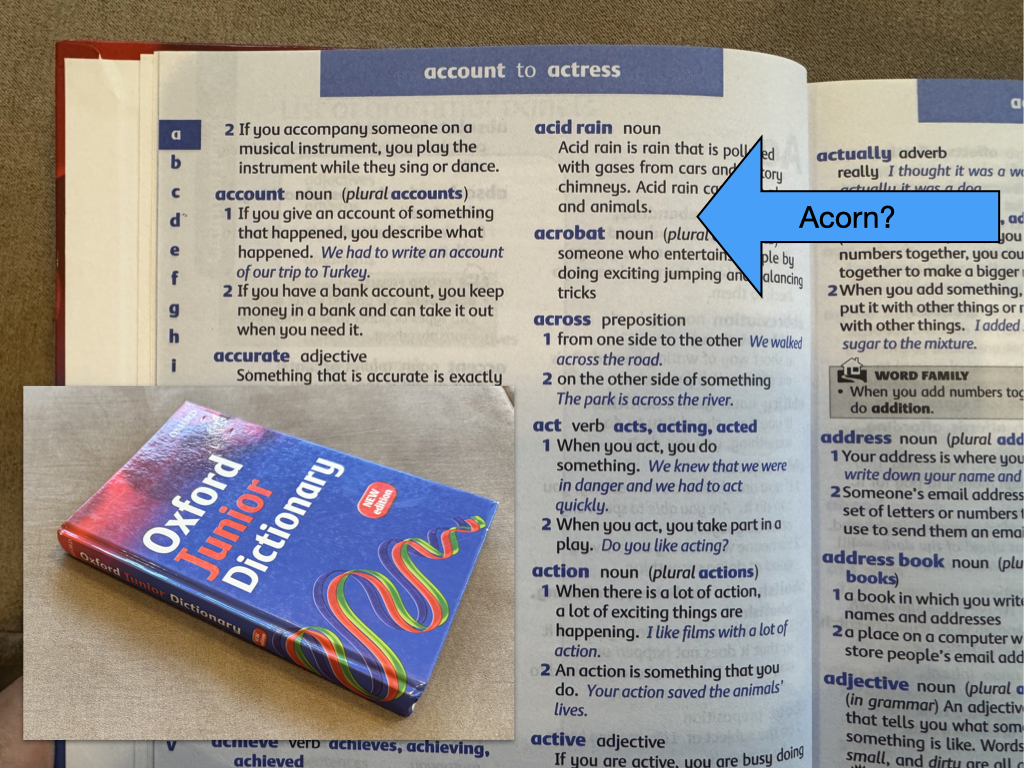
The Lost Words book invites us to recover nature words deleted from the Oxford Junior Dictionary New Edition (2007) (read the story here and here).
“Acorn” removed from the Oxford Junior Dictionary, New edition (2007).
In The Lost Words, Macfarlane describes each of the following creatures, omitted from the dictionary, with a poem:
acorn
adder
bluebell
bramble
conker
dandelion
fern
heather
heron
ivy
kingfisher
lark
magpie
newt
otter
raven
starling
weasel
willow
wren
The “Blessing” is the final song on the album “Spell Songs” (2019) which accompanies the book. They released this video of the creative journey behind the album:
Julie Fowlis describes singing “The Blessing” live (above, top) as “always profoundly moving… I rarely leave the stage without weeping. However, it must be said that Spell Songs live shows are also filled with so much love, laughter and pure joy.” That live version of “The Blessing” is released on “Gifts of Light” (Hudson Records, 2023), performed at Birmingham Symphony Hall. Performers are Karine Polwart, Julie Fowlis, Rachel Newton, Beth Porter, Jim Molyneux, Kris Drever, and Seckou Keita. A Spell Songs II album was released in 2021.
The lyrics to “The Blessing” quote from or allude to the poems in The Lost Words. The Spell Songs and Gifts of Light albums include additional songs about creatures not in The Lost Words. The poems alluded to in “The Blessing” are indicated below, after each line, in quotation marks, e.g., “dandelion” (from The Lost Words), or “Silver Birch” (from Spell Songs II), or “Charm on, Goldfinch” (from Gifts of Light).
Enter the wild with care, my love [bluebell]
And speak the things you see
Let new names take and root and thrive and grow [dandelion]
And even as you travel far from heather, crag and river [heather]
May you like the little fisher, set the stream alight with glitter [kingfisher]
May you enter now as otter without falter into water [otter]
Look to the sky with care, my love
And speak the things you see
Let new names take and root and thrive and grow [dandelion]
And even as you journey on past dying stars exploding [lark]
Like the gilded one in flight, leave your little gifts of light [“Charm on, Goldfinch”]
And in the dead of night my darling, find the gleaming eye of starling [starling]
Like the little aviator, [heron]
sing your heart to all dark matter [lark]
Walk through the world with care, my love [bluebell]
And sing the things you see
Let new names take and root and thrive and grow [dandelion]
And even as you stumble through machair sands eroding [“Thrift”]
Let the fern unfurl your grieving, [fern]
let the heron still your breathing [heron]
Let the selkie swim you deeper, [“Selkie”]
oh my little silver-seeker [“Silver Birch”]
Even as the hour grows bleaker, be the singer and the speaker
And in city and in forest, let the larks become your chorus [lark]
And when every hope is gone, let the raven call you home [raven]
Lament for Lost Words
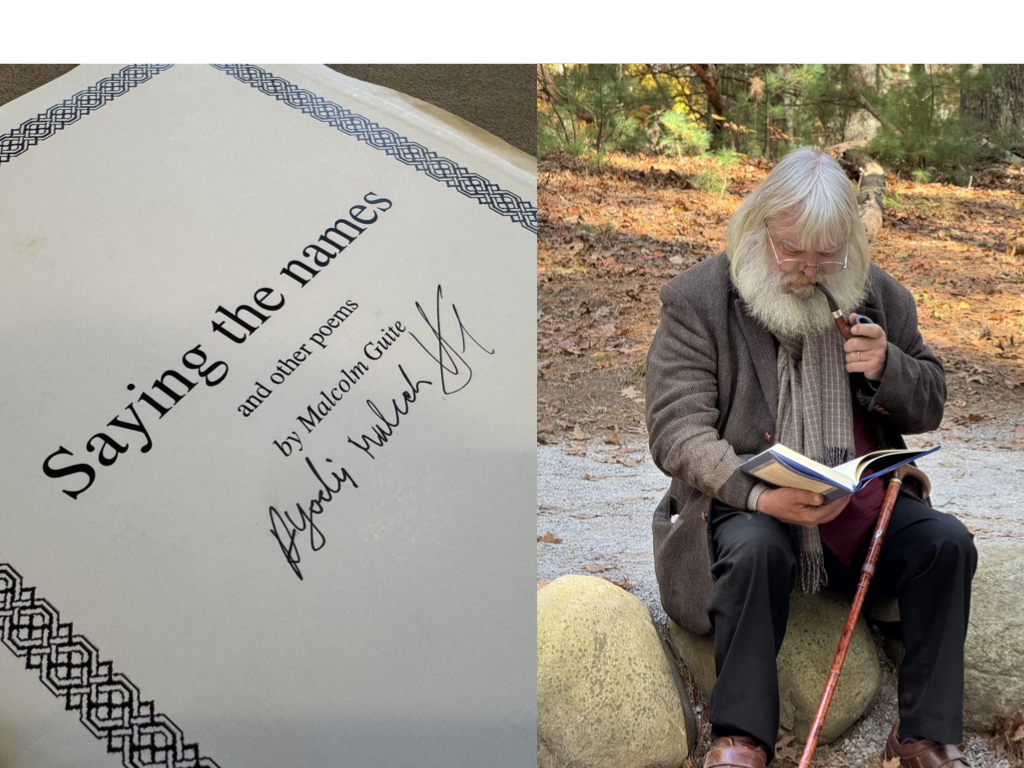
Malcolm Guite has a Spell in the Library episode (2021) devoted to The Lost Words. He reads his poem, “Lament for Lost Words,” which he wrote and sent to Robert Macfarlane after Macfarlane published an article about the lost words (before The Lost Words book was created). Malcolm shows his copy of the book, with a wonderful inscription.
Left: A chapbook of Malcolm’s poetry (2002), with his full name. Right: Malcolm at Walden Pond (October 2026).
With the last line, I cannot help but think of Mr. Raven, the Sexton, in George MacDonald’s fantasy Lilith (1896), who invites the protagonist to enter into the sleep of death and awake to resurrection. For an introduction to Mr. Raven, watch Malcolm Guite, “When a Heart is Really Alive” (the Mr. Raven segment begins nearly 28 mins in). This was the keynote address for the George MacDonald bicentennial gathering held at Wheaton College in May, 2024.
For MacDonald, nature is the storehouse that fills and shapes our imaginations to make it possible for us to apprehend beauty and love, in one another and in God as well as in nature. Not even the gospel makes sense to us if our thought is not first deeply shaped by the forms of nature, which grow out of the very heart of God.
“If the world proceeded from the imagination of God, and man proceeded from the love of God, it is easy to believe that that which proceeded from the imagination of God should rouse the best thoughts in the mind of a being who proceeded from the love of God.” — George MacDonald, “Wordsworth’s Poetry,” A Dish of Orts
Our grandson in the Olympic forest, our friends in the Swiss mountains, our home in the Cross Timbers, the creatures remembered in the Lost Words, and George MacDonald all disclose to us that when we love others as ourselves, we count the creatures of the Earth among our dearest neighbors.
How do we begin to love? Speak and sing their names.
As God has spoken them into being and calls them each by name.
By doing so, we participate in the love of Christ who is the Priest of all Creation.
Speaking the names in love is a practice of anticipating the New Creation. It is a way of entering into the Love of God that is carrying us there.
Update, November 2025: With the above thoughts in mind, Candace and I and Karen Noad led a devotional at the Torrance retreat in Killin, Scotland.Candace
Isaiah 40:26: “Lift up your eyes on high and see: Who created these? He who brings out their host and numbers them, calling them all by name; because he is great in strength, mighty in power, not one is missing.”
Kerry
Oh Lord, you who create all the stars of the heavens, not one is excluded from your love. You see them all and speak their names.
Karen
Psalm 147:3-4:
The Lord heals the brokenhearted,
and binds up their wounds.
He determines the number of the stars;
he gives to all of them their names. Kerry
Oh Lord, you who create the stars of the heavens, you see our wounds and heal us all. You see us all and speak our names.
Candace
“So out of the ground the LORD God formed every animal of the field and every bird of the air, and brought them to the man to see what he would call them; and whatever the man called every living creature, that was its name. The man gave names to all cattle, and to the birds of the air, and to every animal of the field.” (Genesis 2:19-20 NRSV)
Kerry
Oh Lord, you have set us upon this Earth to care for it and all living things, to love them and speak their names.
Our then 18-month-old grandson was touring wild areas of the state of Washington and the Olympic National Forest this past summer with his parents. They sent us adorable photos of him utterly absorbed in watching, looking, touching, learning the names of every created thing. Starfish on the beach, waves upon the shore, the bark of trees in the forest, snow upon the mountains, whales out in the ocean. Our little word-acquirer walking through nature wide-eyed, learning to speak whatever he is seeing. As he grows, he is growing in love for all that he calls by name.
Do you have a child in your life who is learning to speak the names of what he loves around him?
Just a few days ago, we talked with him on FaceTime. He gently caressed our daughter’s cheek, saying Mommy. He reached out his other arm to pat Stephen, saying Daddy. His parents then patted him on the chest, saying Ethan. He gave a sigh of delight and nestled snugly into his mother’s arms.
Speaking one’s name is always a part of what it means to love and be loved.
Karen
Matthew 1:12-16: “Jechoniah was the father of Salathiel, and Salathiel the father of Zerubbabel, and Zerubbabel the father of Abiud, and Abiud the father of Eliakim, and Eliakim the father of Azor, and Azor the father of Zadok, and Zadok the father of Achim, and Achim the father of Eliud, and Eliud the father of Eleazar, and Eleazar the father of Matthan, and Matthan the father of Jacob, and Jacob the father of Joseph the husband of Mary, of whom Jesus was born, who is called the Messiah.”
Kerry
Remember now those you love by quietly whispering their names to God in prayer. Close your eyes if you like. Know that as you speak their names, your love for them is grounded in God’s love for them. You are participating in God’s own love for them. Whisper their names in love…
Someone you love
Family and friends
Those in your church, workplace, and neighborhood
Someone others tend not to see
Someone you know who is poor
Someone you know whose life has been marred by evil
Someone you know who has been abused, oppressed, and suffered trauma
Someone you know who has passed into the communion of saints
Someone who has shaped you but whom you have never met
Some forebear whose name is unknown to you
The face of someone whose name is unknown…
Someone you know who is in need of hope
May God deliver them. May they hear his voice call them by name.God loves them all into being and part of his loving them is also his care for you.
Karen
John 20:13-14: [Mary Magdalene] turned around and saw Jesus standing there, but she did not know that it was Jesus. Jesus said to her, “Woman, why are you weeping? Whom are you looking for?” Supposing him to be the gardener, she said to him, “Sir, if you have carried him away, tell me where you have laid him, and I will take him away.” Jesus said to her, “Mary!”Kerry
Do you hear God call you by name?
Candace
Isaiah 43:1-7: “But now thus says the LORD, he who created you, O Jacob, he who formed you, O Israel: Do not fear, for I have redeemed you; I have called you by name, you are mine.
When you pass through the waters, I will be with you; and through the rivers, they shall not overwhelm you; when you walk through fire you shall not be burned, and the flame shall not consume you.
For I am the LORD your God, the Holy One of Israel, your Savior. I give Egypt as your ransom, Ethiopia and Seba in exchange for you.
Because you are precious in my sight, and honored, and I love you, I give people in return for you, nations in exchange for your life.
Do not fear, for I am with you; I will bring your offspring from the east, and from the west I will gather you;
I will say to the north, “Give them up,” and to the south, “Do not withhold; bring my sons from far away and my daughters from the end of the earth—
everyone who is called by my name, whom I created for my glory, whom I formed and made.”
Kerry
He speaks your name, in love.
When Jesus speaks our names, he brings a new reality into being. As Alan said last night, Jesus reconstituted Simon through speaking his new name. As Bob said this morning, his word is truth. He speaks a dynamic, creative word.
Karen
Matthew 16:17-18: “And Jesus answered him, “Blessed are you, Simon son of Jonah! For flesh and blood has not revealed this to you, but my Father in heaven. And I tell you, you are Peter.”
Kerry
God will address you, too, and give you a new name that is good beyond your boldest imagination.
Candace
Revelation 2:17: “Let anyone who has an ear listen to what the Spirit is saying to the churches. To everyone who conquers I will give some of the hidden manna, and I will give a white stone, and on the white stone is written a new name that no one knows except the one who receives it.”
Kerry
Oh Lord, you who create all the stars of the heavens, we here and now, in the midst of sorrow, are not excluded from your love. Even our darkness is not dark to you. You know our names. You are the God who speaks from all eternity. See us all now, know and behold us, and speak our names. Open our hearts that we might hear when you call, that we might hear you speak our names. For we bear your name. Amen.
Karen and Candace:
Will lead us in singing a slightly revised version of “Fear Not, For I Have Redeemed You,” originally by The Fisherfolk, based on Isaiah 43.