Apple’s core passion

In this 1997 video, Steve Jobs explained that Apple’s

“core value is that we believe that people with passion can change the world for the better.”

Apple was in a very dark, troubled time when Jobs returned. Yet because of the difference the Mac made for my life as a university science teacher, a planetarium educator, and as a graduate student, I was still a believer in 1997 that Apple enabled ordinary people to change the world for the better. Indeed, until it grew threadbare, I proudly wore a t-shirt won in an Apple-sponsored contest that said, “Come help change the world.”

This video records the occasion when Jobs unveiled the “Think Different” ad campaign.

Here’s a better quality version of just the “Think Different” ad:

And here’s the text:

Here’s to the crazy ones.

The misfits.
The rebels.
The troublemakers.
The round pegs in the square holes.

The ones who see things differently.

They’re not fond of rules.
And they have no respect for the status quo.

You can praise them, disagree with them, quote them,
disbelieve them, glorify or vilify them.

About the only thing you can’t do is ignore them.

Because they change things.

They invent. They imagine. They heal.
They explore. They create. They inspire.

They push the human race forward.

Maybe they have to be crazy.

How else can you stare at an empty canvas and see a work of art? Or sit in silence and hear a song that’s never been written? Or gaze at a red planet and see a laboratory on wheels?

We make tools for these kinds of people.

While some see them as the crazy ones, We see genius.

Because the people who are crazy enough to think they can change the world, are the ones who do.

Bondi blue iMac, 1998This ad reflected precisely the way I felt about Apple at the time. It rallied the Macintosh community, and saved the company by giving Jobs enough time to develop the Bondi blue iMac.

That gorgeous machine, introduced in 1998, disrupted computer manufacturing with three revolutionary characteristics:

  • human-friendly design (sensuous shape and translucent color – good-bye square beige PC boxes! Translucent colored plastics later showed up in manufactured items as far removed from computers as clothing irons and hand tools)
  • exclusive adoption of USB (good-bye SCSI and ADB; and because USB united power and data for peripherals, good-bye cable clutter)
  • shift to the internet for file exchange (the “i” in “iMac” stood for “internet”; good-bye floppy disks!)

Our Bondi blue iMac – which still works and adorns our living room – enabled me to finish my graphics-intensive dissertation by drastically reducing the amount of time I spent waiting on Photoshop for each image manipulation. The box it arrived in declared: iMac, therefore i Am.

Over the last dozen years since this video was recorded, Apple has indeed changed the world again. By maintaining a laser focus on the same core passion, Apple’s innovation with Mac OS X, iPod, iPhone and iPad has been singularly disruptive. Apple continues to make us “think different.”

—–

Update: Rob Siltanen, The Real Story Behind Apple’s ‘Think Different’ Campaign

Posted in Apple | Tagged | 7 Comments

Liturgy vs. worship

Celtic Daily Prayer, a contemporary liturgy for daily community lifeOn Sunday morning, Mark Robinson showed “Sunday’s Coming” Movie Trailer to make two points:

  • Every church has a liturgy, even “contemporary” ones like Wildwood
  • Liturgy is not the same as worship

I love this video! It shows that the liturgy we practice (traditional or contemporary) is not the point. Rather, real worship is about God and not about us.

Our worship manifests the grace of God who has lifted up all humanity in the resurrection of Christ. By lifting him up in worship, we are healed as his Spirit comes among us and as his Spirit joins us together in Christ. Worship is thus his act, in which we participate. As Alan Torrance says, “Worship is the gift of participating in the incarnate Son’s eternal communion with the Father.”

What’s amazing is that God desires us to join in his communion:

“But the hour is coming, and is now here, when the true worshipers will worship the Father in spirit and truth, for the Father is seeking such people to worship him. God is spirit, and those who worship him must worship in spirit and truth.”” (John 4:23–24)

Posted in Theology | 2 Comments

Rivendell, 1 year

When I first read The Lord of the Rings I dreamed not of visiting Rivendell, but of living there. One year ago today, August 9, 2009, we moved into a new home that is my Rivendell. I’m like Bilbo, a perpetual visitor.

Our home:
Our home

Some of our movers!
Some of our movers!

Now we have completed our first cycle of seasons in this place, and we have rejoiced in each one: the turning of autumn leaves, the soft falling of winter snow, the renewal of spring and the passing of summer. I am astonished to be here.

Bench in fall

Bench in winter

Bench in spring

Each morning I nearly burst with wonder and gratitude as I walk out of my bedroom. I step down into the soft carpet of the library and music room, then walk across the cherry wooden floor of the dining room, either straight to the kitchen or I detour through the large family room, with more windows than walls, for my first glimpse of the morning light. A vista reveals an expanse of sky behind the flight of passing birds. Flowers nearby open to the forest beyond. Here, nature beckons. This place of ever-changing beauty is our home. I thank God for bringing us here.

Hannah in the swing

This home is Rivendell most of all because of the people who come. Thank you to the dozens of people who helped us move in! Thank you to the many more who have traveled this way! Thank you to so many more who have shared meals with us here! Thank you, all who have in these and diverse other ways joined your lives with ours here in this place. Family… close friends… strangers who became friends… – these many faces, more than I can easily count, are the most cherished memories of the past year.

People

This has been a safe house for sharing deep sorrows. And a place for comfort and healing, renewal and hope, wisdom and laughter. By God’s grace, this home has witnessed overflowing joy and vibrant friendship in its first year.

There is peace in this place.

Come visit; you are welcome here.

Gallery (click the first photo, then the right arrow to advance, with captions).

—–

Grant them peace, most precious gift of all
Keep the worried world far away and small
When they return, may quiet fill their souls,
Dearest Lord, keep them safe within its walls.

Fernando Ortega, Prayer for Home Prayer

Posted in Family | Tagged | 5 Comments

A mighty book

“To produce a mighty book, you must choose a mighty theme. No great and enduring volume can ever be written on the flea, though many there be who have tried it.”

Herman Melville, Moby Dick, ch. CIV.

—–

Below: Robert Hooke, Micrographia (London, 1665), fold-out plate of a flea. View Hooke’s Micrographia in its entirety in the Collections’ image galleries.

Posted in Book quotes, History of Science | Leave a comment

Reading old books

“There is a strange idea abroad that in every subject the ancient books should be read only by the professionals, and that the amateur should content himself with the modern books…. The student… feels himself inadequate and thinks he will not understand…. But if he only knew, the great man, just because of his greatness, is much more intelligible than his modern commentator. The simplest student will be able to understand, if not all, yet a very great deal of what Plato said; but hardly anyone can understand some modern books on Platonism. It has always therefore been one of my main endeavours as a teacher to persuade the young that first-hand knowledge is not only more worth acquiring than second-hand knowledge, but is usually much easier and more delightful to acquire…. It is a good rule, after reading a new book, never to allow yourself another new one till you have read an old one in between. If that is too much for you, you should at least read one old one to every three new ones.”

C. S. Lewis, “On the Reading of Old Books,” preface to Athanasius, On the Incarnation.

—–

Above: First page of The Republic from the first Estienne edition. Plato, Opera (Geneva, 1578), 2 vols. The standard practice for citing passages in Plato is based on the pages and line numbers of this edition. You can read this and many other old books in the OU History of Science Collections.

Posted in Book quotes, History of Science | Leave a comment

Song for the day

All we need to know about the iPhone 4 antenna “problem”:

The take-home point is in the last sentence – so short it’s easily missed.

Who is this guy? Jonathan Mann writes a song every day and posts a video of it to YouTube. What fun! Of course, my cool nephew is also named Jonathan Mann, so judging from this enlarged sample pool, it’s obvious that people of that name are immensely talented and creative.

Since Steve Jobs showed this video during the Apple press conference yesterday, Jonathan’s back with another video today about Jobs himself:

This one I ought to categorize under theology as well as Apple… Very appropriate, and very funny!

Here’s one more that explains why penguins love their iPods:

If these three videos are at all representative, Mann’s work possesses simple but surprising artistry, in conception, composition and production. He makes it look natural. Impressive, and… Hilarious!

You can follow Mann’s Song a Day on facebook or twitter. You can buy his songs from his website: Antenna Song, Jobs and Penguins Having A Party. A selection are also available on Jonathan.

Posted in Apple | 3 Comments

Life Metaphors: Music (2, Time)

Theology, Music and Time
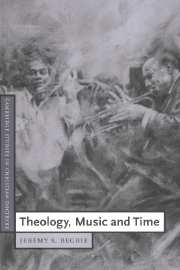
If my life is a song, I have much to learn about it from music. The previous post in this series (Life Metaphors: Music, Part 1) explored the power of music to resurrect the past and make it coinhere with the present, using Robert Siegel’s Whalesong as a point of departure. In this post I want to reflect on the same theme, from the viewpoint of Christian theology.

That we can learn much about life from reflecting upon music is explored by Jeremy Begbie, Theology, Music and Time (Cambridge University Press, 2000). Reading Begbie alongside Whalesong is an ideal way to keep the imagination and intellect in tune, avoiding the imagination deficit disorder. The one reinforces and deepens the other.

In this and the next couple of posts, I’ll mention three ways that music teaches me something about my experience of life: to live in time, to live in hope, and to live in inexhaustible grace. Although I touch upon these themes in a personal way, Begbie explores the theological implications of music with profound insight as a professionally-trained musician and theologian. I am neither, but these reflections profoundly affect my view of life.

Live in time

First, my experience of music shows me how to live in time. I wrote before that music can help wrest us free from the stranglehold of the present. I remember what an enchanting pull I once felt, while an adolescent, for the existentialist ideal of living solely in the NOW. Ralph Waldo Emerson exclaimed,

“With the past, I have nothing to do; nor with the future. I live now.“

I would never detract from the kernel of wisdom behind Emerson’s words that one must repudiate the tyranny of the past and the future, consciously attend to the present, and experience each moment as fully as possible. Before we know it, we will turn around and want these moments back. Living in the present means that I savor each moment, and then willingly let it go, embracing change by welcoming the next moment as it comes. In contrast, to hold on to the past, to refuse to let it go, would be to deny the reality of the present. Similarly, to live in the future, refusing to experience the present, would cause me to miss out on the reality of a present hope. In that hope we have confidence that both past and future are being redeemed. So I learned a profound truth from the existentialist affirmation that we live now.

Kansas, LeftovertureAs an adolescent, I indwellt the albums of Kansas as they came out from 1975 to 1979 (Masque, Leftoverture, Point of Know Return, and Monolith), listening to them more than any other group, and felt a soul kinship with their main songwriter Kerry Livgren. Their journey was my journey; their music the music of my life. I will never forget the first time I heard Livgren’s “Dust in the Wind,” I listened spellbound, riveted against a wall, by the end slumping toward the floor. As Kerry Livgren wrote, in this devastatingly beautiful song: Dust

Don’t hang on, nothing lasts forever but the earth and sky
It slips away, and all your money won’t another minute buy.

Thus to release the past and welcome the future willingly, without hanging on, is to participate in the rhythm and music of life, to accept our nature as finite creatures moving within a greater temporal reality.

This sense of time’s fleetingness is what Begbie calls a “fruitful transience” (p. 92):

“Music depends heavily for its meaning on finitude at every level. Tones give way to tones. Music is constantly dying, giving way. The next tone in the plainsong melody can only come if the last one is not sung. Musical continuity emerges from transcience, from the coming into being and dying of tones, for in this way and only in this way can their dynamic qualities be sensed. The fact that music never solidifies or coagulates to form a thing or substance is critical to its intelligibility.”

Yet Emerson’s manifesto asserts more than this, as if the energy of life were exclusively concentrated in the now. Contrary to Emerson’s actual words, the now as we experience it in music does not exclude the past and the future, but rather gathers them up in a relationship of “coinherence” (more on this below). If taken literally, Emerson’s statement entails a disintegration of temporal reality, a splitting apart of the past, present and future. This split diminishes the reality of the present by subtracting the coinherence of the past and future.

“Dust in the Wind” reflects this split as well, where all that is has contracted into the present moment:

I close my eyes, only for a moment, and the moment’s gone
All my dreams, pass before my eyes, a curiosity
Dust in the wind, all they are is dust in the wind.

In a supreme paradox of existentialism, the futility of these despairing words is decisively contradicted by the very musicality of the song. This work is a masterpiece of despair precisely because of that contradiction. It is a hope against hope, as the piercing longing for coinherence awakened by the music compels one to protest that “dust in the wind” cannot be the last word.

Indeed, like Emerson’s manifesto, “Dust in the Wind” is a powerful example of an insidiously deficient sense of temporal reality.

We are led astray if we have learned from mathematics that the present is a moving point on a timeline, or from physics that a single moment is a solitary tone from an oscilloscope. If we visualize our lives as a timeline where the past and future are separated by the present, we tend to think of the present merely as a geometrical point. If reality is equated with the present, infinitesimally small, the now so conceived rapidly approaches a vanishing point. This reduction of reality and the concomitant disintegration of personal identity is one part of the narcissism of our culture, described with arresting clarity by Christopher Lasch.

Yet our experience of music rescues us from this impoverished view of life as if it were a mathematical point, the now, moving along a time-line so that only the now is real at any given moment. Rather, in music it is clear that there is so much more to reality than the present moment, even if we close our eyes. As we listen to “Dust in the Wind,” for example, at any given moment we experience the import of the past and the anticipation of the future, so that the now is totally other than a solitary note. The experience of music is a powerful demonstration of the way our lives transcend the present, of how our experience of the now involves a real presence, a coinherence, of both past and future. Begbie explains (p. 62):

“If we are in the second phase of a two-beat wave, because of the hierarchical nature of metrical waves, in every instant of the existence of ‘two,’ the ‘one’ is also, in a sense, contained as the partner; ‘two’ is the symmetrical completion of ‘one.'”

When a beat is over, or a note ceases its sound, that moment has not passed from before our eyes like dust in the wind. Hearing a melody is to experience the what is, what was, and what is to come, all at once, coinhering in an enlarged, dynamically-changing now. An atomistic linear model, consisting merely of isolated points on a timeline, cannot account for this. Rather, the present, past and future interpenetrate and coinhere with one another in an inter-related, holistic reality. Begbie (p. 62) quotes the musicologist Victor Zuckerkandl:

“In a melodic succession of tones there is a ‘carrying from’ and a ‘reaching beyond’ sensed through each present: ‘past and future are given with and in the present and are experienced with and in the present; hearing a melody is hearing, having heard, and being about to hear, all at once.’ ‘To a great extent the problems posed by the old concept of time arise from the fact that it distinguished three mutually exclusive elements, whereas only the picture of a constant interaction and intertwining of these elements is adequate to the actual process.'” (Zuckerkandl, Sound and Symbol, 1956, pp. 175, 228.)

The physicist’s simple oscilloscope, like the mathematician’s timeline, similarly misleads us. A single tone from an oscilloscope discloses nothing to the physicist of the dynamic way we experience the full temporality of music. We no more experience life as a moment in abstraction than a song as a single note, devoid of rhythm, harmony, tempo, texture and mode. Our experience of music shows us that the past and the future are not insubstantial. Now we see that history is real. A view of the present cut off from the past and future is radically deficient. Time is not a mirage or illusion. Music shows us how to embrace a full temporality, a now that is not cut off from the past, and in which the future already has begun.

The reality of coinherence in our experience of life is thus disclosed to us by our experience of music. Hruna might need all night and day to sing his whalesong, yet throughout the song, his past acts as a real presence in a dynamic movement toward an already-becoming future. No wonder, as noted in the last post, that the music of past moments in our lives still has the potency to awaken us to a personal identity which is far from being confined exclusively to the present, but rather in which the past coinheres in a full temporal reality.

Next: Live in hope.
Posted in Art-Music-Lit, Theology | 9 Comments

Longitude at Sea: J.T. Mayer (1770)

Originally posted at ouhos.org, the now-discontinued blog of the OU History of Science Collections. Neither this post nor any of its content should be taken as an official communication of the University of Oklahoma.


Recent acquisition: Johann Tobias Mayer, Tabulae motuum solis et lunae novae et correctae … Quibus accedit methodus longitudinum promota … editae jussu praefectorum rei longitudinariae. Edited by Nevil Maskelyne. London, William and John Richardson, 1770. 4to, pp. [viii], 89, [6], 92-136; CXXX, [2]; a fine copy in contemporary calf. First edition.

In her best-selling book, Longitude, Dava Sobel recounts how an Act of the British Parliament in 1714 established a Longitude Prize of up to £20,000 to be awarded to anyone who could discover a method of determining longitude at sea. Like many other prize-seekers, J.T. Mayer believed the answer would lie in the stars, so that a more accurate calculation of lunar and solar positions would enable sailors to fix their location at sea.

Mayer’s lunar and solar tables attained an accuracy of ± 1’, so in 1755 he submitted them to the Admiralty in hopes of winning the prize. Although Mayer failed in that attempt, after his death in 1762, Mayer’s widow resubmitted them to the Board of Longitude, which awarded her a prize of £3,000.

Sobel explains that the solution to the longitude problem came from a different angle: the craftsman John Harrison invented a clock of impeccable accuracy which, since it did not rely upon a pendulum, could survive the worst conditions at sea.

Mayer’s posthumously published tables were used to compute the lunar and solar positions in the early editions of The Nautical Almanac of Greenwich Observatory.

The OU copy of Mayer (1770) belonged to the Earls of Macclesfield, Shirburn Castle, as indicated by an engraved bookplate, a shelfmark on the front pastedown, and a blindstamped Macclesfield crest in the blank margins of the first three leaves.

View Mayer (1770) gallery.

Posted in History of Science | Leave a comment

Life Metaphors: Music (1)

Whalesong

In my first post on Life Metaphors, I observed that seeing life as a journey, a song or a dance is to affirm the presence of lasting meaning in the midst of change. Countless songs liken our experience of life to music. We can all think of many examples (e.g., Arlo Guthrie, “You are the Song” You). But my favorite exploration of this metaphor is an utterly beautiful story about:

“Hruna the humpback whale and his journey into love, mystery, and spiritual awakening in the waters of the world.”

whalesong.jpgThat is how one blurb introduces Whalesong, by Robert Siegel. This book was one of our favorite family read-alouds when our daughters were young (along with Siegel’s other masterpiece, Alpha Centauri). In this skillfully-written and delightfully-crafted tale, Siegel portrays the song of a humpback as its ongoing life-story, a continually growing composition that recounts the events in a whale’s life from birth to death:

“Every whale would stick to his song and repeat it faultlessly. The longer he lived, the longer and more complex the song grew. Sometimes he would sing only a few notes from it, but later he would pick up exactly where he left off. As the years passed, the song grew with the singer until many lasted for hours. We calves only made short whistles and squeaks which grew longer with the months, but we waited impatiently for the day when each one would sing his unique song.”

Whalesong, an epic counterpoint to Melville, is a tale of life as music. While a young calf, Hruna described his mother’s song:

“Each whale had his own song, but none, I thought, equal to my mother’s. Hers lasted a long while, begining with a soft croon to which I’d sometimes fall asleep. Soon, however, it changed into trilling whistles like birds skipping about on a barnacled back or water that leaps and dances down a cliff, then to a long shivery moan that probed every sea cavern between us and the ice at the end of the world. This moan stretched and bent in every direction, sometimes higher, sometimes lower, and was the sweetest sound I’d ever listened to. Sometimes it reduced me to tears – I don’t know why…”

Interlude: Listen to the Kalama Lullaby (mp3) whalesong. Kent Noonan explains:

“Another time I saw a large male singing while I recorded nearby. He was slowly swimming in a large circle under a mother and baby. He went in a circle perhaps 100 yards across at a rate of about 15 minutes to go around it, about 50 to 100 feet down. This is the recording I call “Kalama Lullaby” because it seemed he was making a cradle of sound for the mother and baby to feel protected in, while they snuggled on the surface in the sun.”

Whalesong is so compelling because it demonstrates the power of music as a metaphor for life. The song of Hruna powerfully embodies how our lives are inextricably related to music.

It is no surprise, then, that music moves us profoundly at significant moments in our lives, nor that the experience of hearing a long-neglected song can resurrect a past experience in a most vivid way. A few of my own musical memories, just off the top of my head, would be:

  • Attending a Stephen Foster concert in my teens, keeping my eyes closed the entire time (indeed, never even seeing the outdoor ampitheater). My memory of that event is particularly vivid, just because it is exclusively auditory rather than visual.
  • Kansas. Kansas
  • Candace singing “The Lord is My Shepherd” to me, accompanied only by a flute and a red-winged blackbird, at our wedding.
  • Michael performing “Season Suite” for us at our wedding.
  • Our children’s’ favorite lullabies, such as “Snows are Falling on Douglas Mountain,” “Morningtown Ride,” or the Sleep Sound in Jesus CD (which is now a frequent baby shower gift Sleep ).
  • A lyrical worship dance of Michael Card’s “Simeon’s song” at our daughter Hannah’s baptism ( Now ).
  • Singing Priscilla Herdman’s “First Lullaby” (mangling the French and all) to Susanna when I held her – minutes old – in the delivery room.
  • Julie’s exuberant piano rendition of “Come Thou Fount,” which has become a theme song for reunions and other family gatherings through the years.
  • Candace and our daughters singing through the years; especially at Laura’s wedding, at Christmas and Easter services, and at Candace’s father’s memorial service.
  • Our favorite Christmas albums, listened to during homeward travels each year (Precious Child, John McCutcheon, George Winston, Bruce Cockburn, John Michael Talbot).

All of these and more, with a plenitude of clicks, short whistles, squeaks and moans, are part of my own whale-song.

(More on humpback whales and their songs.)

Postsript: One of the most beautiful stories I’ve ever heard about the power of music to resurrect the past and make it coinhere with the present is an NPR story, “Who is singing me lullabies?” by Oliver Sacks. The recording conveys the story much better than the article, because the audio suggests something of the Irish lullabies. Listening to this story is like listening to Whalesong; if you enjoy one, you’ll enjoy the other.

Next: Part 2: Theology, Music and Time

Posted in Art-Music-Lit, Theology | Tagged | 5 Comments

Books speak of books

“Now, I realized that not infrequently books speak of books: it is as if they spoke among themselves. In the light of this reflection, the library seemed all the more disturbing to me. It was then the place of long, centuries-old murmuring, an imperceptible dialogue between one parchment and another, a living thing, a receptacle of powers not to be ruled by a human mind, a treasure of secrets emanated by many minds, surviving the death of those who had produced them or had been their conveyors.”

Umberto Eco, The Name of the Rose

Posted in Book quotes, History of Science | Tagged | Leave a comment

Really simple explanation of really simple syndication (RSS)

Originally posted at ouhos.org, the now-discontinued blog of the OU History of Science Collections. Neither this post nor any of its content should be taken as an official communication of the University of Oklahoma.


Basic idea

Are you drinking the Internet from a fire-hose? Do you try to keep track of more websites than you can remember off the top of your head? Do you feel like you’re wasting time checking to see if a website has posted anything new? If so, you can keep up with the web more effectively, instead of wasting time, by using an RSS reader.

An RSS reader “aggregates” or combines information from various sites to let you know in a single glance which websites have been updated since the last time you checked. You set your RSS reader to display headlines of new posts on the websites you monitor, or to display excerpts or entire articles (if allowed by the website). With one click, you can move from the RSS reader to the original website – once you know there is something new you wish to view.

An RSS reader informs you in a timely way when new content appears on the websites you monitor. No more wasted clicks just checking to see if anything worth seeing is there. This is why Oprah calls RSS “Ready for Some Stories.”

There are two steps to get started using an RSS reader:

  1. Choose an RSS reader. (See examples below.)
  2. rss_28.gifSubscribe to the news websites and blogs that you wish to follow in your RSS reader. One way to subscribe to any web page is to click an orange RSS icon that appears on many pages.

—-

Get started

Here’s a video explanation of RSS “in plain English” that shows how to subscribe to your favorite news websites and blogs using Google Reader as an example.

To keep it simple, just to get started, we’ll recommend three free RSS readers:

  • Bloglines (probably the most popular online reader)
  • FeedDemon for Windows (stand-alone app)
  • NetNewsWire for Mac, iPad, and iPhone (stand-alone app, syncs between devices)

Once you become accustomed to the utility and convenience of one of these basic readers, then you can explore the countless other RSS reader apps until you find one with just that combination of features that is right for you.

1. Use an online reader if you access the web from many different machines, not all of which are your own. In addition to Bloglines, other popular online or web-based readers are:

In addition, modern web browsers (e.g., Firefox and Safari) directly support RSS reading in the browser as “live bookmarking,” without requiring an additional reader website.

2. Use a stand-alone RSS reader if you prefer to read offline at times; if Google’s privacy issues concern you; or if you prefer the efficiencies of a stand-alone app. Stand-alone apps can sync between various devices, so you can have your feeds with you on the go, much like a web app, so long as you own the different devices. Another potential advantage of a stand-alone reader is that it preserves the page on your desktop for access even if the website goes down or if a post is retracted, as well as when you are offline (e.g., a stand-alone reader offers a great way to catch up with websites you can’t read every day the next time you’re on a bus, train or airplane). There are hundreds of stand-alone RSS readers, including FeedDemon and NetNewsWire.

Get started with FeedDemon or NetNewsWire:

Explore the FeedDemon website for tips and instructions. The website includes a forum section and a blog.

Explore the NetNewsWire website for tips and instructions. The website includes forums, a FAQ and a blog.

To subscribe to an RSS feed for any particular website, first go to the preferences of your RSS reader or web browser to set NetNewsWire as your default RSS reader. Then go to any website to which you wish to subscribe, and click an RSS, Atom or XML button on the website. Tip: Safari identifies websites that offer an RSS feed by displaying a blue RSS icon in the address field; just click that blue RSS icon and you will automatically be subscribed to that website in NetNewsWire.

Once your subscribed sites are listed in NetNewsWire, press the spacebar in NetNewsWire to jump to the next unread article. You can read it in within NetNewsWire, or press return to switch to your web browser and automatically load the article on the website.

Posted in History of Science | Leave a comment

Imagination Deficit Disorder

Back in 1987, Hal Pendergrass offered some of the best advice I have ever received about reading imaginative literature along with nonfiction:

“Dear Kerry –

It’s not healthy to forsake good imaginative literature while you’re studying science or theology – as I’m sure you believe. So I don’t think it’s foolish for me to drop some more reading on you in the thick of your doctoral studies. No one, I believe, can read Chas Wms and walk away unchanged – for the good. As far out & wild as his imaginative images get, the end effect is to make the presence of God more vivid & concrete in day to day living. In this respect, he is CS Lewis squared, or cubed. I hope it does for you what it did for me.

Merriest of Christmases to you, Candace & adorable Rachel –

Hal”

When he gave me that copy of All Hallows Eve, by Charles Williams, it was my first introduction to this lesser-known member of the Inklings. During my graduate program I followed Hal’s suggestion, and ended up reading most of Williams’ 7 novels and a little of his non-fiction. In an interesting confirmation of Hal’s advice, I found Williams’ novel The Place of the Lion an invaluable window into the archetypal thinking of 19th-century Platonist natural philosophers. Without Williams, for example, I would never have understood Richard Owen. But Williams is so much more.

What Hal and Williams both understood is that the vigorous exercise of the imagination is anything but a flight from reality. Rather, imagination is a faculty of perception, apart from which one’s only grasp of reality becomes grotesquely deficient. A failure of imagination is a far more serious affliction than being color blind to the world and misperceiving only the surfaces of things; for imagination grasps the way things really are. Imagination is the fountain of all art and science. Without imagination we perish. All Hallows Eve, with its introduction by T.S. Eliot, reinvigorates the imaginative faculty.

It has been a long time now since I’ve read Williams, although my thoughts often return to him. Yet I have made it a habit to follow Hal’s sage advice about coupling imaginative literature with non-fiction reading. Maybe that’s why I now find that reading George MacDonald, Lord Peter or Barry Lopez provides an ideal complement to reading Torrance, Darwin, or the latest historical monograph in my field. If I go too long without the former, my appreciation of the latter unjustly dulls. Anyone seeking shock therapy to cure the imagination-deficit malady might as well start with Williams.

Thanks, Hal!

Posted in Art-Music-Lit, History of Science | Tagged | 7 Comments