Wikipedia: Ready reference vs. Research literature

Originally posted at ouhos.org, the now-discontinued blog of the OU History of Science Collections. Neither this post nor any of its content should be taken as an official communication of the University of Oklahoma.


Why do we use Wikipedia? Should you?

In this blog and elsewhere I frequently link to Wikipedia for background information on an author or topic in the history of science. This practice is subject to some controversy, at least in certain classrooms and academic institutions. (On this website, I mark links to external websites with a special icon () to distinguish them from OU links.)

To explain why I use Wikipedia so frequently, let’s begin by distinguishing between sources appropriate for original research and the use of Wikipedia as a ready reference.

First, external links should not be taken as an endorsement of the content you find at Wikipedia or any other external website. Wikipedia articles are of markedly uneven quality, and even when Wikipedia is at its best, there is a difference between setting context with background knowledge (where a general, non-professional source like Wikipedia is appropriate) and conducting actual research in the history of science. For the latter, reliable professional secondary sources are required such as you will find with the aid of reference works like the Isis Bibliography for the History of Science, the Dictionary of Scientific Biography, and other reference resources. We link to Wikipedia for background knowledge; we will point you to reliable professional sources when you are doing research.

Undergraduate students: Be aware of the following deficiencies in Wikipedia:

  • Because articles are not signed, the qualifications of writers are unknown.
  • Because Wikipedia allows no original research, articles contain a preponderance of factoids and lack rigorous interpretative context.

These two deficiencies cause many professors to prohibit its use for research purposes.

After 16 OU students turned in final papers for the Spring 2006 semester that were plagiarized from Wikipedia, OU Assistant Provost Greg Heiser cautioned that “the problem with using Wikipedia for research papers is that it stunts a student’s ability to do research. ‘Doing good research is hard, but it is an important skill to master…. It’s almost like thinking you know how to cook because you can get to the nearest McDonald’s.” (Gene Perry and Jarrel Wade, OU Daily, August 31, 2006.)

In a daily newspaper, you expect the articles to present the facts. When you want analysis, you turn to the Editorial and Opinion pages where contributions are signed by known writers who take responsibility for their views. Think of articles from encylopedias like Wikipedia as the former. Original research is like the latter.

Again, most professors will not count articles in Wikipedia as reliable sources for assigned class research papers, for two reasons:

1. Articles that fail to provide author names provide no way of assuring responsibility nor of confirming that the writer possesses direct, first-hand knowledge of the primary sources. In contrast, Wikipedia articles may have been written by someone with far less knowledge than the average student in your classes this semester. Keep in mind as you read any particular article that it might have been written by someone you knew as a not-very-conscientious classmate back in Middle School. Anyone may contribute to Wikipedia; no special qualifications are required other than a self-confidence that may or may not be warranted. Articles may be written by people with little or no expertise. And even when articles are accurate they may not be balanced: some contributors may write with passion for a particular point of view that may not reflect a general consensus of professional opinion.

2. Take to heart the factoid character of Wikipedia, due to the lack of the most current interpretative contexts. This deficiency is due to Wikipedia’s editorial policy of allowing no original research. This is not a criticism of Wikipedia so much as a clear statement of its aim, which should be respected. Wikipedia is not intended to answer every question for every purpose. What this boils down to is that Wikipedia will be of greatest use when you’re looking up matters of fact, on which a consensus among anonymous contributors is easily reached (for example, “In which years did George Washington serve as President?” or “What are the differences between the 802.11a, 802.11b, 802.11g, and 802.11n wi fi specifications?”). On the other hand, Wikipedia is ill-suited to resolve more complex, perspective-dependent questions, particularly those for which definitive answers do not exist and on which an assorted collection of anonymous authors are not likely to agree (e.g., “What were Theories of the Earth?” or “What was the origin of Greek science?”). In the latter case, Wikipedia articles offer, at best, dispassionate summaries of almost up-to-date interpretations. See this illuminating report of how difficult it can be to revise Wikipedia according to current scholarship: Timothy Messer-Kruse, “The Undue Weight of Truth,”, The Chronicle of Higher Education (February 12, 2012).

Wikipedia remains useful for obtaining general background information as a springboard for research (it is not a substitute for research). It is easily accessible, and often the most informative ready reference on the web. Consult it to get your bearings, but then guide your actual research by relying upon the professional literature. Go beyond where Wikipedia leaves off. At a bare minimum, independently verify anything you use from Wikipedia. And as always, if you use it, cite it.

Graduate students: You’re well aware of Wikipedia’s problems with inaccuracy, one-sidedness, and outdated perspectives, so when you see pages that are grievously misleading, why not invest a little of your time trying to improve them? And why not make it a group project with your friends or a class project with a professor? Why not incorporate group activities to improve Wikipedia into class assignments for undergraduates? If you show your students how to leave their mark on Wikipedia, you will inspire them to change the world.

Discussion:

  1. What is plagiarism? Do you think it’s easier to inadvertently plagiarize from Wikipedia than from printed sources? If so, why?
  2. “He says that research is like an Editorial or Opinion page! That’s odd!” How would you reply?
  3. Which limitations of Wikipedia affect your research most?
  4. What editorial policy of Wikipedia guarantees that you can always find some other source to use instead?
  5. Read the article by Messer-Kruse at The Chronicle of Higher Education. How does it illustrate some of the weaknesses of Wikipedia’s editorial policies when it comes to using Wikipedia as a source for basic research in the humanities?

Read more:

Posted in History of Science | Leave a comment

Thank you, from a Bücherwurm

When I finally completed my doctoral dissertation, after many long delays, my parents and sisters celebrated the occasion by giving me a handsomely framed print of Der Bücherwurm, painted by Karl Spitzweg in 1850. I think they were greatly relieved that I finished the degree before I came to look exactly like this! Laura even gave me a Der Bücherwurm tie. The print hangs in my office, and I often wear the tie when I need to look “curatorial” at special events.

Now I am on my way to being more like him, it seems, because as of July 1, 2010, I have tenure. It’s been a long time coming, given that my years at OBU were not counted, and my first several years at OU were not tenure-track. But someone didn’t get the memo, and on Thursday of this past week my position became that of a tenured associate professor.

Spitzweg’s painting pokes gentle fun at a scholar with his nose pressed so closely into the printed page that he has forgotten the world around him. Oblivious, he perches high on the ladder in the Metaphysik section of the library, clutching four books at once, scarcely realizing what a precarious position he is in, much less that he is about to lose his handkerchief. These books look much like the ones I work with practically every day.

A few years ago I had the delight of visiting an old library somewhat like this one, at the Strahov monastery in Prague. Although I was able to spend some time in Bavaria two years ago, I have not yet seen Spitzweg’s original painting, which is held by the Museum Georg Schäfer in Schweinfurt, Germany.

Mother, Dad, Julie, Laura: thanks so much for this print, and tie, and for believing in me when the ladder seemed far too tall to climb.

Now that I’m here, I’ll do my best to share these treasures with the world around me.

Posted in Family | Tagged | 5 Comments

Earliest published microscopic study

Originally posted at ouhos.org, the now-discontinued blog of the OU History of Science Collections. Neither this post nor any of its content should be taken as an official communication of the University of Oklahoma.


Galileo’s Sidereus nuncius (Venice, 1610) created an international sensation as the first published record of observations made with a telescope. Yet many people do not realize that Galileo was also involved with the first published record of observations made with the microscope.

In 1616 Galileo was silenced on Copernicanism, but he bounced back with gusto in 1623. In that year his supporter and friend, Cardinal Maffeo Barberini, a former patron of the Academy of the Lynx and uncle of Cardinal Francesco Barberini , became Pope Urban VIII. The election of Barberini seemed to assure Galileo of support at the highest level in the Church. A visit to Rome confirmed this.

The Apiarium (Rome, 1625) was a gift of the Lynx to the new pope. Galileo adapted the telescope into a new instrument, named a microscope by a member of the Lynx. In the Apiarium, the first publication of observations made with a microscope, Federico Cesi (1585-1630) and Francesco Stelluti (1577-1651) studied the anatomy of the bee.

Only a few copies of this broadsheet were printed. See how the type bit deeply into the hand-made cotton paper? (below).

Along the top of this extremely rare document are representations of ancient coins depicting bees (below). Note the Barberini crest. The classical age of microscopy thus began with diplomacy.

The text includes classical references to bees as well as new knowledge, integrated in a tabular outline (below). Cesi had a fondness for tabular layouts, even in classification.

In a work of the same time, Stelluti published drawings. On the title page (below, left), note the Barberini bees, and the name of their patron, Francesco Barberini. And the Lynx. A remarkable plate displays the fine anatomical structures of bees, arranged in the pattern of the Barberini crest (below, right; click thumbnails for larger versions).

Just as Galileo’s telescope brought near the Moon and stars, so the eyes of the Lynx could see the secrets of the small, portraying structures of the bee never seen before.

An early alumna of the OU History of Science program, Clara Sue Kidwell (right, and below left) translated the Apiarium as part of her PhD dissertation in 1970. The translation appears as an appendix to a larger study of the Academy of the Lynx. Kidwell explains that Curator Duane Roller used to keep the temperature so low in the Collections’ former location on the 3rd floor in order to prevent the old graduate students from spoiling!

Prof. Kidwell later served as Director of the Native American Studies program at OU (1995-2006) and as Director of the American Indian Center at the University of North Carolina (2006-present).

Posted in History of Science | Leave a comment

Happy birthday in Glacier Park, Mother!

Going to the Sun Road is among the most memorable drives in America. Happy birthday, Mother! I’m so glad you and Dad are there on your birthday this year! Thanks for the photos… and best wishes for your visit to Old Faithful Inn and Yellowstone, up next!

100_1971.jpg 100_1973.jpg 100_1983.jpg 100_1986.jpg 100_1989.jpg 100_1990.jpg 100_2001.jpg 100_2006.jpg

Posted in Family | 2 Comments

The Night Sky at Alamut

Originally posted at ouhos.org, the now-discontinued blog of the OU History of Science Collections. Neither this post nor any of its content should be taken as an official communication of the University of Oklahoma.


Today’s Astronomy Picture of the Day features a photo of the night sky at Alamut, in the Alborz Mountains of Iran, northeast of Tehran. Alamut Castle was for a while the home of the Persian mathematician and astronomer Nasir al-Din al-Tusi (1201-1274). Click the link and take a look at the sky as al-Tusi might have known it.

The History of Science Collections hold a copy of the version of Euclid’s Geometry associated with the circle of al-Tusi (right). This is a printed edition, not a manuscript, although through a technological feat it displays ligatures and other features of Arabic writing. However, this edition was not printed in Baghdad or Cairo, but in Rome in 1594. The Medici set up a printing press to make important Arabic works like this one available for European scholars who were willing to learn Arabic in order to make further advances in their fields.

Al-Tusi worked on problems raised by Ptolemy’s Planetary Hypotheses, a work concerned with describing possible physical structures of the universe that would correspond with the geometrical models of the Almagest. Al-Tusi is best known for developing a geometrical device called the “Tusi couple” that acts like a crank mechanism, sliding a planet directly toward or away from the center of the deferent circle. The Tusi couple resolved a problem with Ptolemy’s lunar models, which accurately predicted the position of the Moon but required the Moon to appear with a greatly varying diameter (which is not observed). Therefore the Tusi couple could move the Moon farther out or closer in as needed to maintain a more constant apparent diameter of the Moon. In the 16th century, Copernicus used a Tusi couple in his lunar theory, directly appropriating this technique from Islamic astronomers. [See former OU professor Jamil F. Ragep, “Tusi and Copernicus,” Science in Context, 2001, 14:145-163.]

Posted in History of Science | Leave a comment

Life metaphors: Journey

The most profound metaphors for life are the journey, music, and dance. In recent weeks I’ve been blessed to experience the richness of each of these through a graduation, the discovery of a new song, and a dance recital. Here I want to think a little bit about the journey. In follow-up posts, I’ll reflect on music and dance.*

“Midway this way of life we’re bound upon
I woke to find myself in a dark wood
Where the right road was wholly lost and wholly gone.”

Thus Dorothy Sayers’ magnificent rhythmic translation of Dante’s Inferno opens with the metaphor of a journey. Milestones in life, such as birth, death, marriage, mid-life, graduation or a move, reinforce the metaphor of life as a journey by offering memorable landmarks along the way. For example, some important road markers for me are that Rachel was born in St. Louis; Hannah in Norman; Susanna in Shawnee. These are not just memorized data points, but sign-posts that resurrect for me a host of meaningful experiences and organize them as a story.

For Rachel and Stephen, this year marks what will surely endure as an important milestone on their journey together. Congratulations, Rachel and Stephen, on your graduation! Rachel, our eldest daughter, completed her BA in Linguistics from OU last month, and her husband Stephen finished his bachelors in engineering. We are so proud of both of you, and rejoice in the pilgrimage you have undertaken!


photo by Jackson Mann

Inside the front entrance of our house, we have a beautiful print of The Road Goes Ever On, a poem by J. R. R. Tolkien found in volume 3 of the Lord of the Rings as part of a walking song of Frodo’s:

The Road goes ever on and on
Down from the door where it began.
Now far ahead the Road has gone,
And I must follow, if I can,
Pursuing it with eager feet,

Until it joins some larger way
Where many paths and errands meet.
And whither then? I cannot say.

Still round the corner there may wait
A new road or a secret gate,
And though we pass them by today,
Tomorrow we may come this way
And take the hidden paths that run
west of the Moon and east of the Sun.

This is the journey we’re all embarked upon. Indeed, The Lord of the Rings embodies the metaphor of life as a journey more powerfully than any literary work since Dante, and its success in explicating how each of us are embarked upon our various quests is a prime reason for its wide appeal.

A figure in a famous woodcut (not medieval in origin) embodies such a quest to “take the hidden paths” and boldly go where none have gone before. When I served as director of the OBU Planetarium (for four years ending May 1998), I selected this figure as the basis for our logo, along with those wonderful lines from Frodo’s walking song.

I don’t know if it has been pointed out before, but those lines evoke the conclusion of C. S. Lewis’ The Voyage of the Dawn Treader, where Edmund, Lucy, Eustace, and Reepicheep viewed the mountains of Aslan’s country beyond Narnia’s sun. Reep took the hidden path east of the sun while the others passed through a wall in the sky much like the depicted figure. Perhaps Lewis and Tolkien were writing these two works at the same time. Might they have discussed them together at the Bird and Baby pub where they read their works aloud to one another each week? Might they have known of Flammarion’s woodcut?

The metaphor of the journey is profound in its pull upon our consciousness. The natural condition of any creature is one of constant change. To interpret that change as either a journey or a dance is to recognize the presence of lasting meaning in the midst of change. These metaphors encourage us to let go of our stranglehold upon the present, to confidently embrace the uncertainties of transient life as a welcome rather than necessary state of affairs. More philosophically, for me to accept that my “being” lies essentially in “becoming” requires me to repudiate the ideal of escaping from the realm of change, to regard that ideal as a mirage, as achieving nothing more than a lifeless stasis. In The Problem of Pain, Lewis explains how the vision of life as a journey entails the relinquishing of such ambition:

“The settled happiness and security which we all desire, God withholds from us by the very nature of the world: but joy, pleasure, and merriment He has scattered broadcast. We are never safe, but we have plenty of fun, and some ecstasy. It is not hard to see why. The security we crave would teach us to rest our hearts in this world and oppose an obstacle to our return to God: a few moments of happy love, a landscape, a symphony, a merry meeting with our friends, a bathe or a football match, have no such tendency. Our Father refreshes us on the journey with some pleasant inns, but will not encourage us to mistake them for home.”

Ultimate meaning lies not in transcending change, but in finding joy in the journey and discovering an ever-renewed hope for the destination. Even in heaven, our redeemed condition will remain one of constant though joyous change. As 1 Corinthians 13:13 observes, there we will live in faith, hope and love – yet there can be no hope without meaningful change. The persistence of “hope” teaches us we will never “arrive”; heaven is not eternal stasis, but eternal life. I do not mean the ceaseless change of Sisyphus, a wearying cycle. Rather, the destination at the end of our earthly journey is a glorious strength, freed from the weariness of our brokenness and sin, to hope as we have never hoped before. The metaphor of music expresses this perfectly. Our experience of music even now offers us a glimpse of how the glory, communion and worship of the saints will be everlasting change, both joyous and meaningful. The musicality of heaven is a corollary of the inexhaustibility of the goodness of God.

For these and other reasons, Candace and I have made Os Guinness, Long Journey Home (2003), our standard graduation gift (see also Guinness’ related lecture, The Journey, A Quest for Meaning). What a delight for us that graduation is the one time in a person’s life when it is clearly appropriate to give someone a book. We certainly don’t want to miss that opportunity!

———–
Update: The “Life as a Dance post” appeared later, mainly in this “Thank you Celtic Praise Troupe” post, and in the additional posts linked to at the bottom of that page.

Posted in Art-Music-Lit, Family, Theology | Tagged , , , , | 12 Comments

Candace update

DSCN1947.JPGMany have asked about Candace’s status, so I’m posting our most recent email report. Her radiation regimen is very aggressive, and really wiping her out. And she’s dealing with hot flashes like a rapidly rotating pulsar, a side effect of some medication. However, her spirits could not be higher, and she’s currently on track to finish by the end of July. We’re thankful for that.

————

From: Kerry Magruder
Date: May 25, 2010 10:33:48 PM CDT
To: Magruder Kerry
Subject: Candace update

Hi everyone,

The third and fourth cycles of Candace’s chemotherapy were far more difficult than the first two, but today she is officially done!

During these last four weeks she has experienced exhaustion, peripheral neuropathy, and the assorted and expected aches and pains of chemo, but thankfully she again suffered no major side-effects. She has persevered with physical strength and emotional determination. Immediately below this note I’ve pasted an email report she composed yesterday, after an unusually active day, just before she crashed for the night.

Soon, perhaps next week, she will begin radiation therapy, the third and last measure to fight the cancer following the surgery last January and the chemo. Radiation treatments will be taken daily for 5-7 weeks. Thankfully, the radiation center is in Moore instead of Oklahoma City, but her daily drive will still be about 40 minutes one-way. Fatigue is the chief expected side-effect during radiation, which is much better than chemo, but I’m sure her daytime routine will continue to be very provisional and low key.

But enough about that next step: today is a day for celebrating the steps taken so far, and for looking back over the last few months. We thank God for so many things — our chief emotion right now is gratitude….

  • Gratitude that the cancer was caught early;
  • gratitude for each of you and for the warm and faithful love you have shown us in this journey;
  • gratitude for the deepening of many relationships which has occurred because of this;
  • gratitude for our deepened glimpses of the grace of God actively though hiddenly working all around us;
  • renewed gratitude for ordinary things in life and in our natural surroundings;
  • and gratitude for the fantastic care Candace has received from her primary care physician, her surgeon and her medical oncologist, as well as from the nurses and all of the other health care providers that we have encountered so far. May God bless them all as they care for precious people here in Norman.

We thank you for your cards, calls, meals, and other thoughtful acts of kindness. Candace is currently on track to have radiation behind her by the end of July. Please pray for her continuing physical, spiritual and emotional strength, and for continued minimal side-effects. Pray for her to regain normal use of her fingers and thumbs; fine motor movements such as fastening buttons or unzipping zip-lock baggies are painful because of the peripheral neuropathy. Thank you for your love and prayer!

PEACE
Kerry

“Blessed be the God and Father of our Lord Jesus Christ, the Father of mercies and God of all comfort, who comforts us in all our affliction, so that we may be able to comfort those who are in any affliction, with the comfort with which we ourselves are comforted by God…. as you help us by prayer, so that many will give thanks on our behalf for the blessing granted us through the prayers of many.” (2 Corinthians 1:3–4, 11)

In Candace’s own words:

—————–

Hi, Everybody!

Chemo is done! Hallelujah! I’m two weeks out from my final dose and finally feel like my energy is starting to come back today. I actually rode my riding lawn mower for 2 hours today and mowed the yard myself for the first time this year! I’ll see my medical oncologist tomorrow to get clearance to start on radiation. All in all, I’m very thankful that I’ve had few significant or complicating side effects to deal with. It hasn’t been easy, but when I hear of what many others have suffered from chemotherapy, I’m just so thankful that it’s gone as well as it has. I have some neuropathy in my fingertips due to chemo that makes them numb and tender to touch and I don’t know yet whether that will be a permanent or temporary thing. Thank goodness hair loss is a temporary thing!

I’ve had some wonderful answers to prayer the last few weeks. My oldest daughter, Rachel, and her husband, Stephen, both graduated with bachelor’s degrees from OU. I was able to attend most of their ceremonies and their graduation party. It was the weekend after my final chemo dose. Two weeks before, after my third dose, I had spent the weekend in bed, so my chances weren’t good that I’d be up to it. But, nothing is by chance with the Lord, and He answered the prayers of many! Also, Kerry, Susanna, and I were able to spend a weekend with Kerry’s extended family at Silver Dollar City in early May on one of my “off” weeks, and I had the energy to get up and down most of those hills! Also, the May 10 tornado missed us and our house by half a mile, but I got to see my first tornado after it had passed and have photos to prove it. I hope it’s my last!

Tornado.jpg

I’ve been so thankful to be able to keep up with Susanna’s homeschooling and will finish up next week. I’ve been blessed to have family and friends to help out with meals, errands, and driving Susanna to activities. The Lord has used this time to show me how blessed I am: to be His child and to be held in His comforting arms when I’m totally dependent on Him and others; to have a gentle and patient husband who lets me cry when I need to and has taken wonderful care of me; to have loving family, friends, and church family to help out and to pray for me; and to have good health to combat the side effects of chemo. I’ve gotten loads of cards, emails, and Facebook messages, including many from my hometown region in northeast Missouri (thanks to my mom who practically knows everybody in two counties up there!) that have been a great encouragement to me. I know you all have been praying for me, too, so thank you from the bottom of my heart. You all have been in my prayers, too. May God receive all the glory for His gracious and merciful answers to your prayers on my behalf.

Grace and peace,
Candace

———————

Posted in Family | Tagged | 5 Comments

Saulnier (1822) on the Temple of Dendera

Originally posted at ouhos.org, the now-discontinued blog of the OU History of Science Collections. Neither this post nor any of its content should be taken as an official communication of the University of Oklahoma.


Recent acquisition: Sébastien Saulnier, Notice sur le voyage de M. Lelorrain, en Égypte; et Observations sur le zodiac circulaire de Denderah (Paris, chez lʼauteur, 1822).

This is a story at the intersection of intrigue, thievery, French nationalism, Egyptian archaeology, politics, science and religion:

“On October 1, 1820, an engineer named Jean Lelorrain left Marseilles for Alexandria on a ship under heavy sail, laden with saws, chisels, jacks, and a sledge with wooden rollers made especially for transporting a large object over rough terrain. Lelorrain had been commissioned to remove an immense circular zodiac from the ceiling of an ancient temple near the village of Dendera on the west bank of the Nile. The zodiac, one of only four still extant, had excited tremendous interest and controversy when it had been discovered during Napoleon’s Egypt expedition two decades before.”

Jed Z. Buchwald and Diane Greco Josefowicz, The Zodiac of Paris:  How an Improbable Controversy over an Ancient Egyptian Artifact Provoked a Modern Debate between Religion and Science (Princeton: Princeton University Press, 2010)So begins chapter 1 of the riveting account by Jed Z. Buchwald and Diane Greco Josefowicz, The Zodiac of Paris: How an Improbable Controversy over an Ancient Egyptian Artifact Provoked a Modern Debate between Religion and Science (Princeton: Princeton University Press, 2010).

In 1820, Sébastien-Louis Saulnier (1790-1835) commissioned the master mason Jean-Baptiste Lelorrain to travel to Alexandria, detach the large stone zodiac from its place within the ceiling of the Temple of Dendera, and smuggle the artifact back to France. Lelorrain set out to purloin the stone-carved, bas-relief ceiling of the Temple of Dendera, almost out from under the very noses of Egyptian officials and their favored English antiquities collectors. Against long odds, Lelorrain returned in triumph. Saulnier was an antiquities entrepreneur and past editor of Bibliothèque historique (14 vols) and the journal Minerve française. To promote the arrival of this astonishing artifact to Paris, Saulnier published a book hailing the ceiling as equal in importance to the Rosetta Stone (proudly possessed by the British Museum), and therefore as a fitting symbol of the glory of France. Until it was bested by Heinrich Schliemannʼs excavation and ransacking of Troy in the 1870s, the snatching of the ceiling, or Dendera Affair, was Europeʼs most glamorous and notorious archaeological event.

The Collections’ copy of Saulnier (1822), inscribed by the author, includes a large folding plate of the zodiac ceiling. This is the only North American copy we know of that is bound with an engraved plate of the artifact — which, as stated by a notice on the verso of the half-title page, could be separately purchased for 5 francs. The plate offers a detailed rendering of the zodiac, including the carved statues that encircled it, its band of hieroglyphics, and the dozens of astronomical and astrological symbols carved into its face. The plate was drawn by Vivant Denon, one of the artists on Napoleon’s Egyptian expedition.

A cartouche at the base of the illustration names the first observer of the zodiac as General Louis Desaix (1768-1800), the Napoleonic general who first expressed an interest in removing the ceiling to France. Perhaps resentful of the British capture of the Rosetta Stone in 1801, Saulnier, a police commissioner and prefect during Napoleonʼs regime, became an energetic amateur student of Egyptian antiquity. Although his expertise was middling and his methods of acquisition were frowned upon by professional savants, his activities were encouraged by the government. And Saulnier was successful: not only did Lelorrain deliver the coveted zodiac to Paris, but Louis XVIII paid 150,000 francs for it.

As the Notice was an attempt to persuade the government of Louis XVIII to purchase the zodiac, Saulnier concerned himself primarily with geopolitical intrigue: its first chapter, which comprises over half the volume, chronicles Lelorrainʼs voyage to Egypt and the numerous obstacles Lelorrain had to overcome in order to return to France with his quarry. The report begins with a decidedly unflattering portrait of Mehmed Ali, Egyptʼs viceroy, and climaxes in a sensationalistic account of how Lelorrain dislodged the zodiac from the temple ceiling using explosives, among other tools, in order to place it “under the protection of European civilization.”

Saulnier also provides a detailed description of the zodiac itself. His attempt to identify its date, and the astronomical and mythological significance of its figures, is couched in a discussion of works by Charles Dupuis and the Italian antiquarian Ennio Visconti, among others who wrote specifically on the zodiac, as well as scholars such as the astronomer Jerome Lalande. The exact date and astronomical importance of the zodiac were hotly debated by French scholars for many years.

The Zodiac was exhibited at the Bibliotheque Nationale in Paris until it was moved to the Louvre in 1964, where it remains on display.

View Saulnier, Notice (1822) and the zodiac fold-out plate.

Posted in History of Science | Leave a comment

Wedding Sonnet

This sonnet appeared on the cover of the bulletin for our wedding 24 years ago today: summer solstice, June 21st, 1986. Candace, thank you for joining me on this journey for nearly two and a half decades! I love you!

———

by Kerry Magruder

An early mist rising from the dark and fertile earth
wakes a living flower from cold sleep with foggy breath
as a gentle wind displays a light that with soft caresses births
verdent, fragrant pleasures in a garden of love’s gifts.

A rising joy, in a dance of delight, unfolds the flowers faces
as they turn their delicate eyes toward us in wonder that gaily blesses
our willing love, awakening needs, which beauty satisfies,
like mists of dew that hang like jewels on softly thirsting light.

The touch of a gentle sun emerging, quiet, without show of power
imparts a subtler, vibrant strength within the mist and flower
Though soon its reddened hand may climb and ascend like drying fire,
the moment now, of love we share, will never lose its wonder

for romance that rejoices to delight like freshly falling dew
distills from its sweetness each morning fragile joys anew.

———

Wedding program
Photo gallery

———

“I could just see you, with a baby on the way
And I could just see you, when your hair is turning gray
What I can’t see is how I’m ever gonna love you more
But I’ve said that before

And now you’re my whole life
now you’re my whole world
I just can’t believe the way I feel about you, girl
We’ll look back someday, at this moment that we’re in
And I’ll look at you and say
And I thought I loved you then
And I thought I loved you then”

Brad Paisley, “Then” Then

Posted in Family | 5 Comments

Aurier vs. the positivists

“Imagination is more important than knowledge.”

I selected this saying of Einstein’s for the motto of the History of Science Collections blog in part because it thoroughly undermines the positivist philosophy which was rampant in Einstein’s day and which remains ultimately as destructive to science as to humanity. Not all gave in to positivism, of course – novelists like George MacDonald and G.K. Chesterton rose above it, and the “post” in Post-Impressionist was all about the artists’ determinedly anti-positivist protest.

One of my favorite anti-positivist quotations is from the art critic Albert Aurier (1865-1892):

“After having proclaimed the omnipotence of scientific observation and deduction for eighty years with childlike enthusiasm, and after asserting that for its lenses and scalpels there did not exist a single mystery, the nineteenth century at last seems to perceive that its efforts have been in vain, and its boast puerile. Man is still walking about in the midst of the same enigmas, in the same formidable unknown, which has become even more obscure and disconcerting since its habitual neglect. A great many scientists and scholars today have come to a halt discouraged. They realize that this experimental science, of which they were so proud, is a thousand times less certain than the most bizarre theogony, the maddest metaphysical reverie, the least acceptable poet’s dream, and they have a presentiment that this haughty science which they proudly used to call ‘positive’ may perhaps only be a science of what is relative, of appearances, of ‘shadows’ as Plato said, and that they themselves have nothing to put on old Olympus, from which they have removed the deities and unhinged the constellations.“

Aurier’s words were remarkably prescient, given the revolution in physics that was about to occur with the startling and imaginative revelations of Einstein and Bohr. I came across this passage, so relevant to the history of science, in a book on post-impressionist art by Hans R. Rookmaaker, Gauguin and 19th Century Art Theory (Amsterdam: Swets & Zeitlinger, 1972) pp. 1, 281; translation by Rookmaaker from Aurier, Les Peintres Symbolistes, in Oeuvres posthumes (Paris, 1893), p. 293.

My copy of Gauguin is well worn. Rookmaaker helped me make sense of science and the imagination when I was about 19 y/o, long before the days of Amazon, after I finally found a bookstore in Kansas City that could order a publication from a European press. What a treasure was a book so difficult to find! From the same bookstore, Bibliomania, in the Westport district, I also fondly remember obtaining a copy of Erich Heller, The Disinherited Mind (New York, 1975), another work that led me through many cultural by-ways unconquered by Enlightenment rationalism. Thank you, unknown owners of the now-defunct Bibliomania, for materially assisting me on my journey.

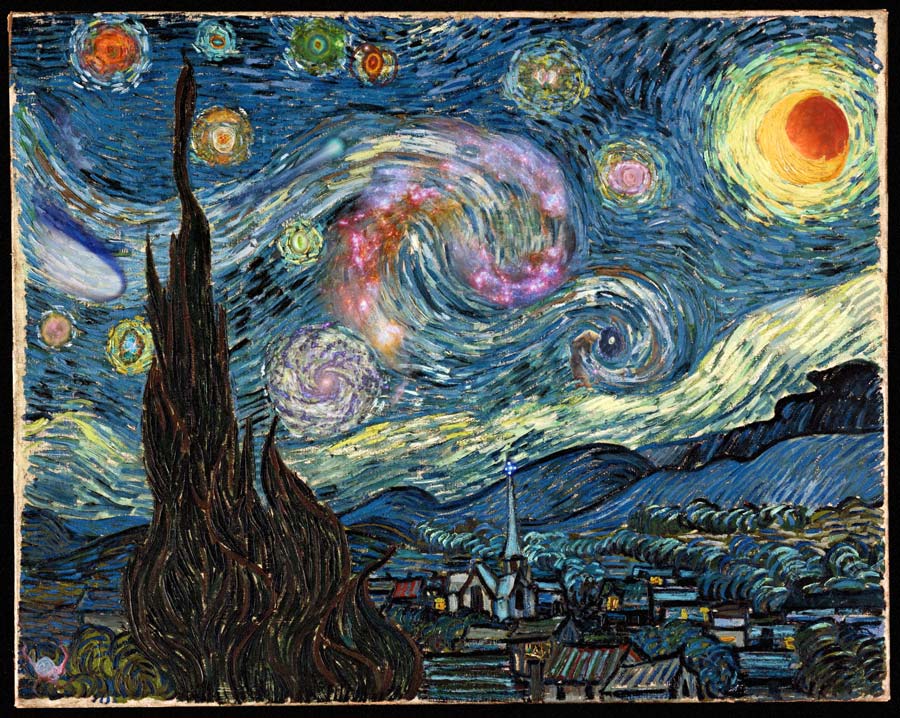
The tribute to Van Gogh below, posted last week on the Astronomy Picture of the Day website, represents a fusion of imagination and knowledge, of art and science, that I’m sure Aurier would appreciate today (this is not Van Gogh’s original painting; click for a larger view).

Postscript: See also Imagination Deficit Disorder.

Posted in Art-Music-Lit, History of Science, Nature | Tagged , , , , , , | 4 Comments

Memories

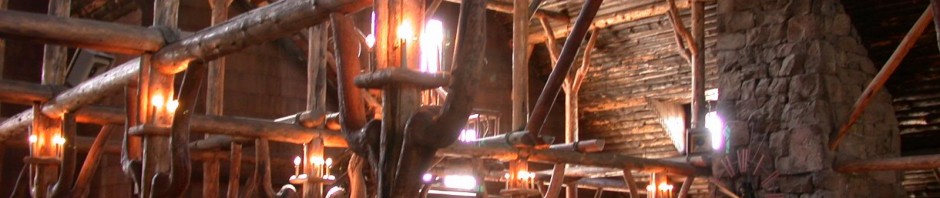
One year ago today we were arriving at Old Faithful Inn to stay for four nights, after spending three days in the Grand Tetons! I’m staring at posters of both the Tetons and Yellowstone, hanging on the wall in my office now, across from my desk, wishing I were there again….

Posted in Family | Leave a comment

John Bulwer, Anthropometamorphosis

Originally posted at ouhos.org, the now-discontinued blog of the OU History of Science Collections. Neither this post nor any of its content should be taken as an official communication of the University of Oklahoma.


Bulwer-1653-466.jpgBulwer-1653-460.jpgRecent acquisition: In 1653, an English physician, John Bulwer (1606-1656), published a curious work in comparative cultural anthropology entitled Anthropometamorphosis: Man Transform’d (London, 590 pages).

Bulwer presented abundant woodcut illustrations of all manners known to him of decorating or transforming the human body, whether ancient or modern, New World or Old. For example, Bulwer depicted tattooing, scarring, circumcisions, binding, lip-piercing, ear-piercing, and the growing of the fingernails.

Bulwer discussed subjects as diverse as women’s maladies, cosmetics, eunuchs, deformities, tooth-rites, breast feeding, children, and monstrosities. An author of five published books, Bulwer is best known for his work on methods for communicating with the deaf via gestures.

View Bulwer image gallery.

Posted in History of Science | Leave a comment