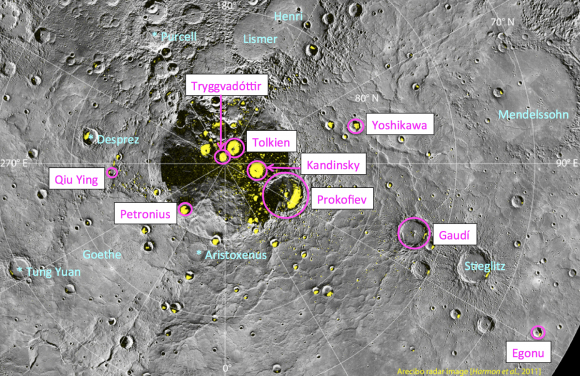
The mercurial mind of J.R.R. Tolkien has now found an appropriate home in the solar system, a newly-named crater on the planet nearest the intense golden rays of the Sun:
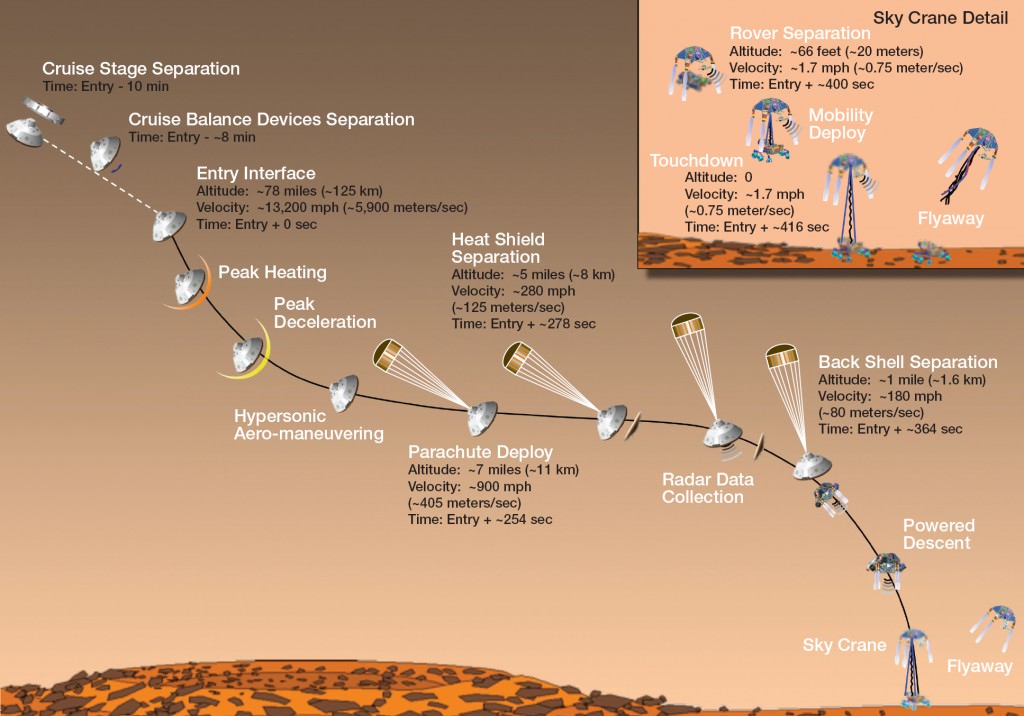
Curiosity, the van-sized high-tech rover, is set to land on Mars tonight! The above animation of Curiosity’s mission to Mars is well-worth watching – seriously – all 11 minutes of it. The landing itself looks harrowing – more nail-biting than women’s gymnastics. Go Curiosity!!!
I remember, as a high schooler, the spectacular drama of the Viking missions to Mars. Then the landings, as a planetarium director, of the Sojourner rover – the predecessor of Spirit and Opportunity, the “little rovers that could.” If all goes well around 2:30 a.m. tonight, Curiosity will open a new era of understanding of Mars. If she survives, they should give her an Olympic gold medal.
“The Curiosity Mars Science Lab rover is by far the hardest and most complex robotic mission that NASA has ever attempted. She marks a quantum leap beyond anything tried before in terms of the technology required to land this 2000 pound beast and the science she’ll carry out for a minimum 2 year prime mission…. Curiosity is the first mobile soil and rock sampling and chemistry lab dispatched to Mars. It’s also the first astrobiology mission to Mars since the twin Viking missions of the 1970’s.” Universe Today
Since an eye surgery in May, I have not been able to maintain this blog, read printed works or monitor email. I am improving, and a surgery on the other eye is coming soon. In a few months, perhaps my vision will return to nearly normal. A violin can break a string but the violinist is still a violinist. Hopefully I’ll return to playing the music soon.
My friend Mike K. read aloud to me the other day an epigram Johann Kepler wrote for his book on optics (Ad Vitellionem paralipomena, 1604). Kepler wrote this prefatory poem as a dialogue between his eyes and his mind, and it reveals his ongoing struggle with poor vision. I am very moved by Kepler’s suffering in the midst of writing one of the most significant works on optics in the entire history of science, and encouraged by Kepler’s insistence that his mind will more than make up for what his eyes may lack. Here is the translation of William H. Donahue:
—–
Eyes:
O dear mind, we have lost our sharpness, while the lights of the true
We have sent to your threshold, through our glazing.
Without this marriage, you would remain blind: of the work,
Give some return to your partners; give, sweet sister!
Mind:
What should I do for those in distress?
When did an implacable hour separate me far from your hospitality?
Eyes:
Snatch us away from darkness, lead us to whatever light you will go to;
And from whatever fear of death you lack, deliver us also.
Mind:
As far as possible, I shall do it; only let fame favor the speaker;
I shall make you mortals eternal with my writings.
Here also I bring back the losses that you have borne for me;
And here I shall cast rays upon its brilliance, even with blemishes.
According to Aristotle, when one drops a ball, the ball falls straight down to the ground, because its “natural motion” seeks the center of the Earth. The ball’s natural motion is straight down – not curved, not sideways, not diagonal, but always directly toward the center of the Earth. This natural motion remains the true path of the ball even if the person dropping it is in motion. The person’s motion, according to Aristotle, should have no continuing effect upon the ball after they are no longer in contact. Suppose that one is running with the ball at the moment the ball is let go. Once released from the runner’s hand, the ball should fall straight down with its own natural motion; whether the runner was in motion or not should make no difference to the ball. This is Aristotle’s account of the natural motion of falling bodies.
Now if Aristotle’s reasoning were true, one would predict that a cannon ball dropped by a sailor from the crow’s mast of a fast-moving ship would splash into the water far behind the ship, for the ship would move out from underneath the ball before enough time had elapsed for the ball to fall to the surface of the water. Aristotle carried out experiments, so it only stands to reason (one might argue) that many Aristotelians carried out this experiment. So why do we have no eye-witness reports refuting this Aristotelian prediction?
My friend Michael Barfield, who frequently posts clever cartoons on This Visual Feast, posted the answer today:
Wonderfully funny! Click the image to go to the original at This Visual Feast and look carefully at the undersea landscape in the last panel. 😀
Thanks, Michael!
—–
PS: In the 14th century, NicoleOresme posed a thought experiment involving ships to demonstrate the relativity of motion and the nature of “impetus,” contrary to Aristotle. Here’s Oresme’s statement of Aristotle’s position, which he rejects in the very last sentence (bolded):
“If a person on a ship moved rapidly eastward and an arrow were shot directly upward, it ought not to fall on the ship but a good distance westward from the ship. Similarly, if the Earth is moved so swiftly in turning from west to east, and it has been posited that one throws a stone directly above, then it ought to fall, not on the place it left, but a good distance to the west. But in fact the contrary is clear.” (Nicole Oresme, 14th century; read more…)
17th-century investigations of inertia by Galileo, Descartes and Newton represent the culmination of a long line of investigations reaching back through medieval Islamic and European civilizations to Basil of Caesarea and John Philoponos in late antiquity.
Undoubtedly, like Basil, Philoponos, and Oresme, sailors throughout history knew good and well that Aristotle’s account of falling bodies was wrong. This explains why the Captain depicted in the first panel of the cartoon has gone mad. 🙂
To hear a report of an experiment normally requires the witnesses to survive to tell about it.
Today is my Mama’s 80th birthday. I am in awe of her. She is a remarkable woman of strength and courage. She is brilliant, vibrant, full of heart and truly a treasure in my life. She has been my comforter, mentor and encourager, and is always my friend. I am so thankful, especially, for that last part.
I love her ‘story’ and have a dream of writing it out one day in its entirety. (in as much as it is possible to ‘write out’ someones story.) She grew up on a homestead near Powell, WY in a little two room house that her Daddy and his cousin built. Her earliest memory is of waking up on the bed she shared with her little brother and older sister and wiping the snow off her eyelashes before she could open her eyes. As she tells it, “the Little House stories were about the rich folks!” But she LOVED her life in the basin of the Big Horn mountains. Even today, when she steps foot on that ground, she feels she is back ‘home’.
Wow, Laura, your post is beautiful! It says exactly how I feel, too. Laura, thank you so much for writing it, for the many links it contains, and for the photos. Your caption to the photo I’ve used above is perfect! Watching my parents laugh together is one of my chief memories growing up. That, and in-depth, thoughtful conversations with Mother.
Dear Mother, now that you and Dad are “retiring” for the second time, I hope you and Laura really will get around to writing together!
“Like a stone on the surface of a still river,
driving the ripples on forever,
redemption rips through the surface of time
in the cry of a tiny babe…”
(Bruce Cockburn, “Cry of a Tiny Babe”)
The Incarnation reveals the divine paradox that redemption for this broken universe arrives quietly rather than with trumpets and fanfare. While some are waiting for an omnipotent power to part the heavens and come down to save us, God has already united himself with us hiddenly and obscurely, entering within our pain and brokenness. No one but a poor young couple in Bethlehem, along with some animals and outcast shepherds, noticed the tiny babe’s first cries. Yet in that moment the rock broke through the surface of the river, as the Lord of the Starfields entered our world from within and changed creation forever. From this we learn that love is incarnational.
Bruce Cockburn (pronounced “Coburn”) also shows us what love looks like in a broken world. By entering into human pain and brokenness, neither flinching nor turning back, his life and music point us to a love that is incarnational.
Bruce Cockburn, shared iTunes playlist:
“What love looks like in a broken world”
(includes songs discussed here)
50 songs, 4 hours, $50
Note: For convenience sake, I’ve linked songs and albums discussed on this page to iTunes for preview or purchase, and to the lyrics page at the Cockburn Project for reading along while listening. The Cockburn Project (abbr. “cbp”) provides lyrics of Cockburn’s songs with comments by Cockburn himself, as well as news and other resources.
(Cockburn’s Dart to the Heart album is, unfortunately, at the moment inexplicably unavailable at iTunes. The singles below from that album will be added to the playlist once it returns to the iTunes store. Meanwhile, it’s at Amazon.)
Michael Barfield (a.k.a. the painted soul, a musician who invites comparison with Cockburn) long ago introduced me to the early albums of Cockburn such as High Winds, White Sky (1971), Salt, Sun and Time (1974) and Joy will Find a Way (1975). Through the decades since, Cockburn’s music has been a regular companion for me, particularly in difficult times. My copies of later vinyl albums such as Dancing in the Dragon’s Jaws (1979) and Humans (1980) are scratchy and the covers worn. In the early years after the launch of the iTunes store, I eagerly waited for Cockburn’s music to appear. My first iPod enabled me to plunge again into the river of Cockburn’s music, which keeps flowing on and evolving in tune with Cockburn’s deepening, maturing experience of life and death in this broken world. Before an eye surgery earlier this month, I prepared an all-Cockburn playlist to hold my attention through a long weekend of pain and recovery. Cockburn’s music is music to live through life with. [Update 8/14/2012: After another eye surgery last Friday, I again managed the pain this weekend by immersing myself in this playlist, several times through.]
Cockburn is a poet and prophet of love in a broken world.
Were it not for his music, Cockburn would be known as a poet. Cockburn’s lyrics are poetry, filled with evocative metaphors, arresting phrases, and multiple layers of meaning. Who can fail to ponder or listen unmoved to opening lines like “Sunset is an angel weeping….” (“Pacing the Cage”); or “Sun went down looking like the eye of God” (“How I Spent My Fall Vacation”). Lyrics that stand on their own with poetic integrity reward careful attention and recitation. Consider how effectively these lines from “Hills of Morning” convey a human scene:
“Underneath the mask of the sulphur sky
a bunch of us were busy waiting,
watching the people looking ill-at-ease,
watching the fraying rope get closer to breaking…”
Cockburn is also a poet of sound, for what a poet does with words is an apt description of Cockburn’s analogous care with instrumentation. He selects diverse styles and varied sounds which reflect an artistry that could stand alone, apart from the lyrics. A consummate guitarist, Cockburn’s music is innovative, experimental, and versatile; as intricate in composition as Crosby, Stills and Nash. Thankfully, instrumental pieces appear on all of Cockburn’s albums. When they shuffle into play in my “instrumental guitar” playlist, they are easy to mistake for pieces by Phil Keaggy or Michael Hedges. One of Cockburn’s albums, Speechless (2005), consists entirely of instrumental works, some collected from previous albums. These far-from-mute pieces wordlessly summon love in a broken world.
Finally, what Cockburn does with a poetry of words and what he does as a musician with a poetry of sound, he also does by weaving both together. He welds words and music together in deft synergy, comparable to Paul Simon. The music and lyrics do reinforce one another, but not in a simplistic way; their juxtaposition often creates contrasts, momentary tensions and a dynamic interplay that express the mystery of life in a broken world.
No wonder Cockburn has received countless awards, including at least five honorary doctoral degrees and induction into the Canadian Music Hall of Fame by Gordon Lightfoot. He is held in universally high regard by performers as diverse as Bono, Emmylou Harris, Jackson Browne, k.d. lang, the Barenaked Ladies, Michael Occhipinti, Ali Farka Toure, Toumani Diabate and the late Michael Hedges, Dan Fogelberg and Mark Heard. His versatile playing has contributed to innovations in guitar tuning, construction and design.
One of the reasons I enjoy listening to Cockburn’s music over and over so much is the surge of defiant joy it causes to rise within me. Listen to the music of songs like “Fascist Architecture,” “Somebody Touched Me,” “Wondering Where the Lions Are” and the other songs on my playlist, even without catching the lyrics, and see if it is possible to maintain a mood of discouragement (cf. the description of “Fascist Architecture” below).
If you’re not familiar with Cockburn, listen to the playlist above or plunge into any of these five albums:
Any one of these albums, or the above playlist, would offer a great way to start listening to Cockburn. I prepared the above playlist to survey some singles selected from a variety of albums, both early and recent, that reflect upon love in a broken world. Give the songs in the playlist a listen, and you’ll have a good sense of the wide range of Cockburn’s music. Preview them at iTunes, while perusing the lyrics (and Cockburn’s comments) at the Cockburn project. The playlist singles are all listed separately below, with links and a few comments.
“Mines of Mozambique,” Charity of Night (1996, cbp, ). This haunting song lamenting the evil of land mine booby-traps ably represents the way Cockburn’s songs of social protest capture the tension and tragedy of life in a sadly, profoundly broken world.
“Red Brother, Red Sister,” Circles in the Stream (1977, cbp, ). The tragedy of North American Indians and native peoples around the globe are a repeated and long-standing concern for Cockburn. This song is representative.
Another moving song about Native Americans is “Kit Carson,” Nothing But a Burning Light (1991, cbp, ).
“The Whole Night Sky,” Charity of Night (1996, cbp, ). Cockburn’s life has not kept pain at a distance, either, in affluent comfort. He is a man of sorrows, acquainted with grief, not afraid to weep, whose tears fill a whole night sky.
“Great Big Love,” Nothing But a Burning Light (1991, cbp, , youTube). Cockburn’s roots may lie in the folk music scene, but he does not share a naive optimism about human nature one sometimes finds in the folk music world. Neither his own personal life experience, nor the brokenness of the world he has seen, allow him any easy comfort. The remedy humans need must reach much more deeply. Our pain is too great for us; we’re desperate for a great big love. With that love, however, we can live our lives and face the evil around us. Cockburn comments:
“I lived on a horse farm for seven years, and that was a different experience for me. Great Big Love… is a product of that atmosphere.”
“Fascist Architecture,” Humans (1980, cbp, , youTube). Cockburn’s truth telling and passion for social justice arise not from cynicism, but from a love characterized by defiant joy. This song is one of many which express that defiant joy through an irrepressible feel of the music, even when the story is about getting a bloody nose. For Cockburn, joy is not the absence of despair, but the defiant refusal to allow despair to triumph or to give it the final word.
“Rumours of Glory,” Humans (1980, cbp, ). Another example of defiant joy expressed through the music.
“You see the extremes
of what humans can be?
In that distance some tension’s born,
energy surging like a storm.
You plunge your hand in
and draw it back scorched,
beneath it’s shining like
gold but better…
Rumours of glory…”
“How I spent my fall vacation,” Humans (1980, cbp, ). Cockburn observes human life closely, fully engaging both the good and the bad, without allowing either to diminish or dominate the other. Cockburn’s keen, unflinching gaze upon human nature is like Annie Dillard’s observation of nature itself as also broken, yet with rumors of glory.
“I saw an old lady’s face once on a Japanese train
Half lit, rich with soft luminosity.
She was dozing straight upright head bobbing almost imperceptibly.
Wheels were playing fast in 9/8 time.
Her husband’s friendly face suddenly folded up in a sneeze…”
This song is also an example of how Cockburn’s songs are filled with subtle humor for the attentive listener. The identity of the homeless people mentioned at the beginning is revealed at the end.
“Soul of a Man,” Nothing But a Burning Light (1991, cbp, , youTube). This one is a spiritual, expressing the mystery of human suffering and significance.
Won’t somebody tell me,
Answer if you can,
Won’t somebody tell me,
Tell me what is the soul of a man?
“Child of the Wind,” Nothing But a Burning Light (1991, cbp, , youTube). Logical proof of anything meaningful is impossible. Learning to see things as they are requires a willingness to love.
Little round planet
in a big universe.
Sometimes it looks blessed,
sometimes it looks cursed.
Depends on what you look at obviously,
but even more it depends on the way that you see…
“Mighty Trucks of Midnight Moving On,” Nothing But a Burning Light (1991, cbp, ). The driving music of this song – which I first heard traveling on the interstate in the late night hours – reinforces the fact that everything in life constantly changes. Permanence eludes us. Yet in the midst of change, the bottom line for Cockburn’s music is that life is all about learning to love:
“The tide of love can leave your prizes scattered,
but when you get to the bottom it’s the only thing that matters.”
“Broken Wheel,” Inner City Front (1981, cbp, ). In this broken universe, as small as we may be on the rim of the galaxy, we are called to uphold justice:
“No adult of sound mind
Can be an innocent bystander…”
Yet the kind of justice we are called to act out lives within rather than in opposition to love; it embraces lamentation, practices confession, and seeks mercy:
“You and me – we are the break in the broken wheel…”
“Lord of the Starfields,” Circles in the Stream (1977, cbp, , youTube). This early song could be used as a worship song on Sunday mornings.
“Voice of the nova,
smile of the dew,
all of our yearning
only comes home to you.
O love that fires the Sun
keep me burning…”
“Starwheel,” Joy Will Find a Way (1975, cbp, ). I sing this one every spring at nighttime under the stars (see Winter Hexagon).
“Orion’s high in the southwest sky,
you’re bound to move on and so am I…
We’re given love and love must be returned;
that’s all the bearings that you need to learn.
See how the starwheel turns.”
“All the Diamonds in the World,” Salt, Sun and Time (1974, cbp; , youTube). Cockburn wrote this song the day after he realized he had become a Christian (*).
All the diamonds in this world
that mean anything to me
are conjured up by wind and sunlight
sparkling on the sea.
“Gavin’s Woodpile,” In the Falling Dark (1976, cbp, ). The last verse and chorus of this song are a spectacular affirmation of hope arising from the midst of a broken world. This song, which Cockburn calls “transcendental wood chopping,” requires meditation; the Cockburn project offers lyrics and context. Perfect for singing to myself next time I’m splitting logs.
“Festival of Friends,” In the Falling Dark (1976, cbp, ). Cockburn again affirms the reality of life and love beyond this world:
Open your heart and grow with what life sends
That’s your ticket to the festival of friends…
Black snake highway – sheet metal ballet
It’s just so much snow on a summer day
Whatever happens, it’s not the end
We’ll meet again at the festival of friends.”
“God Bless the Children,” Night Vision (1973, cbp, ). The Cockburn Project records Cockburn’s cryptic description of this song: “C.S. Lewis meets the surrealists!”
“Cry of a Tiny Babe,” Nothing But a Burning Light (1991, cbp, ). This song is on my favorite Christmas playlist. See the quote from it that appears at the top of this post. Cockburn explains:
“I wanted to put it into terms people can relate to now, because the story itself is so familiar, that its been reduced to traditional images that really work against our understanding of it as a human story. A story that happens to people. You know Joseph’s got a saint in front of his name and Mary’s got a halo. Those images are so entrenched in people’s minds…”
“Closer to the Light,” Dart to the Heart (1994, cbp, iTunes). Cockburn wrote this moving song for Mark Heard, after Heard’s death in 1992 at the age of 41. Thoughtful songs about dying are as profound as they are few in number – this one ranks for me right up there with classics like “Loch Lomond“; Enya’s version of “How Can I Keep from Singing?” (; ); Carrie Newcomer, “The Gathering of Spirits” (); or Annie Lennox, “Into the West” ().
“Lovers in a Dangerous Time,” Stealing Fire (1984, cbp, , youTube). Cockburn shows us the courage to love no matter what the times.
“When you’re lovers in a dangerous time
Sometimes you’re made to feel as if your love’s a crime –
but nothing worth having comes without some kind of fight.
Got to kick at the darkness
’til it bleeds daylight.”
Bono, who regards Cockburn as a modern psalmist, refers to this song in the lyrics to U2’s “God Part 2” (lyrics).
“Strong Hand of Love,” Orphans of God (1996, not at cbp, ). This one, written by Mark Heard and performed by Cockburn on an album in tribute to Heard, is not as well-known as it should be. Cockburn is mentioned several times on Heard’s Wikipedia page; one place to start listening to Heard would be his acoustic Eye of the Storm album (1983).
“Love Loves You, Too,” Dart to the Heart (1994, cbp, iTunes). A beautiful expression of Christian mercy and hope.
“Some take the burden of another’s pain.
Some spend forever for a moment’s gain…
But if you love love, then Love loves you too.”
“Dweller by a Dark Stream,” Mummy Dust (1981, cbp, ).
“I was a dweller by a dark stream,
a crying heart hooked on a dark dream.
In my convict soul I saw your love gleam
and you showed me what you’ve done.
Jesus, thank you, joyous Son.”
“Creation Dream,” Dancing in the Dragon’s Jaws (1979, cbp, ). A beautiful, poetic evocation of creation:
“You were dancing,
I saw you dancing,
throwing your arms toward the sky.
Fingers opening
like flares,
stars were shooting everywhere…”
“The album was influenced partly by the fact that during the period the songs were being written I read all of the works of Charles Williams, who is an English writer with a particularly pronounced ability to describe spiritual things in very vivid terms.”
“Hills of Morning,” Dancing in the Dragon’s Jaws (1979, cbp, ). This song, a richly allusive Christological poem, culminates in a prayer to participate in God’s love for the broken world:
“Let me be a little of your breath
moving over the face of the deep. –
I want to be a particle of your light
flowing over the hills of morning…”
“Northern Lights,” Dancing in the Dragon’s Jaws (1979, cbp, ). Love does not imply the absence of pain. Longing for love is worth the pain.
“I’ve been cut by the beauty of jagged mountains
and cut by the love that flows like a fountain from God.”
“Wondering Where the Lions Are,” Dancing in the Dragon’s Jaws (1979, cbp, , youTube). This bouncy, exuberant song offers another example of Cockburn’s defiant joy in facing eternity.
“Sun’s up, uh huh, looks okay –
the world survives into another day,
and I’m thinking about eternity.
Some kind of ecstasy got a hold on me.”
“No Footprints,” Dancing in the Dragon’s Jaws (1979, cbp, ). We long to love.
“I want to touch you,
touch you deep down
where you live.
Not for power but
because I love you…”
“All The Ways I Want You,” Dart to the Heart (1994, cbp, iTunes). A lonely lament for love, sung when separated from the presence of a lover, or God.
“Someone I Used To Love,” Dart to the Heart (1994, cbp, iTunes). A hopeful prayer for continuing love.
“May no shadow ever fall
that will make me have to call
you someone I used to love.”
“A Dream Like Mine,” Nothing But a Burning Light (1991, cbp, , youTube). Our dreams define us more than external forces ever can.
“When you’ve got a dream like mine,
nobody can take you down…”
“One of the Best Ones,” Nothing But a Burning Light (1991, cbp, ). Finding love in this broken world is a mystery.
“We’re faced with mysteries profound,
and this is one of the best ones…”
“Somebody Touched Me,” Nothing But a Burning Light (1991, cbp, , youTube).
“Somebody touched me,
making everything new…
But I know you’re with me
whatever I go through.”
“Southland of the Heart,” Dart to the Heart (1994, cbp, iTunes). A song offering friendship in the midst of hard times.
“Isn’t That What Friends are For?,” Breakfast in New Orleans, Dinner in Timbuktu (1999, cbp, , youTube). No matter how broken, how fallen we are, we need a friend who loves us.
“You’re as loved as you were
before the strangeness swept through…
I’ve been scraping little shavings off my ration of light
and I’ve formed it into a ball, and each time I pack a bit more onto it…
I blow across it and I send it to you.”
“Look How Far,” Breakfast in New Orleans, Dinner in Timbuktu (1999, cbp, ). A grateful affirmation of friendship.
“Look how far the light came…
to paint you this way.”
“The Coldest Night of the Year,” Inner City Front (1981, cbp, , youTube). A lonely and bewildered man tries unsuccessfully to distract himself from lost love.
“Pacing the Cage,” Charity of Night (1996, cbp, , youTube). In this broken world, we weep and wander. Confused, we pace the cage.
“Sometimes the best map will not guide you,
you can’t see what’s round the bend.
Sometimes the road leads through dark places,
sometimes the darkness is your friend…”
“Understanding Nothing,” Big Circumstance (1988, cbp, , youTube). Life remains a mystery:
“All these years of thinking,
ended up like this,
in front of all this beauty,
understanding nothing.”
“World of Wonders,” World of Wonders (1986, cbp, , youTube). We may understand nothing, but the heart, even while crying inside, can see the beauty and wonder.
“I stand here dazzled with my heart in flames at this
world of wonders…”
“To Fit in My Heart,” Life Short, Call Now (2006, cbp, ). This song’s weird, experimental soundscape evokes the infinity of space and time. Where is the human place? Pascal wrote, “It is not in space that I must seek my human dignity, but in the ordering of my thought. Through space the universe grasps me and swallows me up like a speck; through thought I grasp it.” Cockburn feels the disorienting vastness of space (like Pascal) and time (like Tennyson), yet knows they cannot contain the human heart. The world of wonders around us calls us to the mystery of a Person, known heart to heart.
“Mystery,” Life Short, Call Now (2006, cbp, , youTube). Believing in the Incarnation as the drama of love, Flannery O’Connor equated “dogma” and “drama,” writing, “Dogma is the guardian of mystery.” This is one of my favorite quotations, as I believe that the kind of dogma worth having – the Incarnational drama – is that which opens us up to mystery, taking us outside ourselves to love more. Love is the secret to the mystery.
“You can’t tell me there is no mystery.
It’s everywhere I turn…
Come all you stumblers who believe love rules,
stand up and let it shine.”
“January In the Halifax Airport Lounge,” Joy Will Find a Way (1975, cbp, ). Love is a mystery we long for.
“In life so delicate and strange,
understanding seldom comes in range.
We stumble through familiar scenes
never thinking what it means,
in this cluttered landscape to be loved…
I need you like I need the stars above.”
“Lament for the Last Days,” Joy Will Find a Way (1975, cbp, ). This broken world has its own “rhythm of ruin,” which we strain to resist.
“Oh, Satan take thy cup away,
for I’ll not drink your wine today.
I’ll reach for the chalice of light
that stands on Jesus’ table.”
“Joy Will Find a Way (a song about dying),” Joy Will Find a Way (1975, cbp, ). Death will come, yet joy endures.
“A Long-Time Love Song,” Joy Will Find a Way (1975, cbp, ). This beautiful song is a hopeful love song sung by a wizened old man in a nursing home on the sea-side, holding hands with his long-time wife:
“And you know I long to feel that sail
leaping in the wind!
And I long to see what lies beyond that rim…
Oh, ever-new lover and friend,
sing me that love song again.”
“Jesus Ahatonnia (The Huron Carol),” Christmas (1993, cbp, ). I am moved every time I hear Cockburn sing the verses in Huron instead of the usual French and English. Cockburn remarks that it’s about “the birth of Christ as a liberation from the thrall of evil.” Along with “Joy to the World,” this is my favorite Christmas carol (quoted here). I’ve included this album on my list of favorite Christmas recordings.
“Shepherds,” Christmas (1993, cbp, ). This carol, written by Cockburn, is a poetic and wondrous telling of the angels visiting the shepherds. I highly recommend the entirety of Cockburn’s Christmas album!
“Use Me While You Can,” Breakfast in New Orleans, Dinner in Timbuktu (1999, cbp, , youTube). Cockburn explains:
“It’s about the passage of time and the inevitability of that, and about the need to seize the moment. All the images are about the transitory nature of things. In that part of the Sahara you really have the sense that when you pick up a handful of sand, that it really is the ‘dust of fallen empires,’ and of cultures that came and went. There were people living there when it was grassland. An ancient presence is there, and yet it can only be felt because there’s no sign of it now, no living vestige of it, other than what’s left of Timbuktu. Which relates to what our lives are all about. We’re here, then we’re gone.”
“Last Night of the World,” Breakfast in New Orleans, Dinner in Timbuktu (1999, cbp, , youTube). Perfect for listening to on New Years Eve with a glass of champagne. A song of hope for the last night of the year, the last night of the world, or whenever the darkness comes. An ultimate answer puts an ultimate limit upon our despair – in defiant hope, let’s drink champagne together.
“I’ve seen the flame of hope among the hopeless…
That was the straw that broke me open.”
“When I say that the experience ‘broke me open’ it refers to the process of beginning to recognize the centrality of love. Those people that I saw [refugees from Guatemala] showed an incredible amount of courage, self-discipline and restraint.”
Of course, there are many more Cockburn songs I really enjoy, so this is a sampler of songs related to love in a broken world, not a comprehensive list of favorites. While recuperating, I listened to a repeating all-Cockburn playlist which took more than a day to go just one time through. I decided to whittle down the list to limit it to 50, excluding gems like “In the Falling Dark,” “Burden of the Angel-Beast,” “Tokyo,” “After the Rain,” “Mango,” “Going to the Country,” “Get up, Jonah,” “Life’s Mistress,” “Stained Glass,” “Christmas Song,” “Silver Wheels,” “You Don’t have to Play the Horses,” “The Light Goes On Forever,” “Dialog with the Devil,” “Strange Waters,” and others which might easily extend this list to 75 or more. But hopefully this playlist will be a helpful starting place for anyone wishing to explore Cockburn’s music more fully.
Which of Cockburn’s songs would you include in a top 50 list about love in a broken world? (Answer in the comments.)
After my eyes heal a little more, I can’t wait to read a new book engaging Cockburn’s music by theologian Brian Walsh: Brian J. Walsh, Kicking at the Darkness: Bruce Cockburn and the Christian Imagination, (Brazos Press, 2012). Like another theologian, Chris Kettler, who has taken popular culture seriously by engaging Jayber Crow and Bob Dylan as the points of departure for serious theological reflection, Walsh’s reflections on Cockburn’s music are most welcome. Hopefully I’ll be able to open his pages soon (in iBooks, using my new iPad), and watch his video interviews with Cockburn (cf. links below). At that point perhaps I’ll come back and add to this post, but in any case, anyone who enjoys this “Love in a broken world” playlist will likely also be interested in Walsh’s book.
—————–
The Cockburn Project – includes discography and lyrics to every song. It aims also to provide an “ongoing archiving of Cockburn’s self-commentary on his songs, albums, and issues. You will also find news, tour dates, an online store, and other current information.”
Recent Cockburn documentary: Pacing the Cage, Vision TV. Not yet available on Netflix or iTunes.
Michael Barfield, “In search of the ineffable,”, a representative post from his blog, Nap Dreams: images, ideas and sounds on art and life from the painted soul.
—–
UPDATE: Since originally posting the playlist, I’ve switched out the following songs for others. They were initially included to show the variety of Cockburn’s music, but have been replaced by songs with a greater emphasis on love in a broken world (the playlist theme). Songs added in their place are “Gavin’s Woodpile,” “Festival of Friends,” “Broken Wheel,” “God Bless the Children,” “Mystery,” “To Fit in My Heart,” “Understanding Nothing,” “World of Wonders,” “Isn’t That What Friends are For?,” and “Look How Far.” I’ve updated the playlist in iTunes accordingly.
“High Winds, White Sky,” High Winds, White Sky (1971, cbp, ). Impressionistic poem of what the wind sees as it travels around the world.
“It’s an Elephant World,” High Winds, Night Sky (2003, cbp, ). This whimsical single was recorded on cassette as it was performed live in the 1960’s. It was released only recently as a bonus track to a digital version of the album.
“The Embers of Eden,” Breakfast in New Orleans, Dinner in Timbuktu (1999, cbp, ). We’ve all seen the startling photo of the Earth from space. Cockburn wrote this song after hearing that when the astronauts walked on the Moon they could see rain forests burning on the Earth. This song laments the emptiness of a broken relationship. This lonely planet slowly burns with our broken lives.
“And the embers of Eden burn.
You can even see it from space…”
For a critical review of Cockburn’s autobiography, see Douglas LeBlanc, “Goodbye to my Guitar Hero,” Living Church, published November 24, 2014. I would not have been able to write this post as it reads above if I had read this beforehand. Instead of revising it now, I pray for the mercy of the Father, Son and Spirit to awaken Bruce’s heart to the reality of his mighty love and grace. I will sing “Come Thou fount,” one of my favorite hymns, as a prayer for Bruce:
Come Thou Fount of every blessing Tune my heart to sing Thy grace; Streams of mercy, never ceasing, Call for songs of loudest praise. Teach me some melodious sonnet, Sung by flaming tongues above. Praise the mount! I’m fixed upon it, Mount of God’s unchanging love.
Here I raise my Ebenezer; Hither by Thy help I’m come; And I hope, by Thy good pleasure, Safely to arrive at home. Jesus sought me when a stranger, Wandering from the fold of God; He, to rescue me from danger, Interposed His precious blood.
O to grace how great a debtor Daily I’m constrained to be! Let that grace now like a fetter, Bind my wandering heart to Thee. Prone to wander, Lord, I feel it, Prone to leave the God I love; Here’s my heart, O take and seal it, Seal it for Thy courts above.
I always knew that, at heart, underneath that cowboy hat, beneath that suit and tie, Dad is a hippie in disguise! As a chemistry professor, he kept a peace sign on his office door. He signs his emails “Peace.” As a science educator he taught teachers to love one another and their students. What a joy, then, to hear him say it himself, in an interview for ATSU’s Teacher’s Lounge earlier this spring (1 min, 2 sec):
I also love his 1960-ish take on institutional strategic plans (47 sec):
Here is a longer excerpt from the interview about an “Environmental Studies” class he offered during the summertime (7 min, 49 sec):
As a young teen, the Environmental Studies classes left a lasting impression on me, profoundly shaping my world view for both science and education. Sometimes participating as a “test student,” instead of listening to lectures and taking tests I was set loose to create my own personalized multimedia project with a Polaroid camera – then a startling, wonder-generating, instantly-gratifying, leading-edge technology. The canoe trips, camping and other field trips became my paradigm examples for what doing science meant. Instead of growing weary of one another or trying to outdo each other in a competitive spirit, the teachers would often hang out at our home, riding horses and enjoying relaxed time together. And I would never forget that Dad used a textbook entitled Love by Leo Buscaglia. Buscaglia’s book contained the Animal School parable and other gems. From these experiences I have always believed that the most effective science educators are hippies in disguise. Thank you, Mother and Dad, for these life-defining experiences!
The animals got together in the forest one day and decided to start a school. There was a rabbit, a bird, a squirrel, a fish and an eel, and they formed a Board of Education. The rabbit insisted that running be in the curriculum. The bird insisted that flying be in the curriculum. The fish insisted that swimming be in the curriculum, and the squirrel insisted that perpendicular tree climbing be in the curriculum. They put all of these things together and then wrote a Curriculum Guide. Then they insisted that all the animals take all of the subjects. Although the rabbit was getting an A in running, perpendicular tree climbing was a real problem for him; he kept falling over backwards. Pretty soon he got to be sort of brain damaged, and he couldn’t run anymore. He found that instead of making an A in running, he was making a C and, of course, he had always made an F in perpendicular climbing. The bird was really beautiful at flying, but when it came to burrowing in the ground, he couldn’t do so well. He kept breaking his beak and wings. Pretty soon he was making a C in flying as well as an F in burrowing, and he had a helluva time with perpendicular tree climbing. The moral of the story is that the person who was valedictorian of the class was a mentally retarded eel who did everything in a half-way fashion. But the educators were all happy because everybody was taking all of the subjects, and it was called a broad-based education…. we are really trying to make everybody the same as everybody else.
Leo Buscaglia, Love (Charles B. Slack, 1972)
I remember what an impression “The Animal School” parable made when my parents first showed it to me back when I was in junior or senior high. At that time I walked to the principal’s office every quarter to have my name removed from the honor roll, to ensure that I wasn’t uncritically buying into values more appropriate to some other kind of animal. The story has lost none of its meaning now. No one benefits from cookie-cutter thinking, which is demoralizing and ultimately dehumanizing. This is one of the reasons we homeschool, and one of the motivations that I suspect led to Hannah’s graduation earlier this month in Multi-Disciplinary Studies. Indeed, one of the unexpected pleasant surprises of attending her convocation was seeing for myself the very large number of students who were graduating this year in OU’s MDS program. Life sure is a lot more interesting when people aren’t preoccupied with conforming to others’ expectations. Rabbits running, squirrels climbing, birds flying – as we unleash each other to live creatively and true to their own callings, there’s no foretelling what wonderful changes might be afoot! Education is really about life, and life is about loving.
Wanting a brief devotional? Over the last several years I have regularly followed Speaking of Life, by Joseph Tkach. Speaking of Life is a weekly video podcast by Grace Communion International. I’ve mentioned Tkach before as part of GCI’s You’re Included video series on Trinitarian theology (here). Speaking of Life arises from the same theological perspective, yet each episode lasts only 3 minutes. Despite the concise format, they’re full of meaning, and worth watching multiple times. Tkach’s reflections are ideal conversation starters for adults and families with older children. Here’s a recent one entitled “The Ultimate Love Story” – watch it and see if you’ll want to follow this series regularly, too:
Speaking of Life is available in both audio and video from the GCI website and from . Earlier episodes no longer on iTunes are archived on the GCI website. These are well worth going back and listening to, so you can start back at the beginning and work through the series chronologically as a daily devotional. Transcripts are also available. For other GCI videos, see this page.
I’m so glad to return to this blog, which has seen light posting during a winter and spring of eye problems which included three surgeries, the most recent one last week. One week ago today I realized that it’s time to make a commitment to protect my eyes with dark glasses and a hat while outdoors. To my utter delight, Dad sent me a brand-new hat just like his own: a Stetson Rancher straw hat, natural color, from Sheplers. The size was 1/8th inch too small, but there happens to be a Sheplers in Oklahoma City, and today Candace took me up there and they stretched it to fit, using a steamer and a sturdy steel hat stretching tool. It worked like a charm, now fits perfectly, and saved us a long wait for a replacement to arrive by mail. Here it is:
I’m not sure what the purpose of a hat pin is, and this “JBS” pin (for John B. Stetson) strikes me as ornamental, in contrast to the understated character of the hat as a whole, so it might not last very long on my hat:
The straw is narrow and tightly woven, creating a firm surface with interesting patterns:
Weave pattern in the rim
Weave pattern in the crown
The x’s in a Stetson hat originally referred to the percentage of beaver fur in the felt, by 10% increments, so that a 10x hat would be made from 100% beaver. For straw hats, the x’s indicate the the narrowness of the straw reed and the tightness of the weave.(*)
I remember when I was very young and Dad bought a grey felt Stetson. The box was enormous. We all gathered around in the living room to express admiration for such a hat. The texture was too fine to even think of wearing it in the barn lot. Later, I marveled every time I saw the box, stored away on the top shelf of the front door closet. I wonder how long Dad had waited for his first genuine Stetson.
Dad, I will wear this with delight not because of the protection from sunlight it affords, but because it is a gift from you, and because it is like your own. Thank you!!!
By the way, I’ve been storing up a slew of posts I want to set down in written form, so I’m hoping I’ll be able to focus my eyes well enough to compose them very soon. Stay tuned.

 – the predecessor of