Another Baldi manuscript: The Cronica autograph

Originally posted at ouhos.org, the now-discontinued blog of the OU History of Science Collections. Neither this post nor any of its content should be taken as an official communication of the University of Oklahoma.


Recently we made available a manuscript of an unpublished work on sundials by Bernardino Baldi that had been missing since 1783.

The OU History of Science Collections hold a second Baldi manuscript: his autograph copy of Cronica, a 16th-century history of mathematics, now digitized in its entirety and available from the Collections’ Online Galleries.

Baldi autograph, Cronica (ca. 1596)
Baldi autograph, Cronica (ca. 1596); title page

The Cronica arranges its brief biographical entries as a genealogical account of the restoration of mathematics from Ancient Greece (first entry: Euphorbus) to contemporary Italy (final entry: Guidobaldo del Monte), including an impressive list of Arabic practitioners.  As such it was one of the first histories of mathematics written by a European (though not the first published), and perhaps the first to be written by a European mathematician.  It was an attempt to do for mathematics what Vasari had done for art.

Baldi autograph, Cronica (ca. 1596); Copernicus entry

The manuscript, we learn from internal evidence, was probably completed in 1596:  the final four mathematicians mentioned (Clavius, Aluigi, Magini, Guidobaldo del Monte) all have 1596 as their date. The entry for Guidobaldo mentions some books already printed, others not yet written – this confirms a date of composition between 1580 and 1600.

Baldi autograph, Cronica (ca. 1596); last entry

Here is a bibliographic description:

BALDI, Bernardino. Cronica de Matematici. Overo Epitome del Historia de le Vite Loro. Manuscript, brown ink, 22 lines per page. Folio [28 x 19 cm], (2) ff., 183 pp., (4) ff. 

Bound in 18th century half calf (stained green) and lacquered paper over boards, spine with raised bands and calf title label with tools of the Albani Library, covers slightly abraded. Albani shelfmark 631 on front endleaf. Unidentified private library stamp on leaf following title, a rather blurry cardinals hat with RA at bottom of escutcheon; some worming in blank gutter margin of title and the first few leaves (no loss); some minor toning, but generally a fresh copy, excellent.

Baldi autograph, Cronica (ca. 1596)

We are grateful to Seth Fagen and Prof. Nick Wilding of the Italian Academy for Advanced Studies (Columbia University) for the following description of the Cronica and its provenance:

The Cronica and the Vite

The manuscript appears to be the sole witness for the text in Baldi’s own hand, and most likely served as the basis for the printed edition, which like many of Baldi’s works, was only published posthumously (1707). A polymath of remarkable range who left a large corpus of writings, Baldi (1553-1617) was a serious mathematician and translator of mathematical works; he studied in Urbino with Federico Commandino and Guidobaldo del Monte (see previous post).
 
The printer’s motive for publishing the Cronica in 1707 was to prepare an audience for the more detailed – if less inclusive – two volume Vite [Lives] which never followed.  Rediscovered only in 1972, the voluminous Lives has meant that the less detailed Cronica has received little attention.  But as the printer Monticelli points out, rather than being merely an abridgment of the larger project, the Cronica, with 366 biographical entries, is over half again as large as the Vite and represents a different but related project for the construction of a history of mathematics.
 
Both the manuscript and printed version of the Cronica contain Baldi’s own description of the project: 


“For many mathematicians I have found so much written material that I have been able to piece together their Lives; for others who have had less luck I have not been able to gather together enough to let me write them up in full.  As both groups are my concern, I have put together the present Chronicle, in which I briefly touch on the times in which they flourished and the things they wrote…. May the present narrative be read by those who take pleasure in these studies, which, if I am not mistaken, will not be at all displeasing for its novelty.”

Crescimbeni described the work’s genesis in his biographical notice on Baldi, written about 1704, just before the publication of the Cronica:

“After finishing the Vite he noted that even before Thales there were mathematicians, whose lives could not be written due to the loss of sources, but whose names survived and were worth recalling.  Moreover, he thought that the vastness of the Vite he had written might make reading the work a little unwieldly and cumbersome, and lastly that after Clavius others had lived who were worth mentioning, so after a while he was persuaded to make a succinct chronology of these same Professors, starting with Euphorbus instead of Thales, and ending with Guidobaldo de’ Marchesi del Monte…. He certainly intended such a useful and beautiful work for the press, as we see both volumes [of the Vite] along with the Cronica carefully transcribed in his own hand, but, whether distracted by something else, or prevented by death, he left them unprinted.”

That the Cronica was Baldi’s own work, rather than an abridgment by later readers or printers is attested by Marcantonio Vergilii Battiferri who mentioned in his funeral oration for Baldi (1617) a manuscript he called ‘Cronology of dates and brief Eulogies [of all the mathematicians up to our own day].’  Again in 1621, we find the Cronica distinguished from the project of the Vite: in the first manuscript catalogue of Baldi’s own writings, drawn up by Fabrizio Scarloncino and published in his edition of Baldi’s In Mechanica Aristotelis Problemata Exercitationes, the one-volume Epitome is listed separately from the two-volume Lives.

Provenance

The present manuscript of the Cronica was sought out by the members of the Royal Society of London in the 1670s as being of especial interest.  The French astronomer Adrien Auzout (1622 – 1691) almost succeeded in buying the manuscript for the Society’s secretary Henry Oldenburg in 1673, stressing that the version he had seen was ‘the original in the hand of Baldus.’ 
 
It seems that when the work was printed in 1707, it was from the present autograph copy, or one  derived from it: there are occasional additions to the main body of the text (in one case consisting of an entire biographical entry) that correspond precisely to the printed version.  There is one correction in a hand that is not Baldi’s, of Commandino’s mother’s surname; this correction is also found in the printed text.
 
Most of Baldi’s manuscripts were acquired shortly after his death by the Albani Library, founded by Orazio Albani and consolidated by his grandson Gianfrancesco, who became Pope Clement XI in 1700. It is possible that the present manuscript left the Albani collection at the time of its printing and never returned, for while it bears the binding shelfmark (no. 631) of the Albani library, and is cited in Crescimbeni’s early  eighteenth century Life of Baldi as being in Clement’s XI’s library, it did not pass with the other Albani Baldi manuscripts into the Boncompagni collection when that collector purchased them in 1857/8. 
 
The two Boncompagni manuscript catalogs mention a manuscript of the Cronica, and that of 1892 even refers to the Albani shelfmark, but both entries make it clear that they are referring to a copy of this manuscript, probably made in the mid-seventeenth century by Orazio Albani.  Boncompagni’s Baldi collection, including this copy and both the originals as well as copies of the Vite, were bought by Luigi Celli in 1898 and bequeathed by him in 1939 to the Istituto della Carita Antonio Rosmini in Rome, where they were rediscovered independently in 1972 by Bronislaw Biliński and Paul Rose.  Biliński makes it clear that the manuscript of the Cronica now in Rome (ms 68), which corresponds precisely to ms 68 of the 1892 Boncompagni catalogue, is a seventeenth-century copy (Rose is incorrect in claiming that it is the original).  A comparison of these manuscripts would clarify the work’s printing history. The work was later reprinted along with other printed works as Versi e Prose Scelte di Bernardino Baldi (Firenze, Le Monnier, 1859).
 
Just what happened to the autograph manuscript between its printing and the present day is unknown.  As yet unidentified shelfmarks show that it might well have travelled for part of its life alongside the newly discovered Novae Gnomices Libri Quinque, and De Firmamento et aquis opusculum, which were also in the Albani library but did not enter the Boncompagni collection.  Further research is required to establish its later provenance. 

———–

We thank Antonio Becchi, a historian of Bernardino Baldi, for his further comment on the dispersion of the Baldi manuscripts:

Between 1797-1799, part of the Albani collection was requisitioned by
Napoleon’s experts (great experts, they chose the best, very carefully) and was moved to France. Some of these manuscripts (also Baldi’s manuscripts) are now in the Bibliothèque Nationale (Paris) and in the Library of the École de Médecine in Montpellier. Some years later (beginning of the 19th century) another part went to Naples and is now there in the Biblioteca Nazionale. Other manuscripts – probably some of the most interesting ones – were purchased by the German government (advised by Theodor Mommsen) in 1862 and were then sent to Berlin, through Hamburg. Unfortunately the ship carrying the 1,800 manuscripts of the Albani Collection never reached its destination, but sank in the ocean in August 1863. We don’t even have a catalogue of these manuscripts. Other manuscripts were, at beginning of the 18th century, in the library of the lawyer Alessandro Rivani who then donated them to the Colombaria Library (Florence). They were lost in the night between the 3rd
and 4th of August 1944 when the building was set fire by the Germans. Other manuscripts were sold privately from the heirs of the Albani family – it is impossible to know exactly what and when. In 1928 there was the last big sale: 10,000 printed books and several manuscripts of the Albani Collection went to the Catholic University of America (Washington D.C.), where they still are.

————
 
Sources:

  • Baldi, Bernardino, Cronica de Matematici overo Epitome dell’Istoria delle Vite Loro (Angelo Antonio Monticelli, Urbino, 1707)
  • Baldi, Bernardino, Le Vite de’ Matematici (edizione annotata e commentata della parte medievale e rinascimentale, a cura di Elio Nenci, Francoangeli, Milano, 1998)
  • Serrai, Alfredo, Bernardino Baldi – La vita, le opera, (La biblioteca Milano, Edizioni Sylvestre Bonnard, 2002)
  • Crescimbeni, Giovan Mario, La vita di Bernardino Baldi Abate di Guastalla (a cura di Ilaria Filograsso, Quattroventi, Urbino, 2001)
  • Paul L. Rose, The Italian Renaissance of Mathematics: Studies of Humanists and Mathematicians from Petrarch to Galileo (Geneva, Droz, 1975), esp. 243-79.
  • Biliński, Bronislaw, Prolegomena alle Vite dei Matematici di Bernardino Baldi (1587 – 1596) (Wroclaw, 1977)
  • Menso Folkerts and Ron B. Thomson, “Boncompagni Manuscripts: Present Shelfmarks,” Beta Version 1.4 (October 2010)

History of Science Collections Online Galleries:


Posted in History of Science | Leave a comment

Jeff McSwain, Movements of Grace

Jeff McSwain, Movements of GraceOver the last year or so, I’ve become very thankful for, and greatly blessed by, the ministry of Jeff McSwain. McSwain grew up in a youth ministry context as the son of a Young Life leader, and studied at a variety of eminent institutions with a who’s who of evangelical theologians (at Regent with Gordon Fee, with Gary Deddo through Fuller, at Reformed with Charles MacKenzie, and at St. Andrews in Aberdeen with Alan Torrance, Trevor Hart and Jeremie Begbie). Continuing to put his theology into practice, McSwain founded a youth ministry called Reality Ministries based in Durham, NC.

McSwain’s theological training and experience in youth ministry combine to make him a compelling witness to the gospel of grace in Christ. This is beautifully evident in his engrossing little book, Movements of Grace: The Dynamic Christo-realism of Barth, Bonhoeffer, and the Torrances (Wipf and Stock, 2010). The experience of reading this book is aptly characterized by McSwain’s description of his theological education: “an exhilarating adventure across the landscape of God’s grace” (p. 2).

All Christian traditions believe we are saved by grace, but not all understand grace in the same way. Grace is hard to define – think about it: what does “grace” mean to you?

To some, grace is being granted an exception to a rule, a free pass, a “get out of jail free” card, or God’s VISA to pay for whatever damage I cause. To some, grace is a gift we possess, like a bonus toy in a Happy Meal we acquire by attending the right church or trying harder to please God. To some, grace is what kicks in after we do our best to fulfill the law (where law and gospel are mutually exclusive, one starts with nature and ends with grace). To some, grace is a character trait we develop, a property infused into the soul under certain conditions, or a state of being “full of grace” attained by making use of various “means of grace” that put us in God’s “good graces.” Or to some, grace is an inscrutable, impersonal force about which we have no say, and which we can be sure is ours only through much anguish of spirit and hard work.

In Movements of Grace, Jeff McSwain shows us a better way. Rather, grace is, simply and fundamentally, the person of Christ in his saving relation to us. Grace is the free gift of God to be present with us in Christ, recreating all things in the power of his love. The gift and the Giver are the same. We cannot understand grace by considering it in abstraction apart from the person of Christ. Jesus Christ is the Gospel. In the incarnation, Christ took our brokenness upon himself in order to meet us within our broken lives. Grace is the way Christ encountered Zaccheus, the woman at the well, the leper, the woman caught in adultery. Even now, grace is Christ’s active presence with us, meeting us with unconditional love in the very place of our brokenness, showing us that we belong to him, claiming us for himself in personal relationship and recreating us by his life.

In a foreward, Jeremy Begbie captures the thrust of McSwain’s vision of grace:

“This book responds to a sad distortion of the Christian faith, one that is all too common: we turn the Gospel into something we are convinced needs to be activated and kept in motion by us, something that in the last resort (despite all our talk of ‘grace’) we have to make happen. Jeff McSwain points us unerringly to the joyful alternative, that the momentum behind the Gospel has been running before any human decision, underway long before any of us were born, eternally in motion even before the creation of the world. The utterly dependable love of God, the ceaseless giving and giving back of the Father and Son in the Spirit – this precedes all our willing and acting. And into this extraordinary dynamic we are invited. We are not summoned to make it happen, but because it is already happening.”

In other words, McSwain calls us back to a Christ-centered understanding of grace, in which the reality is that Christ is at work establishing us in a dynamic, loving relationship with him to “reconstitute the personhood of all men and women, equipping us to share in the life of the Triune Persons” (this is the “dynamic Christo-realism” of his subtitle). Grace is not a thing, nor is it static: as a relationship with the person of Christ and a participation in the loving communion of the Trinity, grace is vital, dynamic, and full of movement. Instead of being passive, we actively participate in Christ, yet it is not up to us. Thus, McSwain explains his title, Movements of Grace, as a two-fold reality accomplished by Christ:

  1. A God-humanward relationship in which Christ brings the fullness of God’s love, the Triune communion, to us; and
  2. A human-Godward relationship in which Christ offers the perfect response of obedience and worship to the Father on our behalf.

By the power of the Holy Spirit, we participate in the reality of both of these movements in Christ. In Christ, God has come down and been made one with us in our brokenness, and in Christ’s response we are brought up and made one with God in a new creation. In Christ, the gap between God and humanity has been closed from both directions, and we find ourselves wrapped in the love of God, participating in the divine communion.

To elucidate these two movements of grace, McSwain surveys the thought of several major 20th century theologians: Thomas F. Torrance and his brother, James Torrance (ch. 1), and Dietrich Bonhoeffer and Karl Barth (ch. 2). Because each of these theologians regarded the grace revealed in Christ as absolutely central to their thought, McSwain’s book serves as a splendid introduction to these theologians as well. The first chapter on the theology of Thomas and James Torrance is capable of standing alone as an overview of their proclamation of the gospel. I highly recommend the second chapter if you are seeking an evangelical reading of Barth that appreciates his Christ-centered approach to theology and does not simply dismiss him as neo-orthodox, or if you are hoping to recover an understanding of Bonhoeffer’s Cost of Discipleship that does not misconstrue his opposition to superficial religious conventions and “cheap grace” but appreciates Bonhoeffer’s own Christ-centered approach. So, for reading or reflecting upon Barth, Bonhoeffer, and the Torrance brothers, one could hardly find a better guide in such a brief compass. One does need to be prepared to read slowly and carefully, of course, for the book is densely packed and tersely written, at only 152 pages including the bibliography. Think of it as a “Very Short Introduction” to these theological giants.

— A Riddle Interlude (skip if you want) —

After reading Movements of Grace, one can better understand the riddle-like saying which the Torrances (echoing Barth) formulated to keep theological students up late at night talking at the coffee shop:

“grace is God’s Yes to a yes, and his No to our no.”

The Father says “Yes” in Christ (the first movement listed above) to Christ’s answering “Yes” on our behalf (the second movement). And because God’s grace is not a free pass, in grace he says “No” to our “no” by refusing to accept our refusal to be in relationship with him, but pledging himself to cleanse us of all sin in order to fulfill the loving purposes for which we were made for all eternity. God has said “Yes” to Christ’s answering “Yes,” but not “Yes” to our “no” – in Christ he has crucified our “no” so that God’s grace to us in Christ is a “Yes” to a “Yes.” As McSwain says (in the first podcast episode mentioned below):

“In liberal notions of grace, what you have is God as kind of the grandfather figure, he says, ‘Oh I forgive you, I love you, no matter what you do, just know that I’m always going to accept you and love you no matter what…’ That’s kind of a… Unitarian kind of forgiveness. It’s not a Trinitarian forgiveness at all. God is just saying… he doesn’t care – I’m going to give you carte blanche on your sinfulness and … I’m just going to turn a blind eye, or grace kind of lets us off the hook. And to me, the beauty of Trinitarian forgiveness, the beauty of Trinitarian grace is that it always couches forgiveness inside of re-creation. It never says, OK, I’m just gonna slap a little forgiveness on your sinfulness. Instead it says, ‘Yes,’ God is saying to you, ‘I love you and I love you unconditionally, and I’m never gonna change….’ When all we can say to God is ‘no’ in our sinfulness, stuck in our sinfulness, when all we could say to him is ‘no,’ Jesus Christ comes and he says, ‘I’m going to extricate you from your slavery to the ‘no’ and I’m going to come and for the first time in human affairs I’m actually going to reciprocate the love and faithfulness of the Father toward you that’s unconditional from the human side and I’m going to say, ‘I’m gonna first crucify the ‘no’ that you’re inextricably bound in, I’m going to crucify it and I’m going to recreate you and so now, God is not just saying ‘yes’ to you or ‘yes’ in spite of your sin, or yes, go ahead sinning and I’ll forgive you as much as you want. He is saying ‘yes’ from that direction to you in Christ, because Christ has taken the ‘no,’ he’s crucified it, and he said ‘yes’ to the Father in your behalf. So when we begin to understand that grace is a ‘yes’ to a ‘yes’ – a yes from the God-manward direction, and then a yes from the man-Godward direction [both in Christ], all of a sudden we begin to realize, wow, that forgiveness is pretty thorough, it’s not just a matter of slapping forgiveness on our sinfulness – or just kind of pardoning the criminal – it’s actually a matter of crucifying us and re-creating us in Christ.”

Grace is God’s “No” to our own ability to fix ourselves, for our meager efforts at self-improvement work superficially and do not get at the root of our sin, yet God’s “No” to our own efforts does not make us passive objects. Rather, because of God’s “Yes” to us in Christ, we are now included as active participants in a loving relationship where the power of God is everywhere at work within us, recreating and transforming us from the inside out. As Thomas Torrance says, Jesus is the “personalizing person,” whose grace empowers us to become more fully ourselves, established in loving communion with God.

— End of Interlude —

Just as we should not abstract grace from the incarnate person of Christ, so it would be a mistake to read Movements of Grace in abstraction from McSwain’s own experience of grace in action through incarnational ministry to teenagers. In an interview about his youth ministry, McSwain recounts the impact of his father’s embracing of teens at their worst back in the early days of Young Life:

“Young Life leaders were being ‘as Christ’ unto teenagers and others. That’s why Rayburn [founder of Young Life] encouraged Young Life leaders to base their weekly ‘club’ meeting messages to teenagers on these gospel accounts. The result was a beautiful co-inherence between what was done by Young Life leaders with kids between club meetings and what was spoken from Scripture by those same leaders at the meetings.”

McSwain learned from that ministry and from his theological education to emphasize our belonging to Christ,

“the idea that humanity belongs to Jesus Christ by virtue of creation and redemption. Rather than splitting Christ as Creator from Christ as Redeemer, I was keen to preserve the gospel symmetry proclaimed by Paul in Colossians 1, where he speaks of the Christ who created and reconciled all things (Col. 1:16, 20)*. This is the gospel ‘that has been proclaimed to every creature under heaven’ (Col. 1:23). This is the gospel that declares that every person is included not only in the first Adam but also in the second (Rom. 5:18)**…. My point was that preaching this kind of a Christ-centered message actually brings congruence between our incarnational work and our proclamation message. In other words, we habitually embrace kids at their worst because that is the way God is! We do not show love and grace to kids so that we can eventually introduce them to a different ‘god’ (i.e., a god who is angry and withdrawn).”

* Col. 1:16, 20: “For by Him all things were created, both in the heavens and on earth, visible and invisible, whether thrones or dominions or rulers or authorities — all things have been created through Him and for Him…. and through Him to reconcile all things to Himself, having made peace through the blood of His cross; through Him, I say, whether things on earth or things in heaven.”

** Rom. 5:18: “Therefore, as one trespass led to condemnation for all, so one act of righteousness leads to justification and life for all.”

For more information about McSwain’s youth ministry, check out the Reality Ministries website, an article in Christianity Today, McSwain’s interview for The Other Journal (already quoted), a brief note on “Fearless Belonging” by Jonathan Brink, and a note by Tony Jones.

Another way I’ve benefited from McSwain’s ministry is through his appearances on You’re Included, a “unique interview series devoted to practical implications of Trinitarian theology” hosted by Michael Feazell. In each conversation, about a half hour long, McSwain discusses critical issues in Christ-centered theology with insight and eloquence. Because of their conversational nature, these podcast episodes offer a welcome complement to the tighter analysis of the printed page. If you’re reading Movements of Grace, or planning to, watching these episodes (especially the first two) will make the book easier to digest.

1. Helping Youth Experience Christ

McSwain on You're Included, 1st conversation

In this conversation, McSwain discusses the approach of Reality Ministries to youth ministry. For example, he describes the reality they want youth to see with these words:

“What I want them to know is that the way we are treating them, the way we are accepting them, the way we are loving them unconditionally, the way we are embracing them at their worst and being faithful to them even when they’re faithless to us – and you know how fluctuating the life of a teen-ager can be – one minute they’re warm and leaning in and accepting of you and the love you’re giving to them. Another minute, the next minute, they’re calloused, and the quills come out. And they’re like, ‘get away from me.’ But to continue to be faithful to them regardless of their response – that’s what we do with teenagers and yet what we really want them to know in Reality Ministries is the reason that we do that is because that’s what God is like.”

2. Does Jesus Appease God’s Anger?

McSwain on You're Included, 2nd conversation

In this conversation, McSwain corrects the mistaken perception that Christ and the Father were at odds on the cross, as if Christ had to placate an angry God like a pagan sacrificing to his deity. Rather, as Paul tells us, “God [the Father] was in Christ reconciling the world to himself” (2 Corinthians 5.19).

“I began to realize, well, you know, I’m thinking about this in the wrong way. Yes, I love my kids more than I love other people’s kids because they belong to me and that’s natural. But that’s a wrong way of thinking about God as if somehow we belong to God by our decision and then he loves us more than he loves the other people – but instead God has embraced all of us in a filial way and said, ‘No, Jeff, I love every human being as much as you love your own children and more – and that’s where your love for your own children comes from.’ And so again, thinking about that circle of analogy and making sure and going in the right direction. Not that God loves those – that small sub-group of those who belong to him more that others – but that he loves all people in the same way and even more than a loving father on earth loves his own children.”

3. Calvinism, Arminianism, and Karl Barth

McSwain on You're Included, 3rd conversation

In this conversation, McSwain discusses the strengths and weaknesses of Arminianism and 5-point Calvinism. He shows how a Christ-centered, Trinitarian theology charts a new way while affirming the best of both: that (like the Arminian) Christ died for all, and that (like the Calvinist) our relationship with Christ is established by grace.

“God’s election is not one of excluding others. It is actually meant to always include others. In Romans 9, God says, I will have mercy upon whom I will have mercy. And Paul says, in the next paragraph, ‘God will have mercy upon whom he will have mercy.’ And it talks about ‘what if some people are made unto destruction and others for life?’ And so all these words are used…. And then two chapters later, we get the crescendo to it all in Romans 11:32 where he says, ‘God has given all men over to disobedience that he may have mercy upon all.’ So it’s beautiful: I will have mercy upon whom I will have mercy, so I will have mercy upon all.”

“This keeps the do inside the done. And it essentially says even Christ is the one who believes that you are reconciled to God. So instead of standing out here, aloof and actually looking at this whole situation of reconciliation as if it’s in your laboratory, and you as the almighty human being get to make a decision about this, we have to say, ‘Part of reconciliation is that Jesus Christ does everything from the human side. There is not one modicum of our independent humanity that can make a decision outside of God. We all live and move and have our being in him.'”

4. Are We Sinners, or Saints?

McSwain on You're Included, 4th conversation

In this conversation, McSwain talks about sanctification, how Christ transforms us, considering the question of how, if we are a new creation, why do we still struggle with old habits?

I think one of the biggest struggles that we have is, well, if I’m already a new creation, then why do I sin the way I do? — maybe even worse than I did before I became a Christian? The other side of that coin is: What about people who aren’t Christians, but who seem to live lives that are more Christian, than Christians do? What about people who seem to exhibit more fruit of the Holy Spirit who aren’t Christians — where does that come from? So it’s both, it’s two sides of the same coin.

“I don’t know if you’ve ever heard people say this before, but they’ll say, sanctification is kind of like John the Baptist, his saying of, ‘I must decrease and he must increase.’ If we think of that in a linear way, it’s kind of like a football field and the teams marching down the football field, and they get to mid-field, and they get to the 40-yard line, 30-yard line, 20-yard line, and we’re trying to get to be more Christ-like, which would be to cover all the whole distance. But then we fall back, and we slide back, and we get pushed back into our own end of the field. And we’re constantly going back and forth, and it’s a zero sum game. We’ll be 60 percent like Christ and 40 percent not. Maybe we fall back to 30 percent, maybe we fall back to 20 percent and 80 percent needs to be improved on, and it’s this sliding scale of sanctification. And we think that we’re trying to get to a place that we’re not already. The beautiful thing about the grace of our Lord Jesus Christ, and as is patterned in the Chalcedonian formula, is that we’re already there. We are 100 percent pure and holy, without blemish, free from accusation, seated with Christ in the heavenly realms as sons and daughters of God. That has already taken place — not because of anything we’ve done, but because of what Christ has done.”

“Karl Barth says, ‘I was and still am the old man. I am and will be the new man.’ He gets those asymmetrical. Those solidarities are there, but he always wants us to know they’re asymmetrical. One has a future, one doesn’t.”

5. Reading the Bible With Jesus as the Guide

McSwain on You're Included, 5th conversation

In this conversation, McSwain discusses how to read the Bible in a Christ-centered way, through an “incarnational lens.” Christians rely not only upon ordinary grammar and syntax, literary sense (not “literalistic” sense), historical context, and parallel passages to interpret the meaning of scripture, but we also read the Bible theologically in light of the fullness of divine revelation in the Son, the Word of God made flesh:

“It would behoove us to make sure that everything we read in Scripture is fit into the interpretive key of grace, the interpretive key of Jesus Christ. That means reading the Bible from right to left instead of from left to right, I guess you could say.”

—–

6. Everyone Belongs, Whether They Know It or Not

Jeff McSwain, Everyone Belongs

Jeff explains that Jesus Christ is already the center of our lives and of the cosmos and of everything. All reality belongs to him. As the second Adam, he has joined the human race (and the universe) to himself. Therefore, we are defined by Christ more than by Adam. In his death and resurrection, Christ has lifted us up into the reality of recreation in new life. In contrast to approaches to evangelism that begin with our sin and death, Jeff shows how to begin with Christ – to give priority to Christ, the ultimate reality. Nothing less than starting with Christ as the definer of reality can offer the hope in God we need:

In this generation, this broken and blended generation more than ever, we’ve got to start with belonging. We’ve got to start with every young person knowing that he or she belongs to God. To me, it all comes down to “are we going to define reality by Jesus Christ?” If we are, then there’s at least four points…
1. Do we belong to God because of what Jesus has done, or because of what we’ve done?
2. Secondly, are we reconciled to God because of the work of Christ, or because we made a decision?
3. Thirdly, are we forgiven before we ask, or are we only forgiven when we ask?
4. And fourthly, are we a child of God when we decide we want to be, do we adopt ourselves into God’s family, or are we adopted into God’s family and made sons and daughters of God by the grace of God and what he’s done in revealing his heart through Jesus Christ and in the person and work of Jesus Christ?

Reality Ministries center, I am for you

Theological grounding of Reality Ministries (Reality Ministries website); highly recommended.

Note: All of the You’re Included podcast episodes include a transcript; #4, 5, & 6 also include a group study guide with questions for discussion. Many are available at You're Included - Medium mp4.

In conclusion, watch the videos, read Movements of Grace, and then consider giving Reality Ministries your financial support.

Posted in Theology | Tagged , , , | 8 Comments

Lost manuscript on sundials

Originally posted at ouhos.org, the now-discontinued blog of the OU History of Science Collections. Neither this post nor any of its content should be taken as an official communication of the University of Oklahoma.


Bernardino Baldi (1553-1617), a celebrated Italian polymath, is known to have written a treatise on sun dials and timekeeping. However, this treatise was never published and, since 1783, it has been considered lost. Now we are happy to announce that it has been recently acquired by the History of Science Collections, digitized in high resolution, and made available for study in the Collections’ Online Galleries.

Bernardino Baldi, Novae gnomonices (1592)

Antonio Becchi, a Bernardino Baldi historian at the Max Planck Institute for the History of Science in Berlin, sent us the following note on receiving news of this acquisition:

As you probably know, almost the entire scientific community still thinks that the manuscript of the Novae gnomonices libri quinque is lost. You have one of the most wanted of Baldi’s writings. In the next weeks and years everyone interested in Baldi and in the Albani Collection will put the Library of the University of Oklahoma on his personal map of the most important libraries in the world. Congratulations! And my colleagues will soon discover that the importance of your Library is not only dependent on this missing jewel.

Here is a description of the manuscript itself:

Novae Gnomonices Libri Quinque (1590-92). Guastalla, 26 April 1592. Manuscript written on paper in ink in a cursive hand, c. 30 lines per page. Small folio [28 x 18.5 cm](183) ff., including c. 250 geometrical diagrams and more finished drawings of instruments.

The first 6 leaves are a self-contained quire on the theory of the sphere tipped-in; it is unclear whether they are integral or not. Bound in 18th-century quarter calf and paper boards stained red, with raised bands on spine gilt with alternating star and honeycomb (?) tools. Spine of binding wormed. Several paste-on cancels, numerous ratures with interlinear or marginal corrections in the same hand. Some minor water staining in gutter of scattered leaves; some inconsequential foxing on a few others. Generally a fresh, unsophisticated copy.

Baldi (1592)

Mordechai Feingold, a distinguished historian of science at the California Institute of Technology, commented on this manuscript after its discovery:

Important unpublished autograph manuscript on dialing, evidently unique and extensively illustrated. A long-lost treatise that provides, for the first time, incontrovertible evidence of Baldi’s considerable mathematical proficiency, hitherto inferred mainly from his Lives of the Mathematicians and commentary on Aristotle’s Mechanica. Rose refers to the present manuscript as one of only two original mathematical works by Baldi — in distinction to his translations or his famous history of mathematics. Writing in 1975, Rose considered both manuscripts “lost” (Italian Renaissance of Mathematics, p. 245 & n. 25). The only reference he gives for the manuscript is its listing in Ireneo Affò’s life of Baldi, where the latter claims to have seen it (Vita di Monsignore Bernardino Baldi da Urbino, primo Abate di Guastalla, nella Vita e nella Opere. Parma, 1783, pp. 196, 203). Rose was an extremely thorough scholar, and his mastery of the literature on 16th-century mathematicians from their own time until the date he published his work was exemplary. Given the absence of any record of the manuscript since Affò, we infer that no one has seen the present manuscript since 1783. Its rediscovery offers an important new document for our knowledge of Italian mathematics and precision instruments during the first third of Galileo’s career.

Baldi (1592)

Baldi acquired his knowledge of mathematics and mechanics during the 1570s through private study in his native town of Urbino with Federico Commandino and, following the latter’s death in 1575, with Guidobaldo del Monte [the History of Science Collections hold important works by both Commandino and Guidobaldo del Monte]. It was probably owing to del Monte’s recommendation that Baldi was appointed in 1580 mathematics tutor to Ferrando Gonzaga, lord of Guastalla, who rewarded Baldi six years later with the abbacy of Guastalla. However, Baldi’s determination to assert the ecclesiastical rights of the abbey embroiled him in bitter controversy with the magistrate and inhabitants of Guastalla — at one point Baldi even excommunicated the entire town! —thereby souring Baldi’s relations with Gonzaga himself. He ultimately resigned in 1592.

Baldi (1592)

Against such a volatile backdrop the composition of the Novae Gnomonices took place. Baldi may have been a reluctant cleric. He took holy orders only shortly before he was made an abbot in 1586, and it appears that his scholarly temper was somewhat at odds with a priestly station. Be this as it may, the half decade preceding his resignation was perhaps the most productive of his career, in no small part owing to his determined effort to attract new patrons via his writings. In addition to composing a considerable number of the mathematicians’ Lives, Baldi published in 1589 an Italian translation of Hero of Alexandria’s Automata, which he dedicated to the Venetian Jacomo Contarini — a renowned devotee of practical and theoretical mathematics — in a bid for patronage and support.

The following year Baldi gathered together his more literary efforts and published them as Versi e Prose. The Gnomonices came next. As was his custom, Baldi dated each of the five books upon completion, allowing us to follow his progress: Book I is dated 20 January 1590; Book II was ready on 2 February; Book III on 22 February; and Book IV on 5 October. The fifth book took longer and was completed on 26 April 1592.

Baldi (1592)

The manuscript is dedicated to Francesco Maria della Rovere II, Duke of Urbino (1548-1631), who in 1626 would consign the duchy he had governed for half a century to Pope Urban VIII. Also a student of Commandino, Francesco Maria developed a strong passion for the mathematical sciences, and to practical mathematics in particular, becoming one of the most important patrons of Italian science in the second half of the sixteenth century. Among the books dedicated to him were Commandino’s celebrated translation of Euclid’s Elementorum libri XV (1572), Francisco Maurolico’s Opuscula mathematica (1575), and Guidobaldo del Monte’s Liber mechanicorum (1577). Later, he befriended Galileo. Such interests, along with the mutual ties to Urbino and to Commandino, made the duke a natural recipient of Baldi’s treatise. The gambit paid off, if not immediately. By 1601 Baldi had become historiographer to the duke, a position he held until his death.

Baldi (1592)

The manuscript throws considerable light on Baldi’s mathematical prowess. By 1590 the post-medieval tradition of treatises on dialing was six decades old. Initiated in Germany with Sebastian Münster’s predominantly practical manual Composito Horologiorum (1531) — devoid of any mathematical proofs for the constructions — it gathered strength with the far more considerable Gnomonice of Andreas Schöner (1562). In Italy, the lead was taken by Giovanni Battista Vimercato, whose Dialogo della Descrittione Teorica et Pratica de gli Horologi Solari enjoyed at least nine editions between 1557-1587. Commandino himself enriched the genre with his 1562 edition of a medieval Latin translation of Ptolemy’s Analemma, to which he appended his own Liber de Horologiorum descriptione. Twelve years later, Giovan Battista Benedetti published the far more technical De Gnomonum umbrarumq[ue] solarium usu liber, which attempted to offer a universal method for dialing. Finally, in 1581 there appeared the ultimate word on the subject, Christoph Clavius’s mammoth folio volume Gnomonices libri octo, which offered a comprehensive survey of the construction and use of virtually every known dial, complete with mathematical demonstrations [OU Clavius holdings].

Baldi (1592)

Baldi acknowledged Clavius in his dedication, and aimed to offer a more intelligible — not comprehensive — treatment of the subject. Also flaunted in the dedication was the same purposefulness that had animated much of the scientific work of Commandino and Baldi himself, namely the restitution of the mathematical sciences to their previous glory, and in this case with the science of dialing. The text itself includes a systematic treatment of the theory and practice of dialing, from the determination of meridian lines to the principles of projection onto any plane. Baldi’s treatise provides ample testimony of his full mastery of the principles of construction and demonstration of most sundials. He treats both altitude and direction dials, explicating the mathematical principles underlying construction on flat and curved surfaces, and parades the design (in Book V) of fine equinoctial and universal dials. Baldi exhibits good command of conic sections as well as graphic projection, and the numerous expertly drawn diagrams that accompany the text substantiate contemporary accounts that it was he who supplied the diagrams for all of Commandino’s later works.

Only a detailed study of the Novae Gnomonices, including a close comparison with Clavius’ Gnomonices, will establish the precise contribution of Baldi to dialing. What cannot be doubted is that the manuscript is a significant mathematical treatise by one of the more distinguished practitioners of Italian renaissance mathematics.

Baldi (1592)

 
Sources:

  • Paul L. Rose, The Italian Renaissance of Mathematics: Studies of Humanists and Mathematicians from Petrarch to Galileo (Geneva, 1975), esp. 243-79;
  • A. J. Turner, “Dialing in the Time of Giovan Battista Benedetti,” in Cultura, scienza e tecniche nella Venezia del cinquecento. Atti del convegno internazionale di studio Giovan Battista Benedetti e il suo tempo (Venice, 1987), 311-20;
  • A. J. Turner, “Sun-dials: History and Classifications,” History of Science 27 (1989), 303-18 (both reprinted in A. J. Turner, On Time and Measurement: Studies in the History of Horology and Fine Technology (Aldershot,1993).
  • John L. Heilbron, The Sun in the Church: Cathedrals as Solar Observatories (Harvard University Press, 2001).

Baldi (1592)

View the entire manuscript: Bernardino Baldi, Novae Gnomonices, in the Collections’ Online Galleries.

Posted in History of Science | Leave a comment

Tillman Comstock, Jr.


In 2008 my father-in-law, Tillman Comstock, Jr., passed away on March 19, which happens also to be his youngest daughter’s birthday. At his memorial service, which happened to be on Easter weekend of that year, I offered the following tribute to a man whose faithful friendship to others so clearly expressed the heart of God.

Junior Comstock at Beaver Lake, Colorado

Each year we experience joy in the constellation of Candace’s birthday, Junior’s passing, and the hope of Easter. May this tribute to a kind and faithful friend renew your hope also for our future gathering together.

Happy birthday, dear Candace!

————

Tillman Comstock, Jr., was a faithful friend of all who knew him, and a faithful friend of God.

The famous Oklahoman Will Rogers once said,

“I never met a man I didn’t like.”

Junior never met a man that he didn’t like, but always found something interesting in everyone. Jr. greeted everyone with a warm welcome and an unassuming friendliness. The children’s television host Mr. Rogers always said,

“I like you just the way you are.”

Junior was that way: you could always tell that he genuinely cared about you. Whenever and wherever he found himself, Junior treated all persons with respect and friendliness. Junior was a combination of Will Rogers and Mr. Rogers in this giant capacity for friendship.

Phyllis and Junior Comstock

As the photographs of Junior and Phyllis through the years show, he was a loving and devoted friend to his lovely bride of 60 years. Phyllis, you gave him joy and companionship throughout all those years, and cared for him lovingly through all the suffering he endured. Today we thank you and celebrate your love and life together.

Cheryl, Junior, Candace and Craig Comstock

As the photographs of Junior with his children and grandchildren show, he was a father whose love created a home rich in memories of fatherly care and lasting friendship. Cheryl, Craig and Candace, you have given him great joy and delight through all these years, and it is our honor to celebrate his life with you today.

Hannah Magruder, Rachel Magruder Folmar, and Junior Comstock fishing, near Downing, MO

Junior found a joy in life that could not be diminished. Junior welcomed life like he welcomed people. He enjoyed the outdoors. In my favorite photograph he is standing next to Beaver Lake in Colorado, on the Continental Divide. That is how I picture him now in heaven, standing beside the quiet waters, drinking in the fresh air and mountain scenery. Another photograph captures the day he taught my daughters to fish in the pond behind their home in the country. He loved boating, and passed on to his children a fierce love of water skiing. Other photographs tell of the joy he gave others through humorous acting, whether wearing a blond wig as Buck Owens, a black wig as Loretta Lynne, or posing as the apostle James in the Last Supper.

Junior, Hannah and Rachel

It is difficult to put into words the kind of friendship and joy in life that Junior gave to others, but the Hebrews had a word for it that is difficult to translate into English. In the Psalms and other places, the Bible speaks of God’s hesed, a special kind of friendship. Hesed friendship is a combination of goodness and kindness, expressed in loyal deeds of devotion. A hesed friendship is an unchanging love. Depending on your version of the Bible, Hesed may be translated as lovingkindness (NAS); steadfast love (ESV); unfailing love (NIV); or faithful love (NJB).

Hesed is the lovingkindness of God described In Psa. 23:6:

Surely goodness and lovingkindness will follow me all the days of my life,
And I will dwell in the house of the LORD forever.

God’s friendship with us is a hesed friendship. Junior showed us that same kind of friendship. Junior was a hesed friend, and so he showed us what the friendship of God looks like that we so desperately need. I thank God that Junior is now in the house of the Lord, enjoying the steadfast love, the hesed friendship of the Lord, face to face.

Junior and Phyllis and grandchildren

Junior was a hesed friend to many, a loyal, faithful, devoted servant of others. He showed us what it looks like to accept others just as they are, to think of others’ needs before his own, to affirm others with warmth and caring, to help others whether they asked for it or not. I know that many people here can tell us how Junior rescued them from some kind of mess, without holding it against them, but with the loyalty of true friendship. Junior was a hesed friend. We who have known the hesed friendship of Junior Comstock have seen the steadfast love of God. The photographs tell a hundred stories, and each of us could tell many more.

Junior and Phyllis and descendents

Cheryl, Craig and Candace, you carry inside you this mark of your father, this capacity for hesed friendship. In Junior’s children, grandchildren, and other descendants I see the same determination to help others, to do good, to keep the faith in loyal friendship.

Psa. 31:7 describes hesed as God’s steadfast love:

“I will rejoice and be glad in your steadfast love,
because you have seen my affliction;”

Jr. has been no stranger to affliction since a farming accident confined him to a wheelchair in 1985. This affliction he carried quietly without giving in, day after day, year after year, for 23 years. As someone said yesterday, “What a spirit that man had!”

Accident

Jr. never complained about his own situation in my presence, and many others have told me the same. Over the last few days I have heard this same comment repeated more frequently than any other: that Jr. never complained about his condition or his pain. He only spoke up to help others. In the midst of all his affliction, he found the amazing quiet strength to make the best of any circumstance, to find joy in ordinary life, to look out for the welfare of other people, to make the world a better place, wherever he was.

Junior and Phyllis

Jr. was patient, and he didn’t blame God or become bitter about lost opportunities in this life. In all his affliction, he never ceased rejoicing in life and bringing joy to others (2 Co 7:4). In this way Jr. shared in the sufferings of Christ, and suffered for Christ’s sake (Col 1:24). Just as the sufferings of Christ flowed over into his life, so he was able to comfort and inspire us because of his patient endurance (2 Co 1:5-6). Jr. knew how to get along whether in good times or bad; in any and every circumstance (Phil 4:12). Junior’s 23 years of affliction prepared for him an eternal weight of glory beyond all comparison (2 Co 4:16).

This is the man we celebrate, honor and admire together today.

Junior walking Candace down the aisle at our wedding, 1986. The last time he walked.

A year after the accident in 1986, Jr. walked Candace down the aisle in our wedding. Thereafter Jr. and Phyllis made 11 trips to Oklahoma in their RV, camping out behind our apartment and spending time with our young daughters. Jr. would read books to them until all would fall asleep. He would watch them dance and ask them all about the things that were most important to them. He would take them and their friends on trips around the block with his 3-wheeler. Or he would give them wheel-chair rides. I am so glad that my daughters will treasure warm memories of their grandpa Jr. for the rest of their lives, and there are 10 other grandchildren who I’m sure can say the same.

Rachel, Junior, Hannah

Whether in the family, farm, church, or even more recently at the Scotland County Care Center, Tillman Comstock, Jr., was a faithful friend of all who knew him, and a faithful friend of God.

God is not ashamed to be called his God (Heb 11:16).

On Jr’s homecoming March 19th, angels stood up to cheer and welcome this friend of God as he strode into heaven. And he definitely walks now, free of all affliction.

The words of the prophet have come true for him:

“Even youths shall faint and be weary,
and young men shall fall exhausted;
but they who wait for the LORD shall renew their strength;
they shall mount up with wings like eagles;
they shall run and not be weary;
they shall walk and not faint. (Isaiah 40:30-31)

March 19th is Candace’s birthday. In future years our celebration of this day will be doubled. What we have known as a celebration of life and birth, will now double as a celebration of re-birth, re-creation, of Junior’s re-birthday.

An old Scottish song speaks of the parting of a friend:

You’ll take the high road, and I’ll take the low road,
and you’ll be in Scotland before me.

Jr. has taken the high road. We’re still on the low road. He’s now in heaven, he’s gone on ahead of us. We are blessed, but heaven is better. Heaven is more like home than ever now.

Posted in Family | Tagged , | 2 Comments

Candace Moon

There’s an Owl Moon, a Harvest Moon, a Bad Moon, a Mississippi Moon, a Moon River, Shepherd Moons, and a Grandfather Moon; so why not a Candace Moon? As Rachel puts it:

Even the moon celebrates Mom’s birthday!

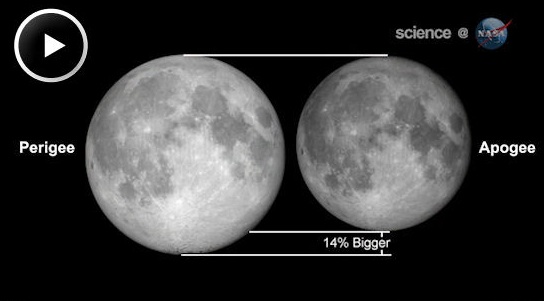
Tomorrow, March 19, is Candace’s birthday, and the Full Moon will be at the point on its elliptical orbit that is closest to the Earth. This nearest point is called the perigee.

Perigee moon

A NASA web page explains:

On March 19th, a full Moon of rare beauty* will rise in the east at sunset. It’s a super “perigee moon” – the biggest in almost 20 years. “The last full Moon so big and close to Earth occurred in March of 1993,” says Geoff Chester of the US Naval Observatory in Washington DC. “I’d say it’s worth a look*.” Full Moons vary in size because of the oval shape of the Moon’s orbit. It is an ellipse with one side (perigee) about 50,000 km closer to Earth than the other (apogee). Nearby perigee moons are about 14% bigger and 30% brighter than lesser moons that occur on the apogee side of the Moon’s orbit.

[* sounds like Candace]

And to top off all that, March 19 is still technically winter, and Full Moons during the winter seem brighter because they occur at a higher altitude in the sky than Full Moons in the summer.

So tomorrow night at sunset or shortly thereafter, when you see the particularly bright Full Moon rising, join the Moon and stars in wishing Candace a very happy birthday!

———-

UPDATE: We had a wonderful time this evening enjoying the rising Moon above the waters of Thunderbird Lake, east of town, with all three daughters and our son-in-law, following upon the Troupe’s participation in the Oklahoma City St. Patrick’s Day parade earlier in the day. A very beautiful night – the clouds just added character to the changing appearances of the Moon over the water. We could feel the Earth turning beneath our feet, and the months and years flying by in a joyous Irish dance.

Here are some photos shot by Stephen:

Candace Moon Clouds

Candace Moon

Candace Moon River

Posted in Family, Nature | Tagged | 2 Comments

Mars: earliest detailed sketches

Originally posted at ouhos.org, the now-discontinued blog of the OU History of Science Collections. Neither this post nor any of its content should be taken as an official communication of the University of Oklahoma.


MarsThe Collections have recently acquired a rare 1666 first edition of three separately issued broadsides (foglie volante) in which Giovanni Domenico Cassini (1625-1712, also known as Jean-Dominique Cassini) reported his observations of Mars, including the first detailed sketches of its surface, preceded only by highly schematic renderings by Fontana in 1636/1638 and Huygens in 1659.

Cassini, De aliis (1666)

Cassini was professor of astronomy at the University of Bologna until becoming the founding director of the Paris Observatory in 1671. In addition to his discoveries about Mars, Cassini is well-known for his observations of Saturn, including the discovery of four of Saturn’s moons and of the largest division between its rings, which now bears his name. In 1672 he devised a way to measure the distance between Mars and Earth, thereby allowing a better estimate of the solar system’s dimensions.

These broadsides are of great interest not only for their content but more generally for what they represent about the practice of astronomy in Italy in the generation after Galileo: all three are brief reports separately issued in quick succession in order to stake out what would nowadays be called an intellectual property claim. 

Among other details, they expressly identify the telescopes used and their maker; most notably, the 17-foot long telescope crafted by Giuseppe Campani. Also scrupulously credited are the correspondents who provided information and even a list of ten witnesses who could in principle verify the observations, including Geminiano Montanari.

Altogether, these documents provide highly interesting and little known documentation for how scientific results were disseminated. It is no accident that the present titles appeared just a year after the founding of the first two scientific journals in Europe: the Journal des Savans and the Philosophical Transactions of the Royal Society of London, in January and March of 1665 respectively. The present pamphlets share a version of experimental methodology like that championed by these journals: precise recording of observational data, especially by means of illustration and tables; description of the means and conditions by and under which the data was obtained; crediting other researches with corroborative data when appropriate; and naming a list of witnesses who could attest to the author’s observations if challenged.

Cassini, De aliis Romanis, 1666

In the first document, Martis circa axem proprium revolubilis observationes Bononiae (below), Cassini provided a page-long description of his observations of the dark areas of Mars, taken over a series of days in February, March, and April of 1666. The planet’s different phases, illustrated on the facing page (above), allowed Cassini to deduce that Mars rotated on its own axis, as well as to detect the planet’s large, Earth-like inclination to the ecliptic.

Martis, 1 Martis, 2 Martis, 3

In the second document, De aliis Romanis observationibus macularum Martis (below), Cassini discussed other interpretations of Mars’ markings. Referring back to both the text and diagrams of the previous document, he responded to the contentions of Francesco and Salvatore Serra that Mars’ rotational period was approximately 13 hours. By Cassini’s calculation, on the other hand, it was 24 hours 40 minutes — just 3 minutes off the modern value for Mars’ sidereal rotation.

De aliis, 1 De aliis, 2 De aliis, 3

Mars’ rotational period is the focus of the third document, De Periodo quotidianæ revolutionis Martis (below), in which Cassini offered a more detailed explanation of his data.

De periodo, 1 De periodo, 2

All three pamphlets were published by the same Bologna publisher in the same year. While issued separately, they form a consecutive series. The present set conforms to the Instituto Centrale per il Catalogo Unico delle Biblioteche Italiane collation of 6 leaves, of which the verso of the 4th leaf is blank and the 6th leaf is an integral blank.

CASSINI, Giovanni/Gian Domenico. Martis Circa Axem Proprium Revolubilis Observationes Bononiae. Bologna, HH de Ducius, 1666. Large 4to. [26.5 x 19.5 cm], (2) ff., including a full-page engraving.
__________. De aliis Romanis observationibus macularum Martis. Bologna, HH de Ducius, 1666. Small folio [30.5 x 21 cm], (2) ff., including 1 full-page engraving.
__________. De Periodo quotidianæ revolutionis Martis. Bologna, HH de Ducius, 1666. Small folio [30.5 x 21 cm], (2) ff., the second blank and integral. Disbound. Some staining but plates clean.
View catalog record.

Of the greatest rarity, we have located only 10 other copies: 2 in Florence, 4 in Paris, and 1 each in Bologna, Munich, Zurich and London (none in America).

View the entire work in the Online Galleries.

With our thanks to Seth Fagan and Nick Dew (McGill University) for their assistance with this description.

Posted in History of Science | Leave a comment

Can these voices live again?

Long, long ago in a far away galaxy, I directed the OBU Planetarium.

OBU Planetarium, photograph by Bill Pope
Photo by Bill Pope

My favorite show during my time there was Starstruck Tonight, which interweaved science and art, astronomy, poetry, mythology and human creativity, all in a 40-minute survey of the winter sky.

Hannah and Rachel.  Star Wars in the Planetarium.

In a future post, I’ll reconstruct the text of the show. But it would be even better if I could make available an audio file to listen to again, a soundtrack one might take outside under the stars. Needless to say, this show captures as well as I could in such a short span all that enchants me about the beauty of the night. But more than that, the narrator is Candace, whose voice is the sweetest and most beautiful sound in all creation. And the readers of the interspersed quotations include Rachel and Hannah, perhaps a year or so younger than pictured above, or in the photo below:

Stars Wars Cantina or Planetarium birthday party?

You decide: is this a Star Wars Cantina, or a Planetarium birthday party?
Can you count the Princess Leias?

Starstruck Tonight, ADAT tapes

So recovering and posting the soundtrack of Starstruck Tonight is something I’ve longed to do for a decade, but it’s not a technically trivial task. The show was recorded on ADAT tapes, as shown above. Session tapes hold the voice takes, and one is the master soundtrack. They look like SVHS tapes, which they are, but they are digital rather than analog recordings. They hold only audio, unlike video tapes. This was back in the era when a 200 MB computer hard drive seemed expansive, and each ADAT tape offered about 6 GB of digital storage!

Fostex RD-8, right side

To produce the show, instead of literally cutting and scotch taping reel-to-reel tape containing the various takes of the program, I stood in front of two synchronized ADAT decks, punching the Mark In and Mark Out buttons to splice the takes into the desired sequence, as shown in the above photo of the right side of a Fostex RD-8. The editing process took about a week, which seemed amazingly efficient at the time but would require less than an hour today in GarageBand. For our ADAT decks, we used Fostex RD-8s, each of which then cost $3,500 at a discount. (RD-8’s from the era of R2-D2; hmmmm. Their co-mingling in our planetarium proves they must be related.) This past Christmas, my parents and sisters pooled together and gave me an RD-8 they found on eBay for much more than such an obsolete piece of equipment should run, but in its day it was a glorious machine. Here’s my setup in our family room now:

Fostex RD-8, Focusrite Saffire Pro 24, ADAT tapes

A fiberoptic cable pipes 8 channels of ADAT digital audio from the Fostex RD-8 into the Focusrite Saffire Pro 24 audio interface (sitting on top of the Fostex RD-8). A firewire cable then carries the audio from the Saffire to my MacBook Pro running Logic Studio. Obtaining a Fostex RD-8 is just the first step; there remain many things that may yet go wrong. The first test was to format a new tape, to determine if the heads of the RD-8 needed cleaning – an expensive and difficult operation. The “dAtA” LED readout in the picture above was shot during formatting, and with great relief I can report that the formatting worked, so the heads appear to be okay. It still may be that the Starstruck Tonight tapes have aged beyond recovery, but my prayer is that, finally, due to the generosity of my family with this Christmas gift, those voices from the past will live again! In a few weeks, if successful, I’ll post the text and soundtrack for Starstruck Tonight.

“The hand of the LORD was upon me, and he brought me out in the Spirit of the LORD and set me down in the middle of the valley; it was full of bones. And he led me around among them, and behold, there were very many on the surface of the valley, and behold, they were very dry. And he said to me, “Son of man, can these bones live?” And I answered, “O Lord GOD, you know.” Then he said to me, “Prophesy over these bones, and say to them, O dry bones, hear the word of the LORD. Thus says the Lord GOD to these bones: Behold, I will cause breath to enter you, and you shall live. And I will lay sinews upon you, and will cause flesh to come upon you, and cover you with skin, and put breath in you, and you shall live, and you shall know that I am the LORD.”” (Ezekiel 37:1–6)

—–

Gallery of photos, including pictures of the installation of the planetarium. See also the Liberal Arts Planetarium powerpoint presentations for an explanation of the academic mission of the OBU Planetarium during my tenure.

Posted in Apple, Family | 2 Comments

Thesis pearls

“Pearls” are attained at great price.

Frodo once answered Gildor:

“It is said, ‘Go not to the Elves for counsel, for they will say both no and yes.’”

“Is it indeed?” laughed Gildor. “Elves seldom give unguarded advice, for advice is a dangerous gift, even from the wise to the wise, and all courses may run ill.”

Nevertheless, I’ve assembled some pearls of advice for any graduate student beginning a thesis or dissertation. Take it or leave it, as you will; the choice is yours. Yet with hopes that perhaps they may assist you in your quest, without lengthening your stay in Mordor unnecessarily, here are my “thesis pearls,” with best wishes for a safe journey:

Thesis Pearls, Kerry Magruder

—–

PS: Eric Ortlund assembles an excellent string of pearls for the young evangelical scholar here.

Posted in Education, History of Science | Tagged | 3 Comments

St. Patrick’s Day

Holidays

This week, spring break at OU, is also the week of St. Patrick’s Day! Our family celebrates March vigorously and joyously in the spirit of Celtic Christianity.

Rachel and Hannah [update: and now Susanna!] participate in an Irish dance troupe which has appeared annually in the St. Patrick’s Day Parade in Oklahoma City, and which performs at numerous Irish-oriented functions throughout the week. Their spring break is always packed full of performances for nursing homes, children’s homes, Irish organizations and public festivals. Here’s a photo of the Celtic Praise Troupe, led by Sarah Decker, from a recent [update: 2013] St. Patrick’s Day parade:

Celtic Praise Troupe at Oklahoma City St. Patrick's Day Parade, 2013

In addition to all the dance events, we celebrate the faith and courage of St. Patrick himself, whose prayer or “breastplate” is an inspiration to Trinitarian confidence and action in the face of daily danger from unseen forces:

Christ be with me, Christ within me,
Christ behind me, Christ before me,
Christ beside me, Christ to win me,
Christ to comfort and restore me.
Christ beneath me, Christ above me,
Christ in quiet, Christ in danger,
Christ in hearts of all that love me,
Christ in mouth of friend and stranger.

I bind unto myself the Name,
The strong Name of the Trinity,
By invocation of the same,
The Three in One and One in Three.
By Whom all nature hath creation,
Eternal Father, Spirit, Word:
Praise to the Lord of my salvation,
Salvation is of Christ the Lord.

Waymarks, Songs for the JourneyThe Northumberland Community singers offer a beautiful musical rendition of Patrick’s prayer, sung to the tune of “Parsley, Sage, Rosemary and Thyme.” This song appears on their CD entitled “Waymarks, Songs for the Journey.”

Other musical versions of St. Patrick’s prayer include the following:

Celtic Daily Prayer, a contemporary liturgy for daily community lifeI’ve sometimes given my family a book for either Valentine’s Day or St. Patrick’s Day. One year it was Celtic Daily Prayer, a beautiful collection of prayers for living through the Christian year compiled by the Northumbria Community mentioned above. Thanks to our friends Robin and Karen Noad, who as former participants in the Community introduced us to them and to this prayer book! This week is a perfect occasion to become acquainted (or re-acquainted) with this book of prayers and devotional reflections. Indeed, its Aidan readings for the month of March feature meditations on Patrick’s breastplate.

Thomas Cahill, How the Irish Saved CivilizationOne of the most insightful brief accounts of St. Patrick is found in Thomas Cahill’s bestseller, How the Irish Saved Civilization. Reading chapters 4 and 5, either silently or aloud together, is an ideal way to spark reflection not only on the faith and life of St. Patrick in his confrontation with Celtic paganism, but also on how his successful engagement with the Ireland of that time offers striking parallels for our witness to the grace of God in today’s similarly pagan, post-Christian culture. The week of St. Patrick’s annually affords us an inviting opportunity to learn from Patrick, and to revisit Cahill’s compelling essay.

“The key to Patrick’s confidence – and it is the sort of ringing, rock-solid confidence on which a civilization may be built, an unmuffled confidence not heard since the Golden Ages of Greece and Rome – is his reliance on “the Creator of Creation,” the phrase with which the Breastplate opens and closes. Our Father in heaven, having created all things, even things that have since become bent or gone bad, will deliver us, his children, from all evil. But our Father is not only in faraway heaven, but lives among us. For he created everything by his Word, which was with him in the beginning, which became flesh in the human Jesus, and flames out in all his creatures.” Cahill, p. 132.

Chi Rho page, Book of KellsThe heritage of the exuberant faith of Patrick is evident in the illuminated Book of Kells now held in Trinity College, Dublin. Created around 800 AD in Iona, a Celtic monastery founded by Columba off the west coast of Scotland, this manuscript of the four gospels consists of 680 pages, all but two of which are illuminated with elaborate celtic knots, interlacing, and depictions of various creatures. Even a square inch detail from the magnificent Chi Rho page (right) contains more interlacings than are easily counted by the unaided eye. In the 13th century, over 400 years after it was created, Giraldus Cambrensis wrote:

“Look closely at it and you will penetrate the innermost secrets of art; you will find embellishments of such intricacy, such a wealth of knots and interlacing links that you might believe it was the work of an angel rather than a human being.”

Wikipedia explains:

“The complexity of these designs is often breath-taking. In one decoration, which occupies one inch square piece of a page, it is possible to count as many as 158 complex interlacements of white ribbon with a black border on either side. Some decorations can only be fully appreciated with magnifying glasses, although glasses of the required power were not available until hundreds of years after the book’s completion. The complicated knotwork and interweaving found in Kells and related manuscripts have many parallels in the metalwork and stone carving of the period. These designs have also had an enduring popularity. Indeed many of these motifs are used today in popular art including jewelry and tattoos.”

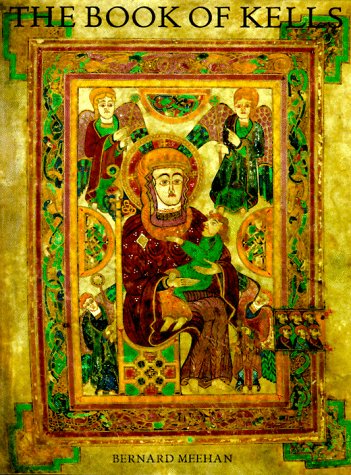
Bernard Meehan, The Book of KellsThis year my St. Patrick’s gift to our daughters is Bernard Meehan, The Book of Kells: An Illustrated Introduction to the Manuscript in Trinity College, Dublin.

When continental Europe was untamed and unsettled in the wake of the Germanic invasions, Celtic scholars worked in monasteries in Ireland and Scotland. These scholars copied and translated Greek and Latin works, and re-introduced them and the gospel of Christ to Europe as the northern areas became settled.

That same Celtic heritage appears today in Irish dance, which praises Christ with steps and music that make the Celtic knotwork come alive, jumping off the Chi Rho page, with lively sound and interlacing motion.

One more suggestion for families this week is to watch Secret of Kells, a remarkable animated portrait of medieval Celtic culture. The darkness of evil is portrayed with imaginative force that makes this film unsuitable for many children, but for pre-teens through adults it is a powerful cinematic experience not to be missed. I recommend the high-definition version available through iTunes, which (if you have an iMac, iPad or Apple TV) captures the detailed animations more richly than a DVD or web-streamed format.

Delightfully, the Secret of Kells movie includes a cat character named Pangur Ban. The filmmakers thus paid tribute to a 9th-century Celtic scholar who scribbled a poem in the margin of a manuscript of Virgil he was copying, in which he compared his scholarly activity to that of Pangur Ban, his cat:

“I and Pangur Ban my cat
‘Tis a like task we are at:
Hunting mice is his delight,
Hunting words I sit all night…

‘Gainst the wall he sets his eye
Full and fierce and sharp and sly;
‘Gainst the wall of knowledge I
All my little wisdom try.

So in peace our task we ply,
Pangur Ban, my cat, and I;
In our arts we find our bliss,
I have mine and he has his…”

The complete poem, much longer, is reproduced in Cahill, and available online at ceantar.org.

Pangur Ban, from The Secret of Kells

Caedmon's SongIn another post, I’ve quoted from Caedmon’s Song. An illustrated book with that title by Ruth Ashby makes another great St. Patrick’s family gift idea.

St. Patrick’s day is not only for the Irish!

Patrick and the heritage of Celtic Christianity belong to all of us. His holiday this week is worthy of vigorous, joyous, thoughtful celebration!

—–

See also:

Posted in Family | Tagged | 5 Comments

Kirksville Dental School moves forward

Wonderful news for Northeast Missouri!

From today’s ATSU news release (watch video):

At a press conference this morning on the Kirksville campus of A.T. Still University, Chair of the ATSU Board of Trustees Carl G. Bynum and University President Jack Magruder announced that the proposal for a dental school in Kirksville will move forward. President Magruder said, “A dental program on the Kirksville campus of ATSU is perfectly aligned with the mission of the University and the vision of the Board to address an unmet patient need in Missouri and to serve rural locations and underserved populations.”

Missouri Governor Jay Nixon sent the following message in support of the ATSU initiative:

“I am extremely pleased that the A.T. Still University Board of Trustees has decided to bring a branch of its school of dentistry and oral health to Kirksville. When it comes to higher education, Kirksville is truly a center of excellence in Missouri, and this new dental program will add to that existing strength. A.T. Still University has a long history of educating outstanding medical professionals, and providing care to individuals in need. We are proud to have this fine institution expanding here in Missouri. I congratulate the A.T. Still University Board of Trustees, President Magruder and the people of Kirksville for taking this important step forward for our state.”

President Magruder thanked the residents of Kirksville and the region for their generous support for establishing the dental program. Through the independent group Community Friends for ATSU Dental, numerous local businesses, organizations, and citizens raised over $1 million to help ATSU start the program in Kirksville. He also thanked the faculty and staff of ATSU, who gave generously in support of the new program. “That million dollars makes a tremendous statement,” Magruder said.

The Kirksville program will be a branch campus of the innovative and successful model of dental education at ATSU’s Arizona School of Dentistry & Oral Health in Mesa, Arizona.

Assuming capital requests are approved by the Board in order to proceed with construction of a building on the ATSU Kirksville campus, and the program receives accreditation, the first group of students will enter the program in fall 2013 and graduate in May 2017. It is anticipated that the size of the first class will be between 40 and 50 students, with the possibility of future expansion.

The new dental program will partner with Community Health Centers (CHCs) around Missouri, including one in Kirksville run by the Northeast Missouri Health Council. These partnerships will ensure that students receive the proper training and be exposed to all levels of patient procedures. Students will study in Kirksville for the first two years of the program and rotate into training slots at CHC locations around the state, including the one in Kirksville. Faculty and staff will need to be hired for the first two years’ instruction, as well as for supervising students in the third- and fourth-year CHC rotations.

“This is a wonderful and important development for the city of Kirksville, northeast Missouri, the State of Missouri, and A.T. Still University,” said President Magruder. “I am proud to be a part of this initiative and grateful to everyone who has played a role in bringing a dental program in Kirksville to this point.”

————–

Read more:

Congratulations, Dad! This was reason enough to come out of retirement.

Posted in Family | 6 Comments

The almighty love of God in Christ’s condescension

Index of Christmas holiday posts

The God of power, as he did ride
In his majestick robes of glorie
Resolv’d to light; and so one day
He did descend, undressing all the way.
– George Herbert

Intellectual historians know that the doctrine of divine omnipotence (“The God of power, as he did ride / In his majestick robes of glorie”) played a critical role in the development of science (see, for example, Osler’s quote in this post, or readings #1, 2 and 5 in this class assignment, or here or here).

Yet for some time, on both theological and experiential grounds, I’ve grown to become more and more convinced that it’s a serious mistake to separate the divine attributes and to consider them in abstraction from one another. Rather, we get started on the wrong foot in our thinking about God if we first consider divine omnipotence in an abstract manner apart from divine love. In the same way, we go astray if we talk about the glory of God or the holiness of God apart from, or in opposition to, the love of God revealed in Christ.

The Ordination of St. HilaryIn contrast, for Nicene Christian theology our knowledge of God comes through Jesus Christ in the Holy Spirit. This Christocentric and Trinitarian starting point produces a quite different framework of thinking that does not separate the divine attributes of omnipotence and love. Moreover, it takes the further step of grounding our understanding of divine love and omnipotence not in speculative reason, which projects human experience onto God, but in the self-revelation of God in Christ. That is, I am being true to Nicene theology when I refuse to think about divine omnipotence (or glory or holiness) except in relation to the astonishing fact that God demonstrated divine freedom by loving the world so much that he sent his Son for us and our salvation (“so one day / He did descend, undressing all the way”). Immanuel, God become man — that is the heart of a distinctively Christian doctrine of divine glory, holiness and omnipotence!

That this was the intention of the Nicene theologians is evident in the writings of Hilary of Poitiers (ca. 300-368), sometimes known as “the Athanasius of the West” (Athanasius was perhaps the leading theologian at the Council of Nicea). Confronting the Hellenistic philosophy of his day, Hilary shifted the terms of the debate from speculation about an omnipotent yet ineffable deity to the attributes of God as the Father revealed through Christ the Son. This shift occurs, for example, at the end of this paragraph from De Trinitate, Book 2, chapter 6:

“It is the Father to whom all existence owes its origin. In Christ and through Christ he is the Source of all. In contrast to all else he is self-existent. He does not draw his being from without, but possesses it from himself and in himself. He is infinite, for nothing contains him and he contains all things; he is eternally unconditioned by space, for he is illimitable; eternally anterior to time, for time is his creation. Let imagination range to what you may suppose is God’s utmost limit, and you will find him present there; strain as you will there is always a further horizon towards which to strain. Infinity is his property, just as the power of making such effort is yours. Words will fail you, but his being will not be circumscribed. Or again, turn back the pages of history, and you will find him ever present; should numbers fail to express the antiquity to which you have penetrated, yet God’s eternity is not diminished. Gird up your intellect to comprehend him as a whole; he eludes you. God, as a whole, has left something within your grasp, but this something is inextricably involved in his entirety. Thus you have missed the whole, since it is only a part that remains in your hands; nay, not even a part, for you are dealing with a whole which you have failed to divide. For a part implies division, a whole is undivided, and God is everywhere and wholly present wherever he is. Reason, therefore, cannot cope with him, since no point of contemplation can be found outside himself and since eternity is eternally his. This is a true statement of the mystery of the unfathomable nature which is expressed by the name Father: God invisible, ineffable, infinite. Let us confess by our silence that words cannot describe him; let sense admit that it is foiled in the attempt to apprehend and reason in the effort to define. Yet he has, as we said, in Father a name to indicate his nature: he is a Father unconditioned. He does not, as men do, receive the power of paternity from an external source. He is unbegotten, everlasting, inherently eternal. To the Son only is he known, for ‘no one knows the Father save the Son and he to whom the Son wills to reveal him,’ nor yet the Son save the Father. Each has perfect and complete knowledge of the other. Therefore, since ‘no one knows the Father save the Son,’ let our thoughts of the Father be at one with the thoughts of the Son, the only faithful witness who reveals him to us.”

Speaking of this passage, Thomas Torrance (one of the 20th century’s most influential Trinitarian theologians) comments:

“What overwhelmed Hilary, perhaps above all else in this respect, was the utterly astonishing power of God manifested in his condescension to become incarnate within the frame of poor creaturely humanity, and in his self-abasing life on earth in the lowliness of the flesh from the wailing infant in the cradle to the weakness of the man on the cross. That God Almighty should become so little, poor and helpless, all for our sake, while remaining who he eternally is as God, was an act of indescribable majesty and power beyond anything that unaided reason could grasp.” (Torrance, The Trinitarian Faith, p. 82.)

Thus the incarnation of Christ fully reveals the paradox glimpsed by Isaiah:

“For thus says the One who is high and lifted up, who inhabits eternity, whose name is Holy: ‘I dwell in the high and holy place, and also with him who is of a contrite and lowly spirit, to revive the spirit of the lowly, and to revive the heart of the contrite.’” (Isaiah 57:15)

Thomas F. Torrance, The Trinitarian FaithFor background context and an in-depth discussion, read The Trinitarian Faith, a magisterial work which Torrance, writer of more than 50 books, regarded as one of his three most important publications. In the cumulative and multi-faceted argument of this work, Torrance carefully elucidates how the Nicene fathers moved from the incarnate appearance of God in Christ to knowledge of the Father in the Holy Spirit. To mention just one example pertinent to the history of science, he shows how only in light of the incarnation did they articulate a doctrine of creatio ex nihilo, repudiating attempts to reach knowledge of divine omnipotence from the creation via a bridge of speculative philosophy.

In other words, divine omnipotence and glory are clothed with the gospel of Christ.

So in the spirit of Nicene theology, whenever I find myself talking with someone about “divine omnipotence” or “glory” or “holiness” in the abstract, don’t be surprised if I shift the terms of the discussion and say instead, “the almighty love of God in Christ…” (or “the glory of the love of God revealed in the humanity of Christ…” or “the holy love of God revealed in Christ…”).

“And the Word became flesh and dwelt among us, and we have seen his glory, glory as of the only Son from the Father, full of grace and truth.” (John 1:14)

Where do we find a holy God of almighty glory? Only in the condescending love of Christ, who for us and our salvation “did descend, undressing all the way.” From “the wailing infant in the cradle to the weakness of the man on the cross” – that is what omnipotence, holiness and glory look like. The gospel is in the manger.

Posted in Theology | Tagged , , | 16 Comments

Kepler and the snowflake

Originally posted at ouhos.org, the now-discontinued blog of the OU History of Science Collections. Neither this post nor any of its content should be taken as an official communication of the University of Oklahoma.


Johann Kepler, Strena (1611), University of Oklahoma Libraries, History of Science CollectionsToday when the University has shut down because of this beautiful snowfall, let’s remember Johann Kepler, one of the most innovative astronomers who ever lived. Yet his contributions reached far beyond the realm of astronomy – to meteorology, mathematics, geology, mineralogy and crystallography.

In 1611, Kepler published a little pamphlet as a New Years greeting for some friends. Entitled Strena, seu de Nive Sexangula, it contained a study of the snowflake. Kepler distinguished the way organisms grow from the growth of crystals by accretion, and pioneered geometrical methods for explaining crystal packing. The work stimulated inquiry in mineralogy for the next two centuries. Indeed, as recently as 1998, Thomas Hales provided what is generally regarded as a mathematical proof of one of Kepler’s conjectures about crystal packing (cf. “Kepler’s Conjecture“).

The Strena (1611) is quite rare, and illustrates the depth of the OU Kepler collection which includes first editions of all of his major works. 30 works by Kepler published before 1700 are held in the OU History of Science Collections. We have digitized the Strena and it is available in our online galleries. The Collections also hold an English translation: The Six-Cornered Snowflake, trans. Colin Hardie (Oxford: Clarendon Press, 1966). For a brief discussion of the Strena’s contents, see Cecil J. Schneer, “Kepler’s New Year’s Gift of a Snowflake,” Isis, 51: 1960, 531-545 (available online at JSTOR).

Posted in History of Science | Leave a comment