Advent Celebration

Index of Christmas holiday posts

Each year, early in Advent, we host an Advent Celebration in our home. After a pot-luck meal, we gather for a participatory Advent devotional. In this time of joyous worship together, we recount the story of Christmas via “lessons and carols,” i.e., alternating singing Christmas carols with readings of scripture and poetry. The atmosphere is casual, family-style. Although it is designed for adult worship, children are most welcome. Indeed, we’ve enjoyed this tradition since our oldest daughters were very young — and we still use the handout originally laid out decades ago on a 1980’s vintage Mac computer (with here and there a few new quotations inserted).

Download it, create your own, and consider hosting an Advent celebration for your family and friends…

Caroling at the Mall
Advent Celebration | Epiphany Celebration

See a previous post for our favorite carol/songbooks.

Update (Monday, Dec 6): some photos from our Advent celebration this year:

December-2010 78.jpg

December-2010 79.jpg

December-2010 81.jpg

December-2010 76.jpg

December-2010 75.jpg

Before the lessons and carols we enjoyed eating and just being together:

December-2010 71.jpg

December-2010 69.jpg

And we now have Christmas lights!

December-2010 64.jpg

Posted in Family | Tagged , | 12 Comments

Christmas Caroling

Index of Christmas holiday posts

Go Christmas caroling sometime this Advent!

Why not plan a caroling party? Meet together to review some favorite carols, and even discuss their sources and history; then go caroling around the neighborhood, to the homes of shut-ins, or in nursing homes.

Got kids? As toddlers, our daughters would act out the Christmas carols we sang with their own plastic nativity sets. They didn’t need to memorize the words. And don’t hesitate to take children caroling with you!

The joy is contagious:

See Christmas nights at home for our favorite carol collections, histories and songbooks.

Update, December 13, 2010
Here are some carolers who braved the brisk temperatures last night to go caroling in our neighborhood (click any photo for a larger view):

After caroling

What a privilege for Candace and I to host these happy carolers, and offer them hot chocolate and hot apple cider after they spent a couple hours outdoors, on one of the coldest nights of the year for us so far, warming neighbors’ hearts with the joyous sounds of Christmas:

Happy Carolers

Here’s Gabe conducting the still-enthusiastic chorus:

Gabe conducting

Thanks, Hannah, for organizing this caroling party!

Other posts related to caroling include:

Posted in Family | Tagged , | 9 Comments

Why make such a big deal about Christmas?

Index of Christmas holiday posts

How the Grinch Stole ChristmasDifferent people react differently to Christmas traditions, such as those listed in the previous post, Christmas nights at home.

If you and your family choose not to celebrate Christmas like we do, or even not to observe Christmas at all, we certainly have no objection and will not think of you as a grinch. 🙂 The history of Christmas observance is complex and fascinating! And every family is different. There is no right or wrong way to celebrate Christmas.

Note: I’m speaking here of Christmas; not the involuntary Xmas commercial “racket,” as C. S. Lewis described it in God in the Dock (“Xmas and Christmas,” and “What Christmas Means to Me”; cf. Skipping Christmas.)

Yet surely we can all agree that it is not wrong for those who voluntarily choose to celebrate Christmas to observe it in ways they enjoy.

For our part, we celebrate Christmas the way we do for both theological and practical reasons:

Theologically, Christmas is a celebration of the Incarnation, of God becoming human flesh. It is a mistake to separate the person of Christ and his work; they are one and the same. The union of God and humanity in Christ is the gospel, and not even the cross or resurrection may be properly understood apart from it. Practice and belief go together. The mystery of the Incarnation cannot be fathomed in a lifetime of reflection. So the practice of Christmas may lead us to discern internal connections between the person of Christ and all that we believe.

As a youngster, I remember coming to believe that there was a joy behind Christmas that would be a mysterious center of Christian faith, if I could devote myself to searching it out.  My continual desire to practice Christmas over the years led me to ponder the Incarnation as central, the mystery of Immanuel as very God and very man, and therefore to Trinitarian theology.

Practically, the celebration of Christmas met our desire as parents of young children to infuse their lives with the joy and imagination of Christian faith.

And even apart from child-rearing, loosely following the liturgical year appeals to us because it shapes the years of our lifetimes together in the same way that the melodies and rhythms of music shape our temporal experience on a shorter time-scale, and it connects us through the ages in the communion of saints.

For us, the most important aspect of celebrating Christmas is joy. So the question is not whether others celebrate Christmas like we do, but that in whatever each family chooses to do, it’s all done for joy, not out of mere social convention or obligation.

So, again, regardless of what you choose to do, we wish you a Merry Christmas!

Posted in Family | Tagged , | 3 Comments

Christmas nights at home

Index of Christmas posts

These are some of the movies, books and music we enjoy on nights at home during Advent (between Thanksgiving and Christmas Day) and Christmas (the 12 days beginning on Christmas Day and leading up to Epiphany). If you’re looking for things to do, perhaps you’ll recognize some of them as among your favorite activities, too, and perhaps others will offer some new ideas that appeal to you.

Posted in Art-Music-Lit, Family | Tagged , | 28 Comments

The Joy of Christmas

Index of Christmas holiday posts

JRR Tolkien, Letters of Father ChristmasJust as music gives shape to a few moments of the day, so seasonal celebrations give shape to the years of our lives. With this in mind, therefore, when Candace and I were first married, we wanted to think of ways to ensure that Christmas would be characterized by joy throughout our lives together. So from the start we settled upon some family traditions that would give joyous shape to our lives during this season. These traditions have proven to be very meaningful both to us and to our children through the years, so in the next several posts I’ll describe some of our traditions for Advent and Christmas.

However, the most important point to clarify up front about these family traditions, from singing carols to reading aloud, is that everything we do is all done for joy.

In his hilarious comedy, Skipping Christmas, John Grisham parodies holiday traditions that arise simply out of convention or in obeisance to commercialism, nationalism and civic religion which we (like Grisham) seek to subvert. Rather than obligatory recital performances conducted with grim resolve, our traditions are joyous jazz improvisations on a recurring theme. Rather than adding even more commitments to an already over-long list of holiday to-do’s, they breathe life into the season by creating space for joyous memories together.

This year try reading aloud the nativity account from Luke, asking others to shout at every word they hear that is either joy or a word derived from joy (rejoice, overjoyed, etc.). You’ll be surprised at the chaos that will ensue! As Tolkien wrote:

“The Birth of Christ is the eucatastrophe of Man’s history. This story begins and ends in joy. It has pre-eminently the inner consistency of reality. This story is supreme, and it has entered history. It is pre-eminently (and infinitely, if our capacity were not finite) high and joyous. There is no tale ever told that men would rather find was true, and none which so many sceptical men have accepted as true on its own merits. To reject it leads either to sadness or to wrath.” — J.R.R. Tolkien, “On Fairy Stories“

Joy is what our Christmas traditions are about.


————–
See also: Why make such a big deal about Christmas?

Posted in Family | Tagged , , | 7 Comments

Miracle on Oak Grove St.

Thanksgiving and Christmas seasons – index
Christmas tree, 2010

The day after Thanksgiving, as usual, we began decorating the home for Christmas. We didn’t get the outside lights up, but we all had fun getting the Christmas boxes down from the attic and unpacking them. Our home is now filled with seasonal music. The Christmas books occupy a couple shelves in the family room bookcase. The nativity is on the buffet – except for the magi, who are journeying toward Bethlehem from far away (over by the George MacDonald books). The Christmas tree looks beautiful! Santas and Nutcrackers are on the fireplace, the stockings are hung, and signs of Christmas appear throughout every room in the house.

Miracle on 34th StreetTo celebrate all that we accomplished, in the evening we snuggled up to watch Miracle on 34th Street. This classic movie offers an ideal bridge from Thanksgiving to Advent, as it opens with Macy’s Thanksgiving parade and ends on Christmas day. The screenplay of the old black and white version is expertly crafted, and the actors and actresses are unsurpassed (Edmund Gwenn, Maureen O’Hara, John Payne, Gene Lockhart, Natalie Wood).

Let me offer just a quick note to clarify the last comment of the film, spoken by the lawyer when he notices Kris Kringle’s cane in the corner and realizes that the verdict and all that ensued was not simply due to his own courtroom skills: “Maybe I didn’t do something so wonderful after all.” The word “wonderful” has changed enough in meaning that this ending has lost something over the years. “Wonderful” was once a synonym for “miraculous,” so a screenwriter today might update that line to run something like this: “Maybe I’m not such a miracle-worker after all!” In other words, he came to better appreciate that Kris contributed more than a little magic of his own. 🙂

Posted in Family | Tagged , , | 5 Comments

Happy Thanksgiving!

Thanksgiving and Christmas seasons – index

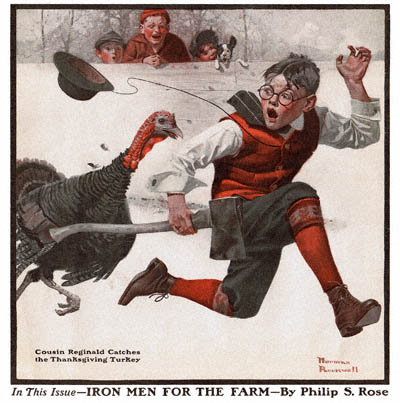
Norman Rockwell, ThanksgivingWhat makes Thanksgiving a special time in your family?

One of the traditions we enjoy is to prepare slips of paper with Thanksgiving-related Scripture verses and quotations. We place them underneath each plate at the Thanksgiving meal. When the plates are taken up, we enjoy an interlude from eating to take turns reading each quotation aloud before desert.

Here are the quotes we put under the plates:

Moses (Leviticus 23.39-41): “After you have gathered the crops of the land, celebrate the festival [of Tabernacles] to the Lord for seven days; . . . take choice fruit from the trees, and palm fronds, leafy branches and poplars, and rejoice before the Lord your God for seven days. Celebrate this as a festival to the Lord for seven days each year. This is to be a lasting ordinance for the generations to come….”

Psalm 100:
“Shout for joy to the Lord, all the earth.
Serve the Lord with gladness;
come before him with joyful songs.
Know that the Lord is God.
It is he who made us, and we are his;
we are his people, the sheep of his pasture.
Enter his gates with thanksgiving
and his courts with praise;
give thanks to him and praise his name.
For the Lord is good and his love endures forever;
his faithfulness continues through all generations.”

The First American Thanksgiving: “The orthodox Puritans of New England objected to the observance of Christmas on the ground that this was a Catholic custom. Accordingly, except in Rhode Island, Christmas was not celebrated in New England at any time during the colonial period. The place of Christmas was taken by the Thanksgiving season. The custom of offering public thanks for material blessings, which had its origin in Europe before the Reformation, was first observed in English America in the fall of 1621, when the Pilgrims celebrated their first harvest by several days of feasting and thanksgiving…. From time to time in the seventeenth century a day was set aside for thanksgiving by the Puritans, and by the end of the century there had grown up in Massachusetts and Connecticut the practice of observing Thanksgiving regularly once a year. This holiday usually lasted about a week and was a time of festivity as well as one of religious observance.” (Chitwood, et al., The United States: From Colony to World Power; p. 83.)

Edward Winslow, Plymouth, Massachusetts, 1621:
“Our harvest being gotten in, our Governor sente four men out fowling that so we might, after a more special manner, rejoyce together after we had gathered the fruit of our labours. These four, in one day, killed as much fowl as, with a little help besides, served the company almost a week, at which time, amongst other recreations, we exercised our armes, many of the Indians coming amongst us. And amongst the rest, their greatest King, Massasoit, with some ninety men, whom, for three days, we entertained and feasted…. And although it be not always so plentifull as it was at this time with us, yet, by the goodness of God, we are so farr from wante that we often wish you partakers of our plentie.”

William Bradford, 1590-1657; Of Plymouth Plantation:
“Being thus arrived in a good harbor, and brought safe to land, they fell upon their knees and blessed the God of heaven who had brought them over the vast and furious ocean, and delivered them from all the perils and miseries thereof, again to set their feet on the firm and stable Earth….”

George Washington: “Now, therefore, I do recommend and assign Thursday the Twenty-Sixth Day of November next, to be devoted by the People of these States, to the Service of that great and glorious Being, who is the beneficient Author of all the good that was, that is, or that will be: That we may then all unite in rendering unto him our sincere and humble thanks for his kind Care and Protection of the People of this Country.”

Thomas à Kempis (1380-1471): “Be thankful for the smallest blessing, and you will deserve to receive greater. Value the least gifts no less than the greatest, and simple graces as especial favors. If you remember the dignity of the Giver, no gift will seem small or mean, for nothing can be valueless that is given by the most high God….”

Turkey Talk: The North American turkey is native to Ontario, the United States and Mexico. Domesticated turkeys all over the world are descended from the wild turkey of North America. The Aztec Indians of southern Mexico domesticated them before the arrival of Europeans. The Spanish brought turkeys back to Europe after 1519, and turkeys eventually arrived in England around 1541. Turkeys were described, for instance, in Sumario de la natural historia de las Indias, published by Oviedo (1478-1557) in 1527. The French name for turkey is dindon, a shortened form of the earlier name coq d’inde: cock of the Indies. By West Indies they meant the Americas, of course. The Jesuits bred them in large numbers, and in some places the common name for turkey is jesuite. But then where did the English name for turkeys come from? The Portuguese used to capture African guinea-fowl, which they shipped to Europe through Turkish territory. For some time the African guinea-fowl and the North American Turkey were called by the same name, Meleagris (as in the classification of Linnaeus), until gradually “turkey” became restricted to the North American bird. Benjamin Franklin argued for the Turkey rather than the Bald Eagle to be our national bird.

James, a brother of Jesus (James 1.17): “Every good and perfect gift is from above, coming down from the Father of the heavenly lights, who does not vary or change like shifting shadows.”

Paul (1 Timothy 4:3): [Hypocritical liars] “forbid people to marry and order them to abstain from certain foods, which God created to be received with thanksgiving…. For everything God created is good, and nothing is to be rejected if it is received with thanksgiving….”

Ralph Waldo Emerson: “Cultivate the habit of being grateful for every good thing that comes to you, and to give thanks continuously. And because all things have contributed to your advancement, you should include all things in your gratitude.”

C.S. Lewis: “The settled happiness and security which we all desire, God withholds from us by the very nature of the world: but joy, pleasure, and merriment He has scattered broadcast. We are never safe, but we have plenty of fun, and some ecstasy. It is not hard to see why. The security we crave would teach us to rest our hearts in this world and oppose an obstacle to our return to God: a few moments of happy love, a landscape, a bathe or a football match, have no such tendency. Our Father refreshes us on the journey with some pleasant inns, but will not encourage us to mistake them for home.”

The apostle John, in a vision (Revelation 7:12): “Praise and glory and wisdom and thanks and honor and power and strength be to our God for ever and ever. Amen!”

Additional Readings:

Exodus 23: 14-17; 1 Chronicles 29:10-14; Psalm 50:23; 92:1-4; 100:1-5; 116:12-13, 17; 136: 1, etc.; Psalm 145; Jonah 2:2,9; Romans 1:21; Ephesians 5:19-20; Philippians 4:4-7; Colossians 2:6-7; 1 Thessalonians 5:16-18; Hebrews 13:15; Revelation 7:12-17.

Psalm 145 also makes appropriate additional reading, or consider one of the antiphonal psalms, in which a leader and the rest of the family may read in turn (e.g., Ps. 118, 100-111; 140-150).

After the meal:

What a great time to read aloud Thanksgiving poetry and enjoy singing together!

Hymns and folk songs:

  • Over the River and through the Wood (Thanksgiving Day, Lydia Child)
  • Gather Round, ye thankful ones
  • All good gifts (Godspell)
  • For the Beauty of the Earth
  • Praise to the Lord, the Almighty
  • Come, Thou Fount of Every Blessing
  • Come Ye Thankful People Come
  • Now Thank We All Our God
  • We Gather Together to Ask the Lord’s Blessings

Poetry:

These two poetry books are wonderful fun!

Watch TV:

Finally, no list of our family Thanksgiving traditions would be complete without noting that we always watch the Macy’s Thanksgiving Day parade first thing Thanksgiving morning. Then, before the end of Thanksgiving break, we watch Miracle on 34th Street, which makes a perfect bridge between Thanksgiving and Advent (more on that in the next post).
Posted in Family | Tagged , | 3 Comments

Look at us, after 25 years!

Candace in the 1980'sLook at us…

After all these years together
Look at us
After all that we’ve been through
Look at us
Still leaning on each other

If you want to see
How true love should be
then just look at us

On the Saturday before Thanksgiving, 25 years ago, Candace and I had dinner together. By the end of December we had decided to marry, which we announced to our families the first Sunday in the new year.

On that long-ago Saturday in November I was visiting my parents for the weekend, and around mid-afternoon I realized that preparations for an evening meal were far more involved than could be justified merely by my presence. Clearly something on a larger scale was in the works. Someone else had to be coming as the guest of honor. When Mother told me they had invited Candace over for the evening, my heart jumped.

Flashback: Neither Mother nor Dad (nor Candace) knew that I had called her apartment to ask her out six months earlier. After hearing her sing early in the summer, I had marveled not only at the smooth, rich clarity of her voice but even more at the thoughtful and articulate reflections with which she introduced the song. I was instantly in love, and just had to meet her. Unfortunately, just as I was returning to Kirksville for the summer, she began spending her weekends in St. Louis where, as her roommate informed me, her father was hospitalized after a farm accident. So I knew I should not complicate her life at that point.

Fast forward a few months later to that Saturday afternoon in November. How surprised I was, then, to hear that my parents had decided we should meet, and took the opportunity to “set us up” when they knew I was coming home for the weekend.

Candace and Kerry circa late 1985.

Thank you, Mother and Dad, for your initiative in hosting that November dinner 25 years ago! And thank you, Michael and Rhonda, and LaNita, for playing your part as additional guests and “facilitators” on that occasion! Your efforts worked out better than you probably could have imagined…

Look at you
Still pretty as a picture
look at me
Still crazy over you
Look at us
Still believin’ in forever

Candace and Kerry circa late 1985.

Look at us
After all these years together
Look at us
After all that we’ve been through
Look at us
Still leaning on each other

Candace and Kerry circa late 1985.

Chances are
We’ll go down in history
When they want to see
How true love should be
They’ll just look at us

Vince Gill, “Look at Us” Look at Us - Souvenirs

Candace and Kerry circa late 1985.

Gallery.

Posted in Family | 12 Comments

Evangelicals and Evolutionary Creation

Darwin 2009 – OU History of Science Collections from Kerry Magruder on Vimeo.

OU Darwin 2009This Darwin 2009 video (m4v, mp4, download) explains that the OU History of Science Collections is one of the handful of places in the world where one may view a complete set of first editions of the works of Charles Darwin. As curator, I was eager to recognize 2009 as the 150th anniversary of publication of Darwin’s Origin of Species (1859) and the 200th anniversary of Darwin’s birth. To celebrate this occasion and to encourage discussion of Darwin’s significance, I invested a large amount of effort in several projects, including:

  • co-curating “Darwin at the Museum,” an exhibition of the Darwin collection at the Sam Noble Oklahoma Museum of Natural History in Fall 2009;
  • providing digitized versions of 40 rare Darwin editions to the Darwin Online project of Cambridge University, which made OU the largest contributor to that project other than Cambridge; and
  • arranging campus visits by paleontologist Keith Miller and Darwin historian Janet Browne, who together offered four public lectures in the OU Darwin 2009 series which were exemplary in their insightful and non-polemical engagement with issues.

In addition, continuously throughout the year, I offered countless tours of the Darwin collection; gave presentations to area civic, church and educational groups; and engaged in discussions with students in various formal and informal settings. Obviously, there was no time last year to create this blog, but if I had, it would surely have seen a great number of Darwin-related posts (to which perhaps I’ll have opportunity to return sometime in the future).

Yet from time to time I am asked how evangelicals can approve of, or be attracted to, the Darwinian theory of evolution. Without here entering into the myriad of issues involved, I nevertheless want to list some resources I recommend as great starting points for thinking through evangelical perspectives on an evolving creation:

  • Evangelical Christians and Evolution – Some Points for Discussion (pdf). This is a 16-point handout I prepared to jump-start discussions with Christian students. To discuss any single point on this handout could legitimately take many days, so, of course there’s no time to touch upon even half of them in a single sitting. Nevertheless, the handout still hopefully offers some sense of the issues that I personally think should be frequently discussed.
  • Get some theological bearings: Thomas F. Torrance, Divine and Contingent Order (T & T Clark, 2005). This little book by one of the 20th century’s leading theologians (more on Torrance) is an influential theological discussion of contingency, an essential consideration for thinking about a Christian view of creation and its history. For an even shorter discussion, whet your appetite for the book by reading T. F. Torrance, “Divine and Contingent Order,” in A.R. Peacocke, ed., The Sciences and Theology in the Twentieth Century (Notre Dame, 1981), pp. 81-97. For Torrance, the principle of contingent order reflects divine freedom and provides an alternative to all explanations couched in terms of chance and necessity. As he explains (p. 85):

    “The universe is contingent for it does not exist of necessity: it might not have been at all and might very well have been different from what it is. Yet in coming to be, the universe is characterised by an open-structured order which partakes of contingence.”

    Quite mistakenly, contingency — the leading characteristic of Darwin’s view of the history of nature — is sometimes taken by advocates of evolution as an argument against Christian theism. For example, in his classic book Wonderful Life, which at one time was the second-favorite book of professional geologists in the United States, Stephen Jay Gould argued that paleontological research regarding the unique organisms captured in the Burgess Shale of British Columbia demonstrates the contingency of Earth history. These fossils, Gould wrote, have

    “confronted our traditional view about progress and predictability in the history of life with the historian’s challenge of contingency -— the “pageant” of evolution as a staggeringly improbable series of events, sensible enough in retrospect and subject to rigorous explanation, but utterly unpredictable and quite unrepeatable. Wind back the tape of life to the early days of the Burgess Shale; let it play again from an identical starting point, and the chance becomes vanishingly small that anything like human intelligence would grace the replay.” — Stephen Jay Gould, Wonderful Life: The Burgess Shale and the Nature of History (Norton, 1989), p. 14.

    Gould’s quotation describes events as contingent when they:

    1. might have turned out otherwise,
    2. are not deducible or fully specifiable in advance,
    3. may be rare or unusual,
    4. but nevertheless become intelligible when considered in retrospect by methods such as historical reconstruction.

    However, this conception of creation as contingent is theologically orthodox. Affirmation of the intelligibility of rare events reflects a long-standing theological usage of contingere. Torrance explores how, in patristic theology, the Incarnation and creatio ex nihilo served as two prime exemplars of rare or even unique but nevertheless intelligible (and therefore contingent) events. In traditions of Christian theology which give adequate attention to divine freedom, the entire creation is viewed as contingent. It is no wonder, then, that Gould took his leading metaphor, A Wonderful Life, from a classic Christmas movie which conveyed the message that God is constantly at work through hidden providences within the history of our lives. It is the same way with a Christian view of nature and the history of nature. What Gould sees as chance, Christians see as contingency, the mark of a transcendent Creator who, unlike some deistic watchmaker, remains intimately involved within his creation.

  • Get some historical bearings: Margaret Osler, Divine Will and the Mechanical Philosophy (Cambridge University Press, 2005). Osler’s study of the Scientific Revolution represents how historians of science in general have discussed the significance of ideas of contingent order and the development of science. Osler concludes (p. 236):

    “Evolution does not have a predictable and determinate course of a kind that can be known by a priori and deductive methods. The metaphysical assumptions underlying this style of evolutionary science can be traced back to a voluntarist interpretation of the biblical worldview. Although theological language has dropped out of scientific discourse, contemporary styles of science are historically linked to the dialectic of the absolute and ordained powers of God. The interplay between necessity and contingency in the world is now constructed entirely in naturalistic terms, but it grew from roots embedded in an earlier, theological understanding.”

    Osler’s study can serve as an introduction to a vast historical literature on the significance of divine freedom (and “voluntarist theology”) for the development of science that deals with figures from Basil and Augustine to Ockham and Newton (e.g., Oakley, Funkenstein, Courtenay, Wojcik, Force, Davis, et al.).

  • The historical context before Darwin: learn a little about the role of contingency in science between the Scientific Revolution, as studied by Osler, and Darwin. Given that Darwin himself first made his scientific reputation as a geologist, the most obvious place to look is the history of geology and the gradually emerging consensus before Darwin’s generation that the Earth itself has a contingent history. Evangelicals often embraced a view of the Earth’s contingent history, in contrast to the deterministic developmental scenarios of materialists and the steady-state views of deists. This topic is briefly surveyed by Martin Rudwick in a published lecture on the role belief in divine freedom played for the articulation of contingent geohistory: Geology and Genesis (Baylor University, 2005; download as pdf). As an example, Rudwick discusses the theological context of the geological ideas of Jean André de Luc:

    “The impact of de Luc’s theistic commitments can be seen in the radical contingency that he attributed to earth history, and which he grounded in God’s ultimate role as creator of everything. As de Luc conceived it, earth history at every stage could have taken another course, with a different outcome, without of course abrogating the ordinary laws of nature. It followed that the sequence of events could not, even in principle, be inferred from the ahistorical laws of physics, as both Hutton and Buffon implied: there was too much contingency in earth history, as in human history, for any such determinism. Rather than imposing top-down some grand conclusion of what “must” have happened, based on unchanging laws of nature, it was necessary, in de Luc’s view, to assemble bottom-up the evidence of nature’s documents and archives, which showed what in fact had happened. So the new way of analyzing the physical traces of earth history, applying the methods of reconstruction being used for human history (including biblical scholarship) was not just an effective heuristic but was rooted in an ultimately divine reality.”

    Rudwick’s larger account of the development of “geohistory” is a two-volume work, Bursting the Limits of Time (the generation of Cuvier) and Worlds Before Adam (the generation of Lyell); both published by Chicago University Press (2005, 2008). An older and still valuable work is Reijer Hooykaas, Natural law and divine miracle;: The principle of uniformity in geology, biology and theology (1963). Also, one of my articles samples ideas of contingent Earth history prior to the figures discussed by Rudwick: “The Idiom of a Six Day Creation and Global Depictions in Theories of the Earth,” in Martina Kölb-Ebert, ed., Geology and Religion (Geological Society of London, 2009), pp. 49-66.

  • Read a little Darwin: An excellent brief account is Darwin’s Origin of Species: A Biography (Harvard University Press, 2006), by Janet Browne, a distinguished professor of the history of science at Harvard and author of the acclaimed two-volume Darwin biography. My favorite edition of the Origin is the illustrated edition (Sterling, 2008); the annotated facsimile edition (Harvard, 2009) is very handy also. Darwin’s most popular book throughout his lifetime was his Voyage of the Beagle, which we’ve made available in a well-illustrated 1890 edition and is soon to come out in a deluxe edition. How odd it would be to criticize Darwin without first giving him a fair reading! He published 19 different books, but these two titles are a great place to start.
    Update: Read the Darwin@theLibrary brochure (pdf) I wrote for a recent exhibit of Darwin first editions.

    Darwin, Zoology of the Voyage of the Beagle

  • Get some general perspective on the history of science and religion, particularly in the debates over evolution: Ronald Numbers, The Creationists (Harvard University Press, 2006), and Numbers, ed. Galileo Goes to Jail and other Myths about Science and Religion (Harvard University Press, 2010), provide general historical perspective on the history of science and religion, and on the development of young-earth creationism, evolution, and intelligent design. For a précis of the former, see Numbers, “The Creationists,” in Numbers and Lindberg, God and Nature (University of California, 1986), pp. 391-423.
  • Supplement the general historical perspective offered by Numbers, above, with three works about the favorable historical reception of evolution by evangelicals:

    “I am a Darwinian of the purest water.” — B.B. Warfield

  • Study the evidence: To make sure that you’re not getting a sense of the evidence for evolution only from the works of its detractors, read at least one rebuttal to creation science and intelligent design. An excellent work of this kind is Donald Prothero, Evolution: What the Fossils Say and Why It Matters (Columbia University Press, 2007), particularly the second half. Check out the chapters on the origin of birds and the origin of whales, for instance. (For a brief summary see this web page Evolution and the Fossil Record of the American Geological Institute.) If you have heard that the theory of evolution is plagued with missing links, then you’ll be in for a huge surprise at the actual abundance of transitional forms preserved in the fossil record. The failure of evangelical Christians to read books like this rebounds back to bite us with aggressive atheist bumper stickers like the ones shown below:

    We have the fossils.  We win.

    Got kids? Visit the natural history museum often, subscribe to National Geographic (they have a Kids version, too), and buy illustrated books like Arnold, Dinosaurs with Feathers.

  • Read three works by evangelical Christians representing the current evangelical engagement with evolution:
    • Keith B. Miller, ed., Perspectives on an Evolving Creation (Eerdmans, 2003). Miller is a paleontologist at Kansas State University. Miller’s book contains chapters on such topics as Charles Hodge, B.B. Warfield, the fossil record, biochemical evolution, and Christology, distributed among three parts devoted to historical context, scientific evidence, and theological insights.
    • Francis Collins, The Language of God (Free Press, 2006). Collins, the former head of the Human Genome Project, explains the evidence from biochemistry and genetics in layman’s terms and articulates the theological vision underlying his BioLogos project.
    • Darrel R. Falk, Coming to Peace with Science (InterVarsity, 2004). Falk’s book sensitively recounts his journey as an evangelical biologist to reconcile evolution and Christian faith.

    I recommend all three of these books as starting points to help evangelical students majoring in any of the natural sciences begin to think through these issues. Miller, Collins and Falk have websites, and you can search for recorded lectures by them online and at iTunes U.

The sources listed above are not in any way meant as the last word, nor as a review of current publications in the history of science and religion, but in my opinion, they do collectively offer a sound starting point for any evangelical wishing to begin to think through these issues.

In conclusion, in answer to the bumper sticker shown above, here’s what the rear of my 1986 Subaru Brat looks like:

My 1986 Subaru Brat

Above the two Apple decals, beneath the “Subaru GL,” there’s a “fishconciliation” magnet:

Fishconciliation

Whether parked at church or university, onlookers are likely to be perplexed and astonished by one fish or the other.

Posted in History of Science, Nature | Tagged , , , , , | 4 Comments

Ebooks


The New Yorker, May 7, 2012

Why ebooks?

Most publishers now offer ebooks as an option for many of their titles. Amazon and other retailers report that ebook sales have already surpassed the sales of hardcover books and of paperback books.

“Amazon began selling hardcover and paperback books in July 1995. Twelve years later in November 2007, Amazon introduced the revolutionary Kindle and began selling Kindle books. By July 2010, Kindle book sales had surpassed hardcover book sales, and six months later, Kindle books overtook paperback books to become the most popular format on Amazon.com. Today, less than four years after introducing Kindle books, Amazon.com customers are now purchasing more Kindle books than all print books – hardcover and paperback – combined.” Amazon news release, May 19, 2011

Update 5/2012: Pew Research Center, “The Rise of E-Reading”; summarized visually by Online Universities (at bottom of this post).

Book reader of the future, ca. 1935, Smithsonian
Book reader of the future (1935); Smithsonian

Finding ebooks

Millions of free ePub books, including thousands of primary sources in the history of science, are available from the following non-commercial sources:

New to ebooks?

Read ePub books in ebook software for various ereader devices:

All the devices listed above use the ePub format, the open standard for ebooks. For the Amazon Kindle, see note below.

Want more information?

ePub features

ePub logoePub is much more than taking your favorite ebook with you to the pub; rather, ePub is the most popular non-proprietary ebook format (readable by every ebook device except the Kindle). Each ePub text is comprised of a bundle of XHTML files, which ensures that the ePub standard is a long-term, sustainable format.

Enhanced ePub texts may support the following features:

  • Hyperlinked tables of contents, footnotes, indices
  • Text search
  • Bookmarks
  • Highlighting
  • Marginal comments & annotations
  • Embedded images (color and black & white)
  • Resizable text, changeable font
  • Customizable background color and adjustable brightness
  • Hyperlinks to the internet, a dictionary, or Wikipedia
  • Embedded audio, video
  • Embedded metadata

Be on the lookout for enhanced ePub texts to become more common as publishers begin to take advantage of the ePub’s inherent support for these methods of content enhancement.

Some ePub readers, such as iBooks, also offer additional conveniences such as pdf support; instant on; automatic sync between devices; opening to the page last viewed.

Additional nonstandard enhancements to the ePub format are possible for ebooks prepared with the free iBooks Author application for Mac OS X. These books offer immersive, multimedia experiences, along with enhanced features to facilitate student study such as review questions, slideshows, widgets, and capabilities for integrating note taking, flash cards and glossaries (cf. iBooks textbooks). For more information, watch the Apple Education event video (January, 2012).

Note to iOS users:

It’s easy to add ePubs to your iPad, iPhone or iPod touch, either from your computer or directly on your iOS device.

Drag an ePub text into the iTunes window1. From your computer:

  1. Download the iBooks app from iTunes or the App Store.
  2. Go to one of the sources for ePubs listed above and download the ebooks you want to your computer.
  3. Drag your downloaded ebooks onto the library area of iTunes (shown right).
  4. Sync your device with iTunes.

2. Directly on your iPad or iOS device:
Ebooks opened on a website, from Dropbox, or within an email will automatically be added to a “shelf” in your iBooks app. The iBooks app also includes access to the iBookstore. In the iBookstore, you may search for and download tens of thousands of free ePubs from Project Gutenberg directly to your iPad or iPhone. Additionally, ebooks may be linked to from course pages in iTunes U.

Note to Kindle users:

The Amazon Kindle does not support texts in the ePub format. Although a Kindle app is available for non-Kindle devices (such as the iPad, iPod touch and iPhone), Kindle devices and Kindle apps use a proprietary format and do not read ePubs. You can convert a text from ePub to the Kindle format using Calibre, although ePub enhancements will be lost in the process.

Instructions for converting ePubs to Kindle format.

———————-

E-book Nation
Brought to you by: OnlineUniversities.com

Posted in History of Science, Technology | Leave a comment

Waltzing with Bears

Somewhere in Colorado. Sunday, October 31, 2010.

Dear Susanna,

Presto and I have arrived in Colorado. I’m glad he is with me; he is an excellent navigator.

November-2010-28 11.jpg

It’s amazing what a pull the mountains have. They constantly attract my attention, as if they had some magnetic force that compels my head to turn that direction.

November-2010-28 76.jpg

Presto and I only wish you and the rest of our family were with us. I hope your fever is going down.

Love,
DaddyO

—–

Denver. November 2, 2010, 8:36 a.m.

Dear Susanna,

This big blue bear came down from the mountains and wanted to come in to attend the conference. Sadly, there wasn’t any room for him, even though he says he’s really interested in geology. I spoke with him over a cup of coffee, and he wanted me to say “good morning, friend” to you from him. We both hope you get to feeling better soon!

Love,
DaddyO

PS: His name is Blue.

November-2010-28 15.jpg

November-2010-28 17.jpg

—–

Denver. November 2, 2010, 2:17 p.m.

Dear Susanna,

It’s kind of sad, but Blue is still waiting to be let inside.

Blue is really tall! Look how much taller he is than the trees and cars. I wish Presto could meet him — I think they would really get along well.

Hope you are feeling better.

PEACE
DaddyO

November-2010-28 25.jpg

November-2010-28 23.jpg

—–

Black Mesa, Oklahoma. Wednesday, November 3, 7:10 p.m.

Dear Susanna,

Your Dad and I just arrived at the Black Mesa Bed & Breakfast. I’m sure you remember the front porch! It’s a beautiful view at sunset, so while he’s unloading I decided I’d help out by sitting on the porch and sending out this upate so that you’d know we got here safely.

Presto-BlackMesa-porch.jpg

While I’m at it, I want to tell you more about Blue. Your Dad doesn’t know this yet (he’s been too busy to ask me very many questions), but I got to talk with Blue myself and I think you might be interested in what he told me. See, late at night, when almost everyone is asleep, Blue leaves the convention center and goes back to his home in a canyon west of Denver. It’s near Douglas Mountain where the snows fall, not far from where your Dad and I went a few nights ago:

November-2010-28 13.jpg

November-2010-28 14.jpg

Our hotel was on the west side of Denver, as it happened (I think your Dad wanted to be as close to the mountains as he could), and so when your Dad was asleep (he’s a very sound sleeper), I flew outside for a “constitutional.” Who should I catch striding by not a block away but this giant blue bear! (I already knew his name and who he was because your Dad did find the time to tell me that.) So I flew over to greet him and he invited me to visit him in his canyon home. We immediately departed together and he gave me an impromptu tour of most of the mountains and canyons west of Denver (i didn’t tell your Dad about this because he would be SO jealous, and because there are so many of them that only a giant bear or a flying dragon could actually see them all in just a few hours).

Then he showed me the way to his home where I met some of the most interesting “people.” Incidentally, he serves wonderful coffee there–he goes to the convention center during the daytime not for the coffee so much (because his is far better than what humans drink) but for the company.

But at night he’s not lonely, and here’s the reason why (but this is a secret): all the dinosaur bones in these parts are really from dragons! (Their wings don’t fossilize well and so far haven’t yet been discovered by humans.) All their descendants (whom Blue calls dragonosaurs just to make them laugh) come out at night and usually hang out at Blue’s home!

You should see it sometime: there are stegodragons, apatodragons, and many others — a vast variety, large and small, old and young, walkers and fliers and swimmers and even tunnelers that bore through the rocks and make homes for them all underground. The Rocky Mountains are made of the homes of dragonosaurs and giant bears, and every canyon is somebody’s front porch.

So the homes of giant bears are huge, which is a very good thing, for when they get together with friends they always want to dance. So there I was in a shimmering underground hall, dancing with dragonosaurs and waltzing with bears, and your Dad snoring in his dreams all the while back at his hotel.

So I’m really glad that I got to come along on this trip and that it happened in November instead of January, because even giant bears have to hibernate after Christmas to make up for how little sleep they get the rest of the year.

Wish you were here. It’s fun to travel with your Dad, but not as much fun as with you. Well, I need to send this off right away because here comes your Dad after setting up our things in the bunkhouse for the night — the same room you slept in when you were here.

Love
Presto

PS: Here’s a picture of me at the door to the bunkhouse:

Presto-bunkhouse.jpg

Posted in Family | Tagged , | 5 Comments

Compass Quotes

Favorite quotesAs an undergraduate I typed up three quotations on index cards to post above my desk. These old cards are tattered now. (Click for a larger view.)

In Junior High my parents delighted me with the gift of a portable electric typewriter. I lugged it everywhere, on weekend trips and even a few times to school. Wherever I might have occasion to write, I wanted the typewriter with me. It was my 1970’s version of a MacBook Air.

Eventually the old typewriter ceded its cherished place in my life to a Commodore 64, then a Mac Classic. Thus decades ago I switched, for my scribblings, from index cards to HyperCard and now Scrivener. But regardless of the writing tools, through all the hardware and software changes, these quotations have been a constant expression of my soul.

They are now joined at the top by a quotation from William Butler Yeats, accompanying a photograph from an old Sierra Club desk calendar, added over a decade later while I was in graduate school.

No matter where I have made my desk or office, I have always kept these index cards in view in a prominent location. Today they hang on my office wall to the right of my desk, where I see them every time I rise from my chair to go out the door.

Another old index card, now sadly lost, used to hang alongside the other three. It displayed a passage from Ecclesiastes, one of my favorite books:

“Go, eat your food with gladness, and drink your wine with a joyful heart, for it is now that God favors what you do. Always be clothed in white, and always anoint your head with oil. Enjoy life with your wife, whom you love, all the days of this meaningless life that God has given you under the sun — all your meaningless days. For this is your lot in life and in your toilsome labor under the sun.” (Ecclesiastes 9:7–9)

The quote from Melville and the first quote from Lewis have already appeared in this blog here and here.

The second Lewis quote comes from “The Weight of Glory”:

“It is a serious thing to live in a society of possible gods and goddesses, to remember that the dullest and most uninteresting person you talk to may one day be a creature which, if you saw it now, you would be strongly tempted to worship, or else a horror and a corruption such as you now meet, if at all, only in a nightmare. All day long we are, in some degree, helping each other to one or other of these destinations. There are no ordinary people. You have never talked to a mere mortal. Nations, cultures, arts, civilizations–these are mortal, and their life is to ours as the life of a gnat. But it is immortals whom we joke with, work with, marry, snub, and exploit–immortal horrors or everlasting splendors.”

The Yeats line is from a short poem, “Gratitude to Unknown Instructors”:

“”What they undertook to do
They brought to pass;
All things hang like a drop of dew
Upon a blade of grass.”

Yeat’s poem aptly expresses the contingency of all things — and how teachers and others change generations by touching one person at a time. The printout of the poem with the photograph is the remnant of a “thank you” card I created on my old Mac back in the early 90’s for my professors when I passed my doctoral general examinations. They, along with family and several close friends, brought to pass an utterly contingent event, a drop of dew clinging upon a blade of grass.

Compass RoseTogether, these quotations map my journey like the large arrows on a compass rose.

What are your “compass quotes”?

Posted in Apple, Art-Music-Lit, Education, Family | Tagged , , , , | 6 Comments