Holly for the holidays!

Originally posted at ouhos.org, the now-discontinued blog of the OU History of Science Collections. Neither this post nor any of its content should be taken as an official communication of the University of Oklahoma.


Baxter, HollyAlong with mistletoe and poinsettias, no plant represents the winter holidays as much as holly (genus Ilex). The image to the right is found in a work currently on display by the British botanist William Baxter (1787 – 1871) (click the image for a higher resolution version).

Baxter was curator of the Oxford Botanic Garden. His British Phaenogamous Botany, or Figures and Descriptions of the Genera of British Flowering Plants, was published in 6 volumes between 1834 and 1843. It contains 509 copper-plate engravings, each hand-colored by Baxter’s daughters and daughter-in-law.

Baxter’s work is on display until the end of this week in the History of Science Collections’ exhibit, Treasures of the Collections: Winter Holidays.

According to Wikipedia, holly berries are not edible by humans, but relished by certain birds and other animals. The dense, light-colored wood is used in works of fine craftsmanship, such as cases and chess pieces. In heraldry, holly represents truth. Holly leaves contain caffeine and may be used to make a stimulating and purgative tea.

As you complete this week of final examinations, stop by to see this exhibit if you’re studying in the library and need to take a break. After hours, if you need inspiration, go outside and gaze upon the bright stars of winter. To warm up we recommend, instead of holly tea, a steaming cup of hot chocolate, as advised by an 18th-century Italian physician. And in any case, we wish you every success in your finals, a wonderful winter break, and a very Merry Christmas!

Posted in History of Science, Holidays | Leave a comment

Christmas reflections – Joseph

Index of Christmas holiday posts

In some ways Joseph is the most enigmatic figure in the nativity story. To reflect on the character of Joseph, read the following passages aloud for discussion: Luke 2:3–5, 39–40; Matthew 1:18–25; 2:13–15.

“But after he had considered this, an angel of the Lord appeared to him in a dream and said, “Joseph son of David, do not be afraid to take Mary home as your wife, because what is conceived in her is from the Holy Spirit. She will give birth to a son, and you are to give him the name Jesus, because he will save his people from their sins.” All this took place to fulfill what the Lord had said through the prophet: “The virgin will be with child and will give birth to a son, and they will call him Immanuel” — which means, ‘God with us.’” (Matthew 1:20–23 NIV)

Joseph, a merciful man who loved God and was betrothed to a woman whose unexpected news perplexed him deeply, had a decision to make, and it was not a pleasant one.

Rembrandt, Dream of Joseph

  • How many times in Matthew 1:18-2:23 did God speak to Joseph through an angel in his dreams?

    The angel appeared in Joseph’s dreams, not to his face – a less tangible revelation than Mary had to go on. Yet because of the message of Immanuel, Joseph was willing to set out wherever he might be sent.

    In the nativity, set the figure of Joseph on his back for any nights when he will be hearing from an angel in his dreams. (See photo below)

  • What effect did Joseph’s decision have upon his reputation?

    G. K. Chesterton wrote a novel, Four Faultless Felons, consisting of the stories of people who, in order to act rightly, chose to act in some way that made them appear to be felons. Does this describe Joseph? Is he a “faultless felon” in Chesterton’s sense?

  • How does scripture indicate that Joseph was a man attentive to God?

    He was attentive to God, as well as to Mary and to the needs of those around him. For example, did Joseph spend more time speaking than listening and acting?

    After receiving the dreams, Joseph did not ask God, how these things could be, as had Zechariah. Does the fact that there are no speaking parts attributed to Joseph support the idea that he was attentive to God?

  • How did the angel describe to Joseph the child that would be born to Mary?

    With the angel’s mysterious explanation that God is Immanuel, “with us,” incarnate in Mary’s child, Joseph was comforted and made strong in his faith (com = “with” [intensifier]; fortis = “strength”). See the previous post on the meaning of Immanuel.

    Guido Reni, 1620s, St. Joseph with the Child in His Arms

    Joseph and Mary would see great hardships, from their first months together to their last. Yet the angel’s tidings of Immanuel encouraged Joseph always to take to heart the guidance angels delivered in his dreams.

    Joseph chose to suffer for the sake of others, to act mercifully and humbly, to be attentive to God, and to follow in the way of love. As we meditate upon the meaning of Immanuel, let us find strength to face our trials and hardships in the spirit of Joseph.

  • What did Matthew mean by describing Joseph as a “righteous man”?

    Was Joseph a legalist with a strict attention to the letter of the law? Or, in Hebrew piety, was a “righteous man” rather one who understands that mercy is the end of the law?

    Compare Hosea 6:6 and Micah 6:8. Do these Old Testament dictums show that the purpose of the law is mercy; that righteousness means setting right? That the law lies within the scope of mercy; that it is never interpreted aright apart from mercy? That far from being an exception to law, mercy is the law’s ground and being?

    If so, how might we sometimes misread the Psalms and other biblical statements about righteousness?

    In contrast to many misconceptions about righteousness, Joseph long before had taken to heart the Old Testament spirit of mercy. This habitual practice occurred before the beginning of Matthew’s story, and it was a prerequisite for Joseph’s ability to be attentive to God. (See my post on Columbo.)

  • Listen to Michael Card’s “Joseph’s Song.”Joseph's Song - The Life
    Card’s book The Promise contains a brief reflection on the character of Joseph: Michael Card, The Promise The Life - Michael Card, pp. 18-22.
  • Listen to “The Angel Gabriel,” by Steve Bell
  • Discuss the work of carpentry. Do you know a carpenter or a craftsman who works with wood? Do you work with wood yourself? Visit a furniture or woodworker’s shop if you can, and learn about woodworking tools.
  • Read aloud: A wonderful Christmas story related to woodcarving is Susan Wojciechowski, Christmas Miracle of Jonathan Toomey.
  • Plant an evergreen as a reminder of Joseph’s care for wood, a symbol of our eternal life in Christ, and to replenish the trees cut down for Christmas this year.
  • Read aloud: Benedict XVI, Jesus of Nazareth: The Infancy Narratives, pp. 38-45.
  • Read aloud: “My Son,” by Armand Currie; in Stories for Christmas, ed. Mary Virginia Robinson (1967).

Rachel adjusting the nativity set
Rachel adjusting the nativity set; we never worried about anything breaking!

See also Christmas nights at home.

Posted in Family | Tagged , | 3 Comments

Celebrating Christmas – Santa Claus

Index of Christmas holiday posts

Looking for a way to handle the whole Santa Claus thing without lying to your children, setting them up for disillusionment, or succumbing to rampant commercialism? If so, here’s our story, but be forewarned, it takes imagination, and to pull it off you might have to don a red suit and boots yourself!

When Candace and I were married, we were determined to sanctify the special character of Christmas and make it the most joyous time of the year for our children. Therefore we began to plan how to redeem Santa — how to put the St. Nicholas back into the Santa Claus. As a result, we came up with a strategy that, I’m happy to report, worked well for our three daughters. It’s not for everybody, but in case you’re curious, here’s what we did.
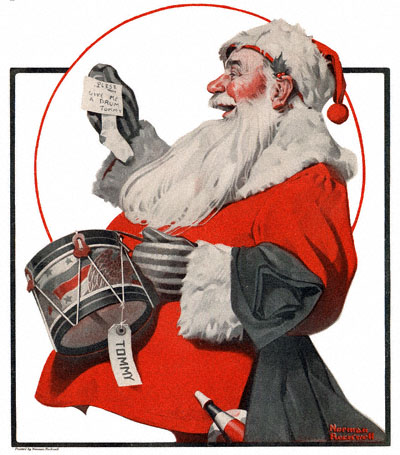
Norman Rockwell, Santa Claus

Set the stage

Every Christmas season, families with young children struggle with a question American culture presses inescapably upon us: How will we handle Santa Claus?

  1. Believing that the birth of Christ has little to do with Santa Claus and that Christmas in our culture is all about the latter rather than the former, some parents try to downplay Santa, and a few even choose not to celebrate Christmas at all, in order to avoid the consumerist materialism that masquerades in his name. But this alternative was unacceptable to us as it dampens the joy of the season and leads children to miss out on so much of the excitement of their peers. We wanted Christmas to be more joyous for them rather than less so.
  2. Parents who do choose to involve Santa in their celebration of Christmas and to provide gifts to their children marked as from Santa, face the dilemma of how to explain the truth about Santa as their children grow older. Do we enlighten them as soon as possible, so that they will not fall for legends and tall tales such as Santa Claus, Jack and the Beanstalk, or Prince Charming?

How do we connect the excitement of Santa Claus with the true joy of Christmas? (Or were they connected from the beginning?)

Stage 1: Introduce Bishop Nicholas

St. Nicholas: A Closer Look at ChristmasAs most everyone knows, Santa Claus derives from the Dutch name Sinter Klaas, which is a form of St. Nicholas, a 4th century bishop from the town of Myra in Asia Minor. St. Nicholas was noted for his gift-giving to the poor. In the church calendar, December 6 became established as the Feast of St. Nicholas, to commemorate the generosity of Bishop Nicholas of Myra.

Bishop Nicholas suffered for his faith under the persecutions of Diocletian. One legend tells about three daughters of a poor family who were unable to marry because their father could not afford dowries. Bishop Nicholas heard about it, and secretly left a bag of gold coins at their house one night. The eldest daughter married soon after. Then he brought another bag of coins, and put it in a window one night; not long after, the next oldest daughter became happily married. Then he brought a third bag of gold for the youngest daughter’s dowry, but in order not to be seen by the wary father, he sneaked down the chimney and left the gold in one of the daughter’s stockings, which was hanging on a bedpost. But the father glimpsed the Bishop’s red robes as he left, and thus we have the story of St. Nicholas.

When our daughters were young, we celebrated St. Nicholas’ Feast on some evening early in the season, on or around December 6. After the meal we told them the story of Bishop Nicholas, and gave them each a gift in Santa’s honor. To help them visualize the story of St. Nicholas, we would dig up pictures of a bishop’s red robes, of Father Christmas, Pere Noel, and a variety of historic Santa figures. We would read our old Little Golden Book edition of “Night Before Christmas.” Nowadays two illustrated storybooks for telling the story of Bishop Nicholas are Dandi Mackall, The Legend of St. Nicholas, or Julie Stiegemeyer, Saint Nicholas: The Real Story of the Christmas Legend. Pore over Norman Rockwell’s charming depictions of Santa. For a treasure trove of St. Nicholas stories, pictures and historical information, get a copy of St. Nicholas: A Closer Look at Christmas or Louise Carus, The Real St. Nicholas: Tales of Generosity and Hope from Around the World. See also William Bennett, The True Saint Nicholas: Why He Matters to Christmas.

Here are some additional ideas for celebrating the feast of St. Nicholas:

  • Make two figures (or have two children dress up): one as Santa Claus, the other in the red robes of Bishop Nicholas. Investigate their similarities.
  • Give the children gold foil covered chocolate coins after dinner.
  • To emphasize the theme of generosity around Santa Claus, together take toys to a Pediatrics Unit, or a charity organization, or make arrangements to ring Salvation army bells together. The above tale could be acted out as a skit at a nursing home or children’s home. Make helping the poor an integral part of celebrating the Christmas season.
  • Watch your favorite movie about Santa Claus.

The Saint Nicholas Center offers more information about St. Nicholas traditions, games and activities for kids, etc.

Celebrating the Feast of St. Nicholas accomplished several things: it diminished our overall focus on Santa by letting him have his day, getting him largely out of the way for the rest of the season. And more importantly, it enabled our children to associate the excitement of Santa and gift-giving with the story of a Bishop who gave gifts to poor children because of his love for the baby Jesus. When our children asked, “Is Santa real?“, our answer was, “Yes, and his first name was Bishop Nicholas.”

Stage 2: Meet Santa Claus

There came a year when each of our daughters would begin to put two and two together: Santa is Bishop Nicholas. Bishop Nicholas was a human like us. Bishop Nicholas lived a long time ago, and humans don’t live forever. So who is Santa Claus today? When they would ask that question, then at that point we were ready to introduce them to the “real” Santa Claus. We let them in on a secret: “Santa Claus today is none other than your own Grandpa Jack!” And then: “When we go to your grandparents’ home for Christmas, let’s try to catch him in the act – delivering presents and filling up the stockings!” Wow — what fun and anticipation they each had that year as we made our annual trek up to Missouri for Christmas break! There was absolutely no let-down about the Santas in stores or parades not being real, nor about Santa not living at the North Pole — what could be better than discovering that their very own Grandpa was the real Santa?

After we arrived, the excitement intensified: It was the day before Christmas. The girls discovered Santa’s black boots in a box left in the back bathroom! We could hardly wait to be on the lookout that night!

Here’s Rachel and Hannah catching Santa Claus in the act:

Rachel and Hannah catching Santa Claus in the act

Here’s what they saw:

Here's what they saw

What happened next:

What happened next

We know a secret!

We know a secret!

Where Santa really lives:

Where Santa really lives

Stage 3: You can be Santa, too

Then the following year, each daughter was ready to ask, “Is Grandpa Jack the only Santa?” How could he make it all around the world? At this time, we would answer that in every generation, for nearly two thousand years, someone in each family follows Bishop Nicholas’ example. Right now it’s Grandpa Jack in our family, and in other families it could be fathers, mothers, grandpas, grandmas, aunts or uncles or a church or ministry who cares. “Someday you can be Santa Claus, too.”

In the next photo, Rachel and Hannah are older, and enjoying passing on a tradition as the younger cousins figure it out:

Passing on a tradition

I think they almost believed in Santa all over again that year, when Santa Claus knocked at the front door early Christmas morning to perform a special delivery of snow saucers – one for every child in the house. On top of Susanna’s saucer was sitting her number one request from Santa that year, which no one but Santa could have obtained: a rainbow bear. There it was, with shimmering rainbow colors as beautiful and snuggly as could be, delivered personally by Santa himself!

It’s impossible to be a Christian unless one becomes like a child and cultivates the art of imagination. It’s difficult to keep hearing the Christmas bell. We found that putting the St. Nicholas back into Santa Claus helped us redeem our imagination at Christmastime, and better appreciate the mystery and joy of the Incarnation.

See also Christmas nights at home.
Posted in Family | Tagged , | 8 Comments

Ancient Christmas traditions – CSNTM

Index of Christmas holiday posts

Merry Christmas from Daniel Wallace and the Center for the Study of New Testament Manuscripts:

“The ancient liturgies of the Church include reading passages from the Bible on special holy days. On Christmas Eve, for example, Luke 2:1–10 and Hebrews 1:1–12 are read, while on Christmas Day Matthew 1:18–25, 2:1–12, and Galatians 4:4–7 are read. Manuscripts that arrange their passages according to what is read on these holy days are called lectionaries. Among Greek New Testament manuscripts, over 2000 of them—about 40%—are lectionaries. And the traditional passages to be read in these lectionaries reach back for more than 1500 years.”

Read more from the CSNTM Christmas newsletter

Center for the Study of New Testament Manuscripts, Leaf 49, ms, Romania

The work of the CSNTM to discover, catalog and digitally preserve manuscripts of the New Testament excites me deeply, and there’s no better season than Christmas to remember their work with our prayers and financial support.

Posted in Theology | Tagged , | 4 Comments

Christmas reflections: Angels

Index of Christmas holiday posts

Family Activities

Giotto, Gabriel

Shown: Giotto, The Angel Gabriel

Read Luke 1.1 – 2.20.

In his first sentences, Luke announces that he has written a historical narrative attested by eye-witnesses. Nevertheless, Luke fills the first two chapters with angels! Angels are not just for fairy tales. Everywhere they are bringing God’s good tidings into the world.

As one reads Luke’s account, let everyone else hold trumpets (kazoos!) and blow them as loud as possible every time angels are mentioned.

Sing:

  • Angels we have heard on high
  • Hark, the Herald Angels Sing
  • It Came Upon the Midnight Clear
  • O Come, All ye Faithful
  • Angels from the Realms of Glory
  • It Came upon the Midnight Clear

Read about angels

  • Read aloud: Madeleine L’Engle and Luci Shaw, WinterSong: Christmas Readings (Regent, 1996), pp. 37-48. This essay by Luci Shaw, with a poem by Madeleine L’Engle, makes a great family read-aloud over one or two evenings.
  • Billy Graham, Angels: God’s Secret Agents (1975). This easy read combines compelling stories with biblical teaching about angels.
  • Background study: Thomas F. Torrance, “The Spiritual Relevance of Angels,” in J.I. Packer and Loren Wilkinson, eds., Alive to God: Studies in Spirituality (InterVarsity Press, 1992), pp. 122-139. This chapter offers a theology of angels in a nutshell.

Watch:

Watch two classic Christmas movies in which angels play a major role: It’s A Wonderful Life, and The Bishop’s Wife.

Talk:

  • What do angels do? What is their ministry to humans, according to the nativity accounts?
  • Why do angels invariably begin their messages of good news with “Fear not”?
  • Both movies mix biblical teaching and angel folklore. Discuss.
  • Both movies emphasize the significance of the ministry of angels. Discuss.
  • Both movies emphasize the significance of persons. Discuss.
  • Both movies illustrate the idea that angels often “put ideas in people’s heads.” Discuss.
  • In both movies, people “entertained angels unawares” (Heb. 13:2). Discuss.
  • What would it be like to meet an angel? Do you know anyone who has seen an angel? If so, did the angel proclaim good news, or minister in some other way?
Posted in Family | Tagged , | 2 Comments

Anfossi, Dell’uso ed abuso della cioccolata (Venice, 1779)

Originally posted at ouhos.org, the now-discontinued blog of the OU History of Science Collections. Neither this post nor any of its content should be taken as an official communication of the University of Oklahoma.


Giovanni Anfossi, Dell'uso ed abuso della cioccolata (Venice, 1779)Is it cold outside? Why not warm up with a steaming cup of hot chocolate?

So advised the 18th-century Italian physician Giovanni Anfossi, in a work recently acquired by the History of Science Collections:

Dell’uso ed abuso della cioccolata (Venice, 1779).

His recommendation was not unqualified, however. Anfossi’s treatise on the origin, composition, and medicinal use of chocolate contains, among other things, arguments both for and against drinking chocolate. Ultimately, however, Anfossi praised the use of chocolate for its high nutritional value, its aphrodisiac qualities, and as a panacea for all sorts of physical maladies.

Got kids? Chocolate might make them high-strung. Anfossi concluded (as did many of his contemporaries) that chocolate, like coffee, was harmful to children and should only be consumed by adults!

The OU copy of Anfossi is bound in contemporary hand-painted wrappers illustrating the cocoa bean plant (below).

Giovanni Anfossi, Dell'uso ed abuso della cioccolata (Venice, 1779)

In the spirit of Anfossi’s wise counsel, History of Science Collections worker Carilyn Giuliano Livesey has prepared her own special hand-made chocolates (below) as door prizes for tomorrow’s Library Christmas party!

Carilyn Giuliano Livesey, hand-made chocolates

Posted in History of Science, Holidays | Leave a comment

Christmas reflections – Mary

Index of Christmas holiday posts

Mary’s Song, by Luci Shaw

Nativity, by Roberto Dughetti

Blue homespun and the bend of my breast
keep warm this small hot naked star
fallen to my arms. (Rest…
you who have had so far
to come.) Now nearness satisfies
the body of God sweetly. Quiet he lies
whose vigor hurled
a universe. He sleeps
whose eyelids have not closed before.

His breath (so slight it seems
no breath at all) once ruffled the dark deeps
to sprout a world.
Charmed by doves’ voices, the whisper of straw,
he dreams,
hearing no music from his other spheres.
Breath, mouth, ears, eyes
he is curtailed
who overflowed all skies,
all years.
Older than eternity, now he
is new. Now native to earth as I am, nailed
to my poor planet, caught that I might be free,
blind in my womb to know my darkness ended,
brought to this birth
for me to be new-born,
and for him to see me mended
I must see him torn.

Listen to the Green (1973); reprinted in Accompanied by Angels: Poems of the Incarnation (2006).

Family activities

Passages to read aloud together to talk about Mary are Luke 1:26-38, 46-56; 2:4-5, 18-19, 29-40. The Magnificat (Mary’s prayer in Luke 1.46-55) is one of the most beautiful praise songs in Scripture. Read it together in several translations.

And Mary said, “My soul magnifies the Lord, and my spirit rejoices in God my Savior, for he has looked on the humble estate of his servant. For behold, from now on all generations will call me blessed; for he who is mighty has done great things for me, and holy is his name. And his mercy is for those who fear him from generation to generation. He has shown strength with his arm; he has scattered the proud in the thoughts of their hearts; he has brought down the mighty from their thrones and exalted those of humble estate; he has filled the hungry with good things, and the rich he has sent away empty. He has helped his servant Israel, in remembrance of his mercy, as he spoke to our fathers, to Abraham and to his offspring forever.” (Luke 1:46–55 ESV)

Discuss how Mary’s response to the angel is the paramount model for the Christian life. Did Mary try to set her own agenda? Did she try to do “the Lord’s work” in her own strength? When facing shame and uncertainty, did she give in to bitterness? How did she give thanks instead? (Read aloud Francis Schaeffer’s discussion of Mary in True Spirituality, pp. 57-59.)

Discuss the meaning of Advent as a time of waiting, of longing, of hoping for the coming of the Messiah. Imagine how Mary would have felt four weeks before the child so mysteriously conceived would be born. Compare this with the centuries of waiting which the Hebrew people endured in faith and hope. How does Mary reflect the yearning of an entire people in her song of praise? How does she reflect a new hope?

Set up a figure of Mary and Joseph, with a donkey, somewhere in the house, to represent their journey to Bethlehem for Caesar’s tax. Each night move them a little closer to the spot where they will find the stable in Bethlehem.

Listen to Bach’s oratorio, The Magnificat.

Sing some carols together, including:

  • Mary, did you know?
  • Breath of Heaven
  • What Child is This?
  • The Cherry Tree Carol
  • Lo, How a Rose E’er Blooming
  • Magnificat
  • (by John Michael Talbot)

Recommended video: Roger Newell reflects upon Mary as a model for responding to God in faith in a conversation with Michael Feazell as part of the series You’re Included. Follow this up, if you want some theological reflection, with the section of Karl Barth’s Church Dogmatics about the virgin birth, entitled, “The Miracle of Christmas,” or Karl Barth, The Great Promise: Luke 1; chs. 2-3.

Read aloud:

Update (12/19/2011), from Rachel, Onward into Light:

I’ve been contemplating the mysteries of advent, thinking about “eternity shut in a span” and God new-born. I’ve also been thinking about a girl faced with a possibility — a question, beautiful and wondrous and wild with hope — and saying yes. I think about all the amazing and wonderful things that followed, things she stored up like treasures in her heart. I also think of all the sacrifices that followed that “yes” — the shame of rejection by her community, the pain of childbirth far from home; the fear, the confusion — how does one be the mother of God? — and, towards the end, the agony and heartache of watching her son suffer and die. But it was all so beautiful, so worth it. “Tidings of great joy” — a joy that slept incarnate in her arms, that shared the depths of her sorrow and tears; a joy that conquered death.

Posted in Family | Tagged , , | 2 Comments

Christmas reflections – the Shepherds

Index of Christmas holiday posts

Adoration of the Shepherds, by Matthias Stomer
Adoration of the Shepherds, by Matthias Stomer (North Carolina Museum of Art)

In Adoration of the Shepherds, the 17th-century Dutch painter Matthias Stomer captured the wonder of the first witnesses to the birth of the Lamb of God who takes away the sin of the world. Shepherds were the homeless of the day, the outcast, the despised, the forgotten, the lowest of the menial classes, and yet they were the ones chosen to receive the angelic message of good news and peace for all humanity. God is Immanuel, God is with us – shepherds were included in his coming, and so are we.

“It is good that somewhere in the world there are men who realize that Christ is born. There were only a few shepherds at the first Bethlehem, and it is the same now. The ox and the ass understood more of the first Christmas than the high priests in Jerusalem. And it is the same today.”

Thomas Merton, “Christmas in the Monastery” (in Eerdmans’ Book of Christian Classics)

Family activities:

Read:
Read Luke 2.8-20.
Poem: “Oxen Pay Homage”
Randy Alcorn, brief reflections on shepherds, in Nancy Guthrie, ed., Come, Thou Long-Expected Jesus.

“Now there were shepherds nearby living out in the field, keeping guard over their flock at night. An angel of the Lord appeared to them, and the glory of the Lord shone around them, and they were absolutely terrified. But the angel said to them, “Do not be afraid! Listen carefully, for I proclaim to you good news that brings great joy to all the people: Today your Savior is born in the city of David. He is Christ the Lord. This will be a sign for you: You will find a baby wrapped in strips of cloth and lying in a manger.” Suddenly a vast, heavenly army appeared with the angel, praising God and saying, “Glory to God in the highest, and on earth peace among people with whom he is pleased!” When the angels left them and went back to heaven, the shepherds said to one another, “Let us go over to Bethlehem and see this thing that has taken place, that the Lord has made known to us.” So they hurried off and located Mary and Joseph, and found the baby lying in a manger. When they saw him, they related what they had been told about this child, and all who heard it were astonished at what the shepherds said. But Mary treasured up all these words, pondering in her heart what they might mean. So the shepherds returned, glorifying and praising God for all they had heard and seen; everything was just as they had been told.” (Luke 2:8–20 NET)

Do:
Set up the nativity – the Bethlehem stable – with farm animals. Set up shepherds with their sheep across the room somewhere. When Christ is born they will come to visit him.

If possible, visit a farm, zoo or a “live nativity.”

Sing:
The Friendly Beasts
Away in a Manger (*see note below)
The First Noël
While Shepherds Watched their Flocks by Night
Rise up Shepherd and Follow
Come Leave Your Sheep

—–

*Note on Away in a Manger:
We correct the line of Away in the Manger that says:

“The little Lord Jesus, no crying he makes.”

This line diminishes the humanity of Christ, so we change it to:

“The little Lord Jesus, what a squalling he makes.”

This latter phrase is more consistent with Christ’s coming to share our place as Immanuel, and with his assumption of our human nature. The Incarnation is the central mystery of Christian faith and the wonder of Christmas. To sing Away in the Manger with children using this correction offers a wonderful opportunity, not to be missed, for engendering family theological reflection and discussion. 🙂

—–

See also Christmas nights at home.

Posted in Family | Tagged , | 5 Comments

Christmas reflections – Immanuel

Index of Christmas holiday posts

Immanuel - God with us

“The virgin will be with child and will give birth to a son, and they will call him Immanuel” — which means, ‘God with us.’” (Matthew 1:20–23)

That God is with us in the baby Jesus, the child born in Bethlehem, Immanuel, is a great mystery, indeed, and repays extended reflection. Thomas Torrance explains:

In His first Advent Jesus came… in grace and humiliation. He came in such a way as to enter into our guilty human life and to heal it from within…

“God with us” means that in the birth of Jesus Christ, God has given Himself wholly to us, in a love that is absolutely unstinting and infinitely lavish. It is God’s utmost self-giving that stopped at nothing. God could do no more than come Himself into our humanity, and give Himself entirely to us — and that is exactly what He has done in Jesus. The sheer extent, the boundless range, of His act of love takes our breath away.

“God with us” means that God Almighty insists on sharing His life with us. Far from abandoning us…, God has identified Himself with us. Once and for all He has become one of us, bone of our bone and flesh of our flesh. God has committed Himself to us in such unrestrained love in the birth of Jesus, and in such a way that now He cannot abandon us any more than He can abandon Himself in Jesus Christ.

That is why the birth of Jesus was heralded with such sublime joy among men and angels, for now that God is with us, the whole situation in heaven and earth is entirely altered, and all things are made new. Now that God is actually with us and of us, everything else is assured. Whatever may happen in the future, God’s purposes of love and fellowship and peace with man will all be fulfilled.

“God with us” means God with us sinners in our lost and bankrupt state. Where we have sold ourselves irretrievably into slavery and perdition and are hopelessly broken and damned, God has joined Himself to us. God has refused to let us go. He has insisted on making Himself one of us, and one with us, in order to make our lost cause His very own, and so to restore us to Himself in love.

“God with us” means that God is for us, God is on our side; that He has come among us to shoulder our burden, and to rescue us from disaster and doom and to reinstate us as sons of the heavenly Father. That is the meaning of the whole life of Jesus from His birth to His death. It was God taking upon Himself our poor human life in all its wretchedness and need, God living out our human life from beginning to end, in order to redeem it…, in order to make our lost cause His own.

Thomas F. Torrance, When Christ Comes and Comes Again, pp. 20, 40, 41.

See also Christmas nights at home.

Posted in Theology | Tagged , , | 16 Comments

Christmas gifts: You are a meteorite

Index of Christmas holiday posts

Update 2022: Meteorite fragments I’m giving out this year are pieces from the largest group of meteorite fragments ever found — more than 100 tons have been recovered so far from this single fall, which created a field of more than 26 craters known as Campo Del Cielo in the Chaco Province of Argentina, about 4,500 years ago.


GiftsI’m terrible at choosing gifts. Some people (especially God, and my sister Laura) have a special knack for choosing gifts that are meaningful to the recipient while at the same time they reflect the relationship of the giver. When that happens, the exchange of a gift is a joyous event. My gift-giving, on the other hand, seems more often than not an awkward transaction, despite my delight in giving. For example, most people, most of the time, when they are receiving a gift from me, get a book. Or sometimes several books. That fact alone epitomizes my relative inability to get beyond myself to give a gift whose nature reflects the recipient more than myself.

The most telling example took place one year when I was rather too old for it to be excusable, but I gave my Mother a huge, warehouse-sized case of toilet paper. In my defense, it might be noted that this was long before Sam’s or Aldi’s made the acquisition of such a treasure a rather common occurrence. But even with that noted, there’s little to be said in my defense. At the time, I naively thought it would lift a burden off her shoulders. In my mind I was thinking that shopping for all that toilet paper must be a heavy chore, and I could get it out of the way for her at the start of the new year. Yet, once the deed was done, for some reason I did not experience as much joy in the giving of the gift as I had anticipated.

Last year, however, for the first time (and possibly the last), I did feel like I hit upon a gift that was possibly nearly as meaningful to others as it was to myself: genuine meteorite fragments. Meteorite fragments may be had from a variety of rock and mineral resellers. I purchased several dozen from Ikon Mining & Exploration Company. On her blog, Laura described how my nieces and nephews received their meteorites. Click the image below to view a 3-minute video:

meteorite.jpg

As she mentions in her post, the meteorite specimens were accompanied by a set of reflections. At Christmas we celebrate the Divine Meteorite, God come down from heaven to earth. And each of us, also, is an extraordinary, heaven-sent meteorite, no matter how ordinary we may feel. You are a meteorite. Here’s the booklet (click to download pdf):

You are a meteorite

Be forewarned: Unfortunately, this year I don’t think I can top the meteorite. That was my one good gift idea to last my lifetime, a bolt from the blue. Lightning doesn’t strike twice. I’m back to my own resources now, so this year expect books or toilet paper.

—–

Update: For Christmas 2010, our gift to nephews and nieces was copal, a hardened form of resin that, over time, becomes amber. Here’s the pdf description of copal (2.6 MB) that we distributed with the gift, which considers several analogies between copal/amber and the young people receiving the gift (made in time, unique as Madagascar, idiosyncratic inclusions, a pleasant aroma, electrifying and light-bearing, and to be handled gently with great care).

Copal and Amber

Posted in Family, Nature | Tagged , , | 13 Comments

Christmas nights around town

Index of Christmas holiday posts

In a previous holiday post I mentioned the carol Gaudete, and linked to a video of Rachel and Hannah’s dance troupe performing it last year. At that time I didn’t realize they would be performing it last night at the city of Norman’s annual Christmas Tree lighting event! What fun! It was too dark in Andrews Park to get a good picture of their dancing, but here’s one of the lighted “tree”:

Norman Christmas Tree, Andrews Park

Standing underneath, the view overhead was filled with multicolored lights shining like the bright winter stars! The stars of winter are my favorites of any season: Orion the Hunter and The Winter Hexagon are now in clear view above the horizon after sunset. And I always enjoy a star on the top of any Christmas tree.

Afterward, many of us went to Borders for the monthly Celtic jam. Fewer musicians than usual turned up, but that left more room for dancing:

Dancing at Borders

Candace, Rachel and Hannah sang a Gaelic lullaby to the Christ child, and a medley of a capella Christmas carols:

Candace, Hannah and Rachel at Borders

The night before, Candace and I made it to the OU combined choirs holiday concert. For several reasons it seemed even more joyous, if possible, than in previous years. The selection of carols included some of Candace’s old favorites from her college days, and audience participation was high — the conductor led the audience in singing during transitions between choirs.

Earlier that evening, “I saw Candace kissing…” not Santa Claus, but Susanna T. Rex:

Susanna as Spike the dino with Candace at the Natural History Museum

Susanna got to welcome youngsters to the Natural History Museum’s Christmas event dressed up as Spike, their dinosaur mascot (and later as Slash, another dinosaur costume). As Susanna would get down upon her knees, it was fun to watch little kids overcome their trepidation and dare to walk over to Spike’s outstretched arms for hugs.

Santa Claus comes to the Natural History Museum

Tonight it will be time for our journey to Bethlehem, and afterward maybe catch the finish of the Big 12 title game. Since moving back to Norman we’ve enjoyed the annual Journey to Bethlehem at Forest Hill Christian Church. If it’s just for kids, then I’m a kid, because I love it, hokeyness and all.

We’ve already been out driving around to see Christmas lights. Soon we’ll make the drive up to Joe B. Barnes Regional Park in Midwest City (see pic below), one of the Top 5 Oklahoma City lighting displays; and maybe this year we’ll finally make it down to see the Chickasha Festival of Lights as well.

The Loch Ness Monster at the Midwest City Joe B. Barnes Regional Park Christmas lights display

Meanwhile, some of our dear friends are taking lead roles in the Christmas Traditions festivities in Missouri. Wish we could go visit St. Charles in time to see them!

See also my previous post: Christmas nights at home.

Posted in Family | Tagged , | 8 Comments

Gaudium Mundo: Latin Christmas Carols

Index of Christmas holiday posts

Gaudium Mundo - Latin carol for December 5My dear friend Laura Gibbs, who is my inspiration for all things related to the digital humanities, maintains a wonderful Latin Holiday Songs blog featuring 80 different “carols of the day.” You can see all 80, or subscribe by email, here.

One of my favorite Latin carols is Gaudete Gaudete - A Winter's Night. As its name implies, it’s a lively carol announcing joy to all because Christ is born of the virgin Mary. I love to see it performed live; it simply calls forth joyous dancing! Here it is performed last year by the Celtic Praise Troupe, including my two older daughters, Rachel and Hannah:

Gaudete, performed by the Celtic Praise Troupe

Posted in Family | Tagged , | 5 Comments