Darwin on orchids

Originally posted at ouhos.org, the now-discontinued blog of the OU History of Science Collections. Neither this post nor any of its content should be taken as an official communication of the University of Oklahoma.


Darwin@the Library info | Exhibit brochure (pdf)

After publishing the Origin of Species (1859), Darwin spent the remainder of his life exploring the ramifications of his theory of evolution by descent with modification. Darwin’s next work explored the immense degree of variation present in nature, using orchids as the prime example.

Charles Darwin, On the Various Contrivances by which British and Foreign Orchids are Fertilised by Insects (London, 1862); F800

A beautiful gilt inlaid depiction of an orchid adorns the cover.

Charles Darwin, On the Various Contrivances by which British and Foreign Orchids are Fertilised by Insects (London, 1862); F800

Darwin@the Library info | Exhibit brochure (pdf)

Posted in History of Science | Leave a comment

Wedding music

25 years!

I fell in love with Candace the first time I saw her as I listened to her sing, and ever since she has brought wonderful music into my life. At our wedding, held outdoors near a wooded stream at 8 o’clock in the morning, she sang Keith Green’s The Lord is My Shepherd, accompanied by Diane Ramsey on the flute and Jody Kessel on the guitar:

The Lord is my Shepherd from Kerry Magruder on Vimeo.

The wedding ceremony was filled with joyous music from start to finish, beginning with Purcell’s Ayre as the Prelude, and a trumpet voluntary as the processional, both performed by a brass quartet of Glenn Lemons (trumpet), Troy Peterson (trumpet), Dr. Roger Cody (trombone) and Trent Kite (tuba). Then Gloria Fields sang Morning Has Broken, by Cat Stevens, again accompanied by Diane Ramsey on the flute and Jody Kessel on the guitar:

Morning Has Broken from Kerry Magruder on Vimeo.

Just before the charge to the couple and the exchange of wedding vows, our dear friend Michael Barfield performed his Season Suite, a song that could not have been better suited to the occasion:

Season Suite from Kerry Magruder on Vimeo.

Finally, a sextet of Tanya Henmen, Gloria Fields, LaNita Partin, Jill Stoufer, Lori Zoll and Sharon Tait Burch concluded the ceremony with The Lord Bless You and Keep You, by Lutkin:

The Lord Bless You and Keep You from Kerry Magruder on Vimeo.

To all of you who gave us the gift of music on this special day, we offer our continual, life-long thanks. We remember you with joy and treasure your friendship.

But there was more: throughout these performances various songbirds provided improvisational melodies, particularly one red-winged blackbird who repeatedly serenaded us with his organ pipes. As Robert Frost wrote,

“to do that to birds was why she came.”

Thank you, Candace, for making music such a central part of our lives together!

25 years!

Posted in Art-Music-Lit, Family | Tagged , , , | 6 Comments

25 years!

Thank you, Candace, for 25 wonderful years!

Candace and I at Bryce Canyon, June 2011
At Bryce Canyon, June 2011

Triqueta, Trinitarian communion of personsOn the heels of last fall’s 25th anniversary of our first date (see Look at us), this month Candace and I celebrated our silver anniversary. On June 21, 1986, we were married in an outdoor ceremony on summer solstice. On that date this year, Candace wore a sterling silver triquetra pendant, which reflects some ideas about marriage as a participation in the divine communion of persons which I shared earlier this year (Marriage is the gospel made visible).

On our anniversary last year, I posted my Wedding Sonnet, which adorned the back cover of our program.

“for romance that rejoices to delight like freshly falling dew
distills from its sweetness each morning fragile joys anew.”

In 1999, on our 13th anniversary, I put up an old wedding site. In the next several posts, I’ll be updating and transferring the contents of that old website here.

First, wedding photos are now available on Flickr.

The wedding video is available on Vimeo:

Wedding, 1986 from Kerry Magruder on Vimeo.

Additional wedding/anniversary posts:

Posted in Family | Tagged | 12 Comments

Darwin, Origin of Species (1859)

Originally posted at ouhos.org, the now-discontinued blog of the OU History of Science Collections. Neither this post nor any of its content should be taken as an official communication of the University of Oklahoma.


Darwin@the Library info | Exhibit brochure (pdf)

Charles Darwin, Origin of Species (1859)After refining his ideas about species change in the special case of barnacles, in 1859 Charles Darwin published a general account of his theory of descent with modification by means of natural selection. Contemporaries referred to the origin of species as that “mystery of mysteries.” Darwin appreciated the complex relations of any species with its environment, and clarified how it is that some varieties have greater success than others in leaving offspring. Varying conditions of life cause organisms with particular variations to survive — this is natural selection.

3 copies of Darwin, Origin (1859)

Three copies of Darwin, Origin of Species (1959), first edition,
in the Darwin@the Library exhibit.

If you have an old copy of the Origin of Species, turn to page 20 and count down to the 11th line. If “speceies” is misspelled, then you have a first edition.

In the first chapter, Darwin demonstrated the vast extent of variation among domesticated species. As a result of human selection in breeding, dogs and pigeons and other animals have undergone remarkable changes.

In chapter 2, Darwin explored the extent of variation of animals under natural conditions, apart from human selection. To explain the concepts of “the struggle for existence” and “natural selection,” in chapters 3 and 4 Darwin elucidated the complex relations between closely related species and their habitats in order to explore how natural conditions might exercise a similar effect as human selection. Darwin argued that the process of species change remained wrapped in obscurity because of the complexity of these relations. Therefore Darwin patiently accumulated accounts of animal relations, elucidating far-reaching connections, with careful attention to detail. One of Darwin’s favorite stories is mentioned on p. 74, where he wrote that

“The number of humble-bees in any district depends in a great degree on the number of field mice, which destroy their combs and nests….”

As it was elsewhere elaborated: The humble bee pollinates the most desirable variety of clover, but because the bee builds its nests on the ground, a certain species of field mouse destroys the humble bee’s nests. The clover is used to make the best quality hay, which is used to feed the best horses of the British cavalry. The British cavalry enforces British power in the colonies. Because cats eat mice, and old ladies keep cats, the continuance of the British empire therefore obviously depends upon a bountiful supply of old ladies!

Darwin bees

Darwin’s theory of evolution was expressed most clearly in a foldout diagram which illustrates a pattern of “branching divergence,” as species change by descent with modification from common ancestors. Darwin marshaled evidence from geology and geography showing that species appear, both geographically and in the fossil record, in patterns consistent with their descent by modification from common ancestors.

Charles Darwin, Origin of Species (1859), branching divergence

At the end of the Origin, Darwin closed with some meditative words: “There is grandeur in this view of life….”

Charles Darwin, Origin of Species (1859), p. 490

Curiously, the very last word of the book is the only place in the entire work where the word evolution appears in any form.

Darwin@the Library info | Exhibit brochure (pdf)

Posted in History of Science | Leave a comment

New era: The Four Lassies

For many years, Candace, Rachel and Hannah have performed music together for various family, church and social events. Sometimes they play instruments (hammered dulcimer, mountain dulcimer, piano and other folk instruments). But most of all, they blend their voices together in beautiful harmonies.

This year a new era has dawned: where once there were three, now there are four! Susanna joined her Mom and two older sisters in singing “Be Still, My Soul” at the annual dance recital on June 4, just before we headed west for a family trip. A few days later, when the entire company of family travelers were together in Mesa, Arizona, they sang it again. Laura captured it with her camera, and made it available online:

Be Still My Soul from Laura M. on Vimeo.

Be still my soul, the Lord is on your side
Bear patiently the cross of grief or pain
Leave to your God to order and provide;
In every change He faithful will remain.
Be still my soul – your best, your heavenly Friend
Through thorny ways leads to a joyful end.

Be still my soul, your God will undertake
To guide the future as He has the past.
Your hope, your confidence let nothing shake;
All now mysterious shall be bright at last.
Be still my soul — the waves and winds still know
His voice who ruled them while He dwelt below.

Be still my soul, when dearest friends depart
And all is darkened in the vale of tears
Then shall you better know His love, His heart
Who comes to soothe your sorrow and your fears.
Be still my soul — your Jesus can repay
From His own fullness all He takes away.

Be still my soul; the hour is hastening on
When we shall be forever with the Lord,
When disappointment, grief and fear are gone,
Sorrow forgot, love’s purest joys restored.
Be still my soul — when change and tears are past
All safe and blessed we shall meet at last!

Susanna, you sang beautifully. Welcome aboard!

And to all of my four lassies: I love the way each one of you interweaves the beauty of music and dance into our ordinary life together. Thank you for enriching my life so profoundly.

Related: Advent Celebration (Susanna’s Celtic harp); and Christmas nights around town (three lassies).

Posted in Family | Tagged | 5 Comments

Darwin on barnacles

Originally posted at ouhos.org, the now-discontinued blog of the OU History of Science Collections. Neither this post nor any of its content should be taken as an official communication of the University of Oklahoma.


Darwin@the Library info | Exhibit brochure (pdf)

Darwin, BarnaclesAfter Darwin’s emergence as a popular writer and a leading geologist, he turned to some thoughts that had been nagging him about species change. Darwin would devote the next decade to theorizing about the evolution of species.

Darwin began with an eight-year investigation of barnacles. In 1851 and 1854 Darwin published two monographs on barnacles containing page after page of depictions of both living and fossil forms. It may seem strange that after launching his career as a global voyager, Darwin then retreated into his study to spend eight years preoccupied with barnacles! Yet scrupulous study of barnacle variation provided him with an ideal laboratory to forge his ideas about species change.

Charles Darwin, Monograph on the Sub-Class Cirripedia... [Vol. 2] The Balanidae (or Sessile Cirripedes); The Verrucidae, etc., etc., etc. (London, Printed for the Ray Society, 1854). F339.2

Barnacles were simply a way of life in these long years for Darwin and his growing family. When Darwin’s young son visited a friend and saw no evidence of dissections in the house, he asked, “Where does your Daddy do his barnacles?”

Darwin@the Library info | Exhibit brochure (pdf)

Posted in History of Science | Leave a comment

Storytelling and The Lord of the Rings

Songs are the very soul of The Lord of the Rings.

BBC dramatization, The Fellowship of the RingTraveling often recalls my mind to that masterwork of the journey, J.R.R. Tolkien’s Lord of the Rings. On a recent trip, therefore, I listened to the excellent BBC dramatization of all three titles prepared by Brian Sibley: Fellowship of the Ring, The Two Towers, and Return of the King. Decades ago I treasured a little wooden crate filled with cassettes dramatizing The Hobbit, likewise produced by the BBC, and so I was looking forward to listening to these LOTR dramatizations with nostalgic anticipation. As the miles went rolling by, I was by no means disappointed.

I have much to learn from the imaginative perception of others, so I am one who welcomes multiple interpretations of The Lord of the Rings, whether through songs, paintings, films or audio dramatizations (like the BBC production).

Janet Croft, Tolkien on FilmJanet Croft and others have discussed the significant differences between Tolkien’s epic and the Peter Jackson movies. Most obviously, despite the extended length of Jackson’s trilogy, the screenplay had to be immensely compressed. Thus the movies eschew the patient plodding of Tolkien’s narrative, as it recounted long journeys experienced at a walker’s pace. In this respect as well as others, movies, like any dramatization, are interpretations, pointers and tributes to, rather than replacements of, the original work. Nevertheless, I was pleased that Jackson’s films took their visual aesthetic in large part from the paintings of Alan Lee. More than that, I rejoiced that a new generation encountering Tolkien for the first time would be drawn into a lifetime of reading the books for themselves.

What I most missed from Jackson’s films, however, were the songs.

Make no mistake – I love the soundtracks to all three films. The final songs – May It Be by Enya and Into the West by Annie Lennox – are profoundly moving. On my office wall I keep a translation into Quenya of the latter’s lyrics produced by Rachel, who delighted Candace and me one evening by coming down from her bedroom (where she had been ensconced translating it) to sing it for us. Billy Boyd’s rendition of The Steward of Gondor is a haunting epitome of lamentation. A video extra devoted to the music of Rohan, found on the extended edition of The Two Towers, demonstrates the producers’ detailed attention to the distinct musical tradition of each place. Who could forget the themes of Rohan, Hobbiton or Rivendell? Remove the music and there would be no films. I regard the soundtracks of the films as equally successful as the Alan Lee visual aesthetic.

Yet, still, something more elusive is missing by nature from a cinematic film. It has to do with the way songs and poetry and storytelling were meant to be a way of life. Inevitably, the domination of the visual image over the spoken word and the rapid pace of the movies transposes the songs and the telling of tales from the foreground into the background. Instead, action is everywhere prominent. A telling question: Do we witness the lead actors singing more often than fighting? In some places, perhaps, but more often lore and storytelling become merely implicit. The songs occur with high production value rather than forming the matrix of daily life. This sadly reflects our general cultural shift from social music-making to the consumption of music as a commodity.

Yet it struck me while listening to the BBC dramatizations, rather, that characters frequently burst into song and launch into storytelling. This was an unexpected delight. Curiously, Tolkien’s songs (set to music by Stephen Oliver and sold as an accompanying soundtrack) appear in the dramatization despite its similar length: only 13 hours for the BBC dramatizations vs. 11 hours and 22 minutes for the Jackson extended editions. For one accustomed to the movies, all that singing is recurrently refreshing, and makes the dramatizations more faithful to the feel of the books. All this points to the meaning of The Lord of the Rings, the importance of the spoken word, and the imaginative way of life Tolkien sought to recover.

Songs, poetry and storytelling are the heart and soul of The Lord of the Rings. In a captivating essay, “Tolkien’s Mythopoesis,” Kirstin Jeffrey Johnson explores how, through story, the imagination enables us to experience reality concretely, which reason alone could grasp only as a wraith-like abstraction. Through the story we gain delight, wisdom and strength on a far deeper personal level than we could ever experience from contemplating an abstract summary of the plot. Johnson explains:

“The book begins with a Middle-earth from which story is rapidly being lost. One of Bilbo’s distinguishing features is that he is both a story collector and a storyteller… The reason Frodo, Sam, Pippin and Merry are able to journey (Tolkien repeatedly reminds us) is because they have benefited from Bilbo’s love of stories and likewise love those stories…. Knowing and believing in elves, for instance, not only makes these hobbits somehow different from other hobbits but also causes them to look about with different eyes. In each place of rest and restoration along the journey, Tolkien makes clear that part of the essential nourishment that the hobbits receive is story – in word and in song, and even in picture.”
(Kirstin Jeffrey Johnson, Tree of Tales, p. 34.)

In this essay, published in Trevor Hart, ed., Tree of Tales: Tolkien, Literature and Theology (Baylor University Press, 2007), Johnson explores the significance of songs and stories for Elrond (“greatest of lore-masters”), Gandalf, Aragorn, Celeborn, as well as the hobbits. The same meaning-making role of song and story could be shown in the lives of Arwen, Galadriel, Eomer, Gimli, Legolas and others. Johnson contrasts Boromir (who “cared little for lore”) with Faramir (“a lover of lore and music”):

“It is crucially significant to understand why [Faramir, when] given the opportunity to take the Ring is not even tempted. Here, I think, the film of the book fails us. For it is important to Tolkien that the reader understands that Faramir has truly learned … from ancient tales…. He is able to believe in things no man he knows has seen….” (Johnson, p. 36.)

Théoden laments, “Songs we have that tell of these things, but we are forgetting them, teaching them only to children, as a careless custom” (Johnson, p. 36). Tolkien conveys the significance of song and storytelling through the character of every major figure in the epic, for good or ill.

Regarding video interpretations of Tolkien, Jackson’s movies are neither the first word nor the last. I hope the next attempt will be a lengthy mini-series, where words will receive as much emphasis as deeds. To do this, each episode would need to feature a song sung, or a tale recounted, in a full, unhurried manner. As Gandalf chided Théoden: “Is it so long since you listened to tales by the fireside?” (quoted by Johnson, p. 36.)

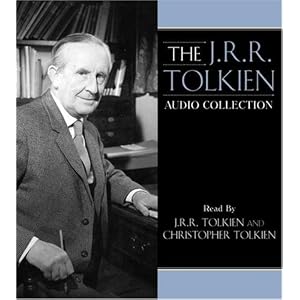
Meanwhile, as a provisional countermeasure, I suggest that we movie-lovers listen to The Lord of the Rings soundtracks at least once all the way through for every time we watch one of Jackson’s films. More than that, between each film watching, spend several days listening to the J.R.R. Tolkien Audio Collection and the Essential Tolkien CD, in both of which Tolkien sings and reads his poems and stories. It would be a pity if lines from the films come more readily to mind than the original poems and songs of Tolkien himself, the greatest of lore-masters.

The J.R.R. Tolkien Audio Collection Essential Tolkien CD

For deeper insights into these matters, read Johnson’s essay, as well as the other contributions to this excellent book, Tree of Tales, ed. Trevor Hart. Similar themes appear in Ralph Wood, The Gospel According to Tolkien (2003), which I also listened to as an audiobook on my recent trip. Wood is a most astute interpreter of Tolkien’s theological imagination. If you read just one book about Tolkien, I can’t think of any better. Chris Van Allsburg puts the meaning of music and storytelling in a nutshell in his illustrated storybook, The Wretched Stone (1991).

All these books whet my appetite to read The Lord of the Rings again, start to finish. So now that I’m by the fireside safely home, the real journey begins.

Chris Van Allsburg, The Wretched Stone

See a Stephen Oliver music video of Bilbo’s Last Song; buy Tolkien music here and here.

Posted in Art-Music-Lit | Tagged | 3 Comments

Dashing pell-mell around the Colorado Plateau

Delicate Arch, photo by Jackson Mann
Moon rising over Delicate Arch, photo by Jackson Mann

“A weird, lovely, fantastic object out of nature like Delicate Arch has the curious ability to remind us – like rock and sunlight and wind and wilderness – that out there is a different world, older and greater and deeper by far than ours, a world which surrounds and sustains the little world of men as sea and sky surround and sustain a ship. The shock of the real. For a little while we are again able to see, as the child sees, a world of marvels. For a few moments we discover that nothing can be taken for granted, for if this ring of stone is marvelous then all which shaped it is marvelous, and our journey here on earth, able to see and touch and hear in the midst of tangible and mysterious things-in-themselves, is the most strange and daring of all adventures.”

Edward Abbey, Desert Solitaire, Chapter: Cliffrose and Bayonets, p. 37.)
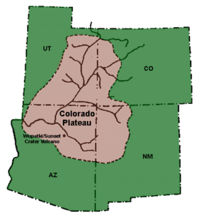
Colorado PlateauThe Colorado Plateau of northern Arizona and southern Utah is one of the most striking regions of North America. It combines one of the lowest numbers of human inhabitants per square mile with one of the highest numbers of national parks and monuments, including the Grand Canyon, Zion, Bryce, and Arches. I remember the slides taken of our family visiting these strange, exotic places when I was a child, beyond the reach of actual memory yet always present to my imagination.

Thanks to Mother and Dad, we enjoyed a large family gathering in the Phoenix area, following which about 13 of us made a pell-mell dash around the Colorado Plateau. Thanks to Laura and Jackson for the photos which illustrate this post. Thanks to Stephen for putting together the ambitious itinerary that made it possible for us to see so many facets of this strange and varied land in a short span of time. Like a Bach fugue, the Colorado Plateau is a giant theme with many variations: a vast uplifted desert, with layer-cake formations exposed like a grand staircase and cut through by canyon-forming rivers. (In the section below, observe Bryce Canyon in the upper right, Zion in the middle, and the Grand Canyon on the lower left. See: Anne Egger; Ron Blakey; USGS.)

Grand Staircase formations

From the beginning, we told ourselves we were only scouting out the land. Rather than staying in one or a few places long enough to immerse ourselves in its character and history, we elected to make a reconnaissance trip of the entire plateau, so that next time we might better appreciate any particular place on its own. As Rick Steves says, “Expect to return.”

In anticipation of a return, and for the sake of friends who may ask us about a Grand Tour, I will outline below a circle path one might follow to gain a holistic sense of the Colorado Plateau. Several weeks would be needed; on our brief trip, we did not visit every site and in no place did we linger long enough. My Grand Tour begins in NE Arizona on the way to Phoenix, but one could begin the circular itinerary at any point.

There are many ways to experience new country. To travel with a fisherman, one experiences new country primarily alongside its rivers and lakes. Traveling with a hiker or cyclist involves seeking out the bicycle trails and footpaths. Compared with hiking or cycling, the view from the back of a horse has its own distinctive rhythm, adding the responsibility of caring for a living and breathing fellow traveling companion. If the friend is not a horse but a pilot, one views the country from overhead, with a wide angle. To travel with a reader or movie-goer requires quiet, unhurried time to experience literary and cinematic works in situ. These ways and others are fun and enlightening, so kerrymagruder.com out opportunities for a wide variety of perspectives.

Yet even from the roadside or on short and easy hikes, one imaginative way to approach unfamiliar places is from the perspective of geology and history. Where they intersect, the human and natural stories interweave in an endlessly varied tapestry. These are some guides I recommend for becoming acquainted with the natural and human stories of the Colorado Plateau:
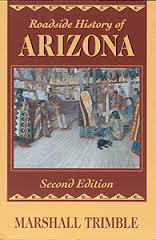
Marshall Trimble, Roadside History of Arizona

Roadside History of Utah Roadside Geology of Utah

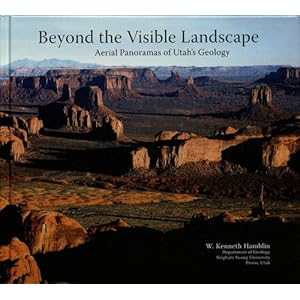
Kenneth Hamblin, Beyond the Visible Landscape

Sibley Guide to Birds Canyon Country Wildflowers

Grand Tour of the Colorado Plateau

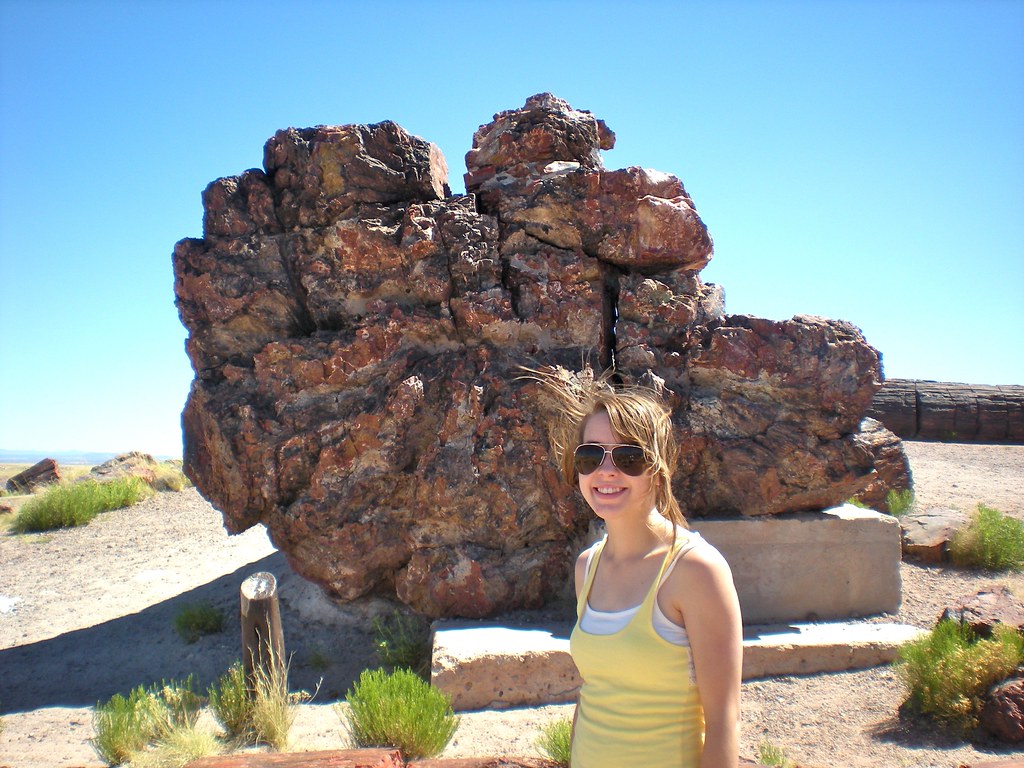
1. Petrified Forest, Painted Desert National Parks, AZ. An audio tour is available in the Visitor Center gift shops.
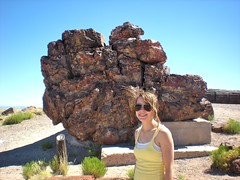
Rachel at the Petrified Forest
Rachel at Petrified Forest

2. Mogollon Rim – the south boundary of the Colorado Plateau. From the Petrified Forest go south, following State Highways 377 to Heber, 270 to Payson, and 87 to Phoenix. One could actually fall off the Colorado Plateau over the steep Mogollon Rim. Keep those roadside guides handy. We gathered at A.T. Still University in Mesa (cf. Laura’s post).

3. Grand Canyon National Park, AZ (USGS). We visited the North Rim this time, which was definitely worth the extra driving time. The drive north of Flagstaff on US-89 through Navajo land along the Echo cliffs takes one through the northwestern tip of the painted desert. This drive is a singularly striking introduction to the desert country and superbly exemplifies the Colorado Plateau. When you turn westward along the Vermillion Cliffs south of Page toward the North Rim, the view of the Kaibab Plateau is striking. The Kaibab Plateau is an island of alpine forest rising above the surrounding desert which laps at its shores, while the Grand Canyon cuts the south side. We stayed at Jacob’s Lake Inn, which is excellent, although next time we’ll try for a National Park cabin right on the North Rim.
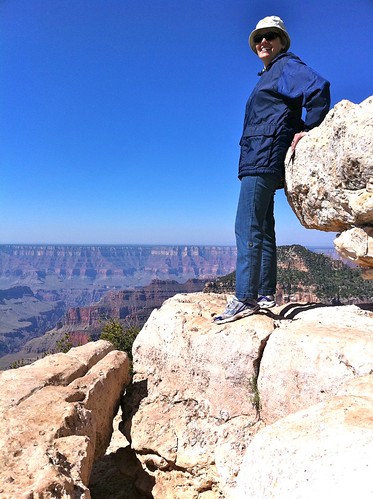
Candace on the North Rim

Candace and I laughed our way through a hilarious account of a mule-ride into the Grand Canyon by Donald Davis. Listen to The Grand Canyon – Donald Davis. It’s a hoot.

4. Page, AZ (at least a full day): Horseshoe Bend, Antelope Canyon, Glen Canyon Dam and Lake Powell (USGS). One of the high points of the trip for me was the moment a Navajo guide walked through Antelope Canyon playing his Navajo flute. Surrounded by windswept ancient sand-dunes fossilized into this stunning slot canyon, it just seemed appropriate to pause to listen to the wind of his breath passing through the desert flute. One of my favorite souvenirs of the trip is the CD Radiant Sky by Scott August, which features a Navajo flute.
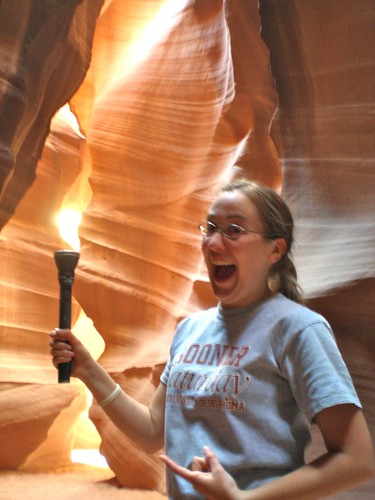
Hannah at Antelope Canyon

5. Zion National Park, UT (USGS). The drive from Page, AZ to Springdale, UT, is again spectacular. Keep those roadside guides handy. We stayed at the Bumbleberry Inn in Springdale. The Wayside Tours and Patricia Lawrence audio guides to Zion were helpful (we listened to them on the way), as was riding the shuttle from the Visitor’s Center to the end of the line to get our bearings. Laura and Marvin and family, who stayed at Zion Lodge, got to do this on a late Moonlight Ride, an ideal way to let Zion introduce itself.

Zion Canyon is distinguished by its near vertical walls which create a massive grandeur. Truly awesome. Although Zion is in desert country, due to the Virgin River and the seeping rocks and springs, inside the canyon the vegetation can be surprisingly lush. Rachel commented that the descent into Zion as we arrived reminded her of Rivendell.

Warm up the first day with brief walks to the Emerald Pools, Weeping Rock (my favorite), and the lush riverside walk from Sinawava Temple, where we watched a California Condor soar overhead – an unforgettable sight. If more ambitious, on later days hike the Canyon Overlook Trail, wade through the Narrows, and climb Angel’s Landing. Plan ahead for these: come prepared with proper footwear, water bottle, hat, sunscreen, sunglasses, energy snacks and other gear. Next time we’re going to try out walking poles to keep us from turning an ankle on the softball-sized rounded rocks that cover the bed of the Virgin River, and we’ll come with hiking boots that offer strong ankle support and good traction on wet surfaces. And we won’t forget the binoculars.

We could spend a week in Zion without batting an eye.
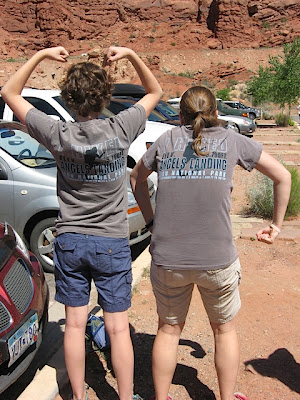
Anna and Hannah, photo by Jackson Mann

Before leaving, don’t miss the unusually beautiful Kolob Canyons area in northwest Zion. The Kolob Canyon area also affords a dramatic view of the western edge of the Colorado Plateau.

Kolob Canyons are on the way to the spectacular State Highway 14, which runs along the north side of Zion through Dixie National Forest and affords a glimpse of Zion Canyon from above. The extensive lava flows are a remarkable sight, distributed among aspen and pine forests, with plenty of snowfall remaining on the ground. What a total about-face from the heat of the desert below. Laura particularly enjoyed the signs saying “8% grade” or “No stopping or standing next 2 miles due to falling rocks” as well as the ones that had so many s-shaped squiggles they would tie a snake in knots. In one place the lane turned to gravel where a landslide must have knocked it out this past winter. But the view was well worth it! Next time we’ll also check out Cedar Breaks National Monument. Plan on a full day to travel from Springdale through Kolob Canyon and Hwy 14 to Bryce.

(Laura’s post on Zion, Kolob, and Hwy 14.)

6. Bryce Canyon National Park, UT. Among canyons in the desert southwest, Bryce stands out for its varied colors and delicate structures. The Grand Canyon might as well be infinite for the way its immensity plays tricks upon sensory perception. Zion’s massive verticality is an awesome Romanesque cathedral. Bryce, in comparison, appears less imposing, more comprehensible. We caught Sunset Point at sunset. Beautiful.
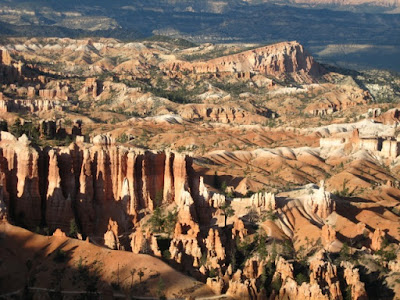
Bryce Canyon, from Sunset Point, by Jackson Mann

On the way out, we gave a lift to Michelle and Marie-Claire, from Orléans, France, who had missed the last shuttle back to their hotel. Although National Parks inevitably are crowded tourist destinations (campgrounds and hotels require advance reservations), one of the compensating joys is the number of languages one hears spoken in them. We were thrilled to meet this wonderful French couple and have the chance to talk with them for a while. Likewise in Zion, within a blind arch carved away behind a waterfall, we were treated to the echo-producing yodels of a Swiss man who was traveling with Hebrew-speaking companions from Israel. What a small world, indeed.

Trails below the rim open up another world. An early settler remarked that Bryce is “a hell of a place to lose a cow.” Be careful and save your strength when hiking: after seeing what you go afoot to see, the only way home is up.

Recommendation for next time: spend several nights at Bryce. (Cf. Laura’s post.)

7. Take your time traveling from Bryce to Arches along State Highways 12 and 24, which eventually join up with I-70, west of Green River. Like Highway 14 north of Zion, this is one of the most scenic highway stretches in the American southwest, where desert features alternate with alpine meadows and aspen forests. Hwy 24 runs through Capitol Reef National Park. My friend Ken advises:

“As you approach Boulder, there is an incredible section where the road goes along the top of a ‘backbone’. Pull off the road somewhere on this section for fantastic Grand Staircase vistas. A few miles out of Boulder, going NE, the road rises as it goes along the southern flank of Boulder Mtn. Again, don’t fail to pull off at the scenic points (marked) for incredible vistas. A little farther along, as the highway turns north toward Torrey, the pull-outs offer great views over the Waterpocket Fold and Capitol Reef; and the Henry Mtns beyond (famous as where GK Gilbert found out about laccoliths). Perhaps you will be in too much haste to do this side trip out of Boulder – but it is a beaut: It’s called the Burr Trail road. Just where highway 12 takes a bend, in town, from eastward to northward, the Burr Trail road continuing to head east takes you through some wonderful Grand Staircase type of country – the exposed rock here is quite a sight. You can visit a modest slot canyon right by the road, about a dozen or so miles in (I think – I cannot recall exact mileages), but even if you only go four or five miles down Burr Trail road before turning around, the sights of rock are quite fine.

At Boulder, by the way, the Hell’s Backbone Grill is actually an outstanding place to eat. Located just N of where highway 12 bends northward in the middle of (tiny) Boulder.

Capitol Reef is quite interesting – worth a short visit, which involves a drive south into the park from the highway (no. 24 at this point) a few miles – you don’t have to go in terribly far to get an idea of the place. Even if you don’t go into the park, at the old Gifford Farm House close by the visitor center and campground they sell fresh-baked mini-pies in various versions (apple, rhubarb, blackberry, etc) that are to die for, especially with some vanilla ice cream on top.

To continue on from Cap Reef toward Arches, you go east from Capitol Reef to Hanksville. Here you have a choice of the shorter, dull way to Arches (north on 24 to I-70) or the somewhat longer, very scenic way, south and SE on 95 to the crossing at the upper end of Lake Powell. This has the advantage, too – if you have time to do it – of a possible look at Natural Bridges, a wonderful place. Beyond that Hwy 95 continues quite scenic for a good way (one spectacular mile or two along a wall front and then finally through it), and connects with 191 just S of Blanding.”

Keep that roadside geology guide handy, even on I-70 where the roadcuts and panoramas are astonishing. At Green River, stop at the John Wesley Powell River History Museum, where after we had gone on down the road following a picnic lunch, a kind worker fished my daughter’s retainer out of the trash and saved it for us. There must be a special circle of heavenly joy awaiting those who assist hapless travelers on their way.

8. Arches National Park, UT. The Visitors Center sells an audio tour with an accompanying paperback booklet. As in all parks, ranger tours are informative. We hiked the trail to Delicate Arch at sunset, then stayed put as a one-day from Full Moon rose above the arch. Sublime. I wanted to stay in Arches long enough to read Desert Solitaire. And find the double arch that appears in the prologue of Indiana Jones and the Last Crusade. (Cf. Laura’s post.)
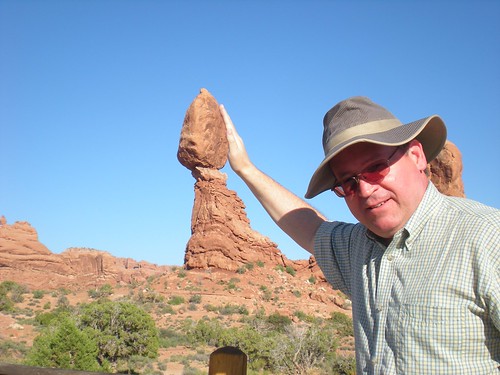
Balancing Rock, Arches National Park
A giant vandal tries to push over the Balancing Rock (which is 6 stories high)

9. Canyonlands National Park, UT (USGS). An audio tour and booklet is available in the Arches Visitor Center. Again, Ken writes:

“Mesa Arch (a short walk, perhaps 20 minutes round trip from the road). Green River Overlook (this is the one I would choose if allowed only one stop). Grandview point overlook. Dead Horse Point, which is not in the Natl Park but a separate State Park — so a separate charge — is also a breathtaking sight.”

As you head south, admire the La Sal mountains to the east.

10. Either on the way south from Canyonlands, or after visiting Monument Valley, take a detour east to spend a day or two near Cortez, Colorado, at Mesa Verde National Park (USGS), near the boundary between the Colorado Plateau and the mountain chains that make up the backbone of the state. Cliff House – the largest settlement – is a guided tour. Spruce House is self-guided, and to us, the most interesting. Next time we’ll try Balcony House, a guided tour which involves more climbing. (Cf. Laura’s post.)
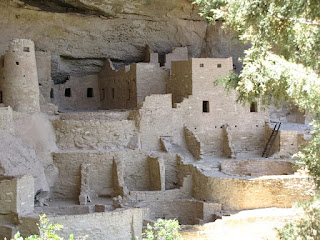
Mesa Verde, by Jackson Mann
Mesa Verde, photo by Jackson Mann

11. Monument Valley, UT. During the Great Depression, the impoverished Navajo funded Harry Goulding’s trip to Hollywood where he persuaded John Ford to shoot films on Navajo land. The result was a string of westerns starring John Wayne. Check out Where God Put the West by Bette L. Stanton. The main overlook is a Navajo Nation Park. As we drove away, Susanna paused the movie she was watching – Spirit, Stallion of the Cimarron – to show us a frame that exactly matched this view from the main overlook:
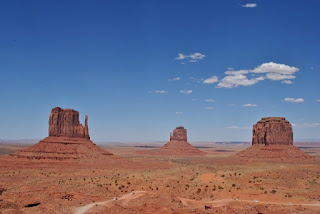
Monument Valley, photo by Jackson Mann

(Cf. Laura’s post.)

Several amazing sites, as Ken notes, are easily reachable from a base hotel at Bluff, Mexican Hat, or Monument Valley:

“As you approach Mexican Hat (NE of Monument Valley) from the north, there are at least two very enticing prospects of side trips: the Valley of the Gods, which you can enter right off of hwy 163; and Goosenecks of the San Juan, several miles to the side, up hwy 261, then a jog to the left [you can actually do both in succession – as you exit the Valley of the Gods drive not far from the Goosenecks side road].”

12. Canyon de Chelly National Monument, AZ (USGS). From here, it’s a quick trip down US-191 to I-70 to complete the grand circle tour.

See our photo gallery. Now I’m ready to read some Louis L’Amours and watch some old westerns.

Expect to return!
Posted in Family, Nature, Travel | 5 Comments

Charles Darwin: Geologist

Originally posted at ouhos.org, the now-discontinued blog of the OU History of Science Collections. Neither this post nor any of its content should be taken as an official communication of the University of Oklahoma.


Darwin@the Library info | Exhibit brochure (pdf)

On the heels of the Beagle voyage, the magnificent Zoology of the Beagle drew attention to Charles Darwin as a promising young scientist, while at the same time the travel narrative made him well-known to the public. But Darwin established his reputation as one of the scientific elite with three substantial books on geology.

Coral Reefs, 1842; F271
First came his study of coral reefs in 1842. During the Beagle voyage, Darwin visited many coral reefs. He compiled reliable observations of additional sites through personal correspondence and the published literature.

Charles Darwin, Coral Reefs (1842), map

Coral reefs typically surround a volcanic island in a protective ring, creating a lagoon of quiet water within the reef. Darwin explained coral reefs as the cumulative result of small and gradual changes. He would follow the same methodology in his thinking about the history of life on Earth. At the time, Darwin’s explanation of the gradual origin of coral reefs was hailed as a major advance in geology, and it is still accepted today.

Charles Darwin, Coral Reefs (1842), section

VolcanicBombVolcanic Islands, 1844; F272
Next came Darwin’s study of volcanic islands in 1844. He gave pride of place to his description of Ascension Island. He observed volcanic bombs, including one the size of a man’s head.

Charles Darwin, Volcanic Islands (1844), Ascension Island

And he described the Galapagos Archipelago, where his observations later proved fertile for his theory of evolution.

Galapagos

Geological Observations on South America, 1846; F273
In 1846 Darwin published his geology of South America, the result of extensive fieldwork he undertook during the Beagle’s explorations there. Because of the many excursions ashore, Darwin actually spent more time on land than aboard ship during the Beagle’s voyage. To explain the geological features of South America, Darwin again argued for the significance of small and gradual changes. Had Darwin never written another word, he would still be remembered as a leading 
19th-century geologist.

SouthAmerica

Darwin@the Library info | Exhibit brochure (pdf)

Posted in History of Science | Leave a comment

Charles Darwin, Voyage of the Beagle (1839)

Originally posted at ouhos.org, the now-discontinued blog of the OU History of Science Collections. Neither this post nor any of its content should be taken as an official communication of the University of Oklahoma.


Darwin@the Library info | Exhibit brochure (pdf)

Charles Darwin, Voyage of the Beagle (1890)

Which of Darwin’s books was the most popular during his own lifetime?

Charles Darwin’s second book was a travel narrative, a lively account of the Beagle voyage originally published in 1839 as the third volume of the Journal of Researches. The Journal was a 4-volume report of the voyage edited by Robert Fitzroy, captain of H.M.S. Beagle.

Darwin, Journal of Researches (1839), title page

Darwin’s journal became known in subsequent editions simply as the Voyage of H.M.S. Beagle. Darwin’s Voyage was an immediate best-seller. More people read this book in the 19th century than any of Darwin’s other works.

Charles Darwin, Voyage of the Beagle (1890)

Darwin recounted adventures at sea: sailing around Cape Horn, passing by snow-topped mountains and volcanic islands.

HMS Beagle at Cape Horn Snow covered mountains Volcanos

And adventures on land: crossing icy bridges in the Andes and traversing treacherous mountain passages. He relayed visions of strange, far-away places and the exotic people who lived there.

Icy bridge Mountain bridge Exotic people

Darwin’s travel narrative was widely admired, both in Britain and on the continent, as a description of the scientist as an explorer encountering the exotic and sublime.

Forest waterfall

The Voyage makes compelling reading, recounting stories about many of the specimens described in the Zoology. For example, the Voyage explains that Darwin caught the vampire bat beautifully colored in the Zoology as it alighted on the back of his horse near Coquimbo, in Chile.

Vampire bat, from the Zoology Vampire bat, from the Voyage (1890)

Galapagos tortoise, from the Voyage (1890)The 1890 edition of the Voyage depicted the Galapagos tortoise, which somehow escaped being described in the Zoology.

It’s no wonder the Voyage of the Beagle has remained in print to this day.

—–

Examine the Voyage of the Beagle in high resolution at the Online Galleries:

More info about Darwin’s first book, the Zoology.

Darwin@the Library info | Exhibit brochure (pdf)

Posted in History of Science | Leave a comment

Charles Darwin, Zoology of the Voyage of H.M.S. Beagle (1838-1843)

Originally posted at ouhos.org, the now-discontinued blog of the OU History of Science Collections. Neither this post nor any of its content should be taken as an official communication of the University of Oklahoma.


Darwin@the Library info | Exhibit brochure (pdf)

Charles Darwin, Zoology of H.M.S. Beagle (1838-1843), fox

In the Zoology, Charles Darwin described the specimens he collected and sent back to England during the Beagle voyage. The Zoology is the rarest of all Darwin’s works, issued in 19 separate parts from 1838 to 1843, with half of its 180 lithographs colored by hand. The OU copy is bound in three volumes; no page or plate is missing.

Charles Darwin, Zoology of H.M.S. Beagle (1838-1843)

Although Darwin edited and superintended the work, he was a young man and not well known to the British scientific scene, so he enlisted five elite and well-respected naturalists to collaborate with him.

Charles Darwin, Zoology of H.M.S. Beagle (1838-1843)

In Part 1, Richard Owen assisted in describing South American fossil mammals. Detailed engravings include a fold-out actual-size depiction of the skull of the prehistoric Toxodon mammal.

Darwin Toxodon

George Waterhouse assisted with living mammal specimens in Part 2. South American foxes, wild cats and aquatic mammals are portrayed alongside various species of field mice and larger rodents.

Charles Darwin, Zoology of H.M.S. Beagle (1838-1843)

Part 3 is devoted to birds. For these specimens, Darwin obtained the help of John Gould, the great English ornithologist and artist. This volume is one of Gould’s most famous works of art. Each lithograph was printed in black and white and then painstakingly hand-colored by John Gould and his wife, Elizabeth. The illustrations capture the immense variation found among species of mockingbirds and finches, and provide glimpses of species’ natural habitats based upon Darwin’s notes.

Charles Darwin, Zoology of H.M.S. Beagle (1838-1843)

Part 4 is devoted to fish and Part 5 covers reptiles. Lizards from the Galapagos Islands are depicted, along with South American frogs and toads. Surprisingly, there is no description of a Galapagos tortoise.

Charles Darwin, Zoology of H.M.S. Beagle (1838-1843)

Had Darwin never written another word, he would still be famous as the supervising author of the Zoology, a magnificent work of color natural history illustration. The Zoology brought Darwin to the attention of scientists everywhere as one of Britain’s up-and-coming young naturalists.

The voyage of H.M.S. Beagle from December 1831 through October 1836 became one of the most famous expeditions of modern times. Originally planned as a survey of southern South America and some islands in the Pacific, the voyage became a stimulus for the ideas that later crystallized as Charles Darwin’s theory of evolution. On this voyage Darwin collected many specimens of plants, animals and fossils.

Darwin, Zoology of the Beagle, Fox: Canus antarcticus

When Darwin returned, he enlisted leading naturalists of the day to describe the specimens. The Zoology of the Voyage of the Beagle was published as a collaborative effort between 1838 and 1843. Contributors included Richard Owen (fossil mammals), George Waterhouse (mammals), John Gould (birds), Leonard Jenyns (fish) and Thomas Bell (reptiles).

Darwin, Zoology of the Beagle, bird:  Tanagra Darwinii

The quarto work of 632 total pages includes 166 plates, 82 of which were hand colored. Gould’s illustrations of birds are renowned (he also recognized that Darwin’s finches represented more than one species). Darwin superintended the production of the work, including the plates, and contributed introductions, notes and descriptive comments throughout. Aspects of habitat that appear in the illustrations, such as background depictions of associated plants and insects, reflect Darwin’s close collaboration with his senior contributors. This work introduced Darwin to the British scene, after the Beagle voyage, as an important and upcoming young naturalist.

Darwin, Zoology of the Beagle, bird:  Xanthornus flaviceps

The Zoology of the Beagle was originally published in 5 Parts, consisting of a total of 19 Numbers issued over a six-year period:

1. Fossil Mammalia (4 Numbers: F8.1, F8.7, F8.8, F8.13)
2. Mammalia (4 Numbers: F8.2, F8.4, F8.5, F8.10)
3. Birds (5 Numbers: F8.3, F8.6, F8.9, F8.11, F8.15)
4. Fish (4 Numbers: F8.12, F8.14, F8.16, F8.17)
5. Reptiles (2 Numbers: F8.18, F8.19)

Darwin, Zoology of the Beagle, rodents: Mus elegansDarwin editions are designated according to Freeman number based upon the bibliographic work of Richard B. Freeman. This work as a whole is designated F8. Each individual Number of the work is designated by a decimal “.#” from F8.1 through F8.19.

The OU copy is bound in three volumes:

  1. Fossil and living mammals (Parts 1 and 2)
  2. Birds (Part 3)
  3. Fish and Reptiles (Parts 4 and 5)

The OU copy of Darwin’s first and rarest work is exceptional, with minimal foxing, no missing plates, and all errata sheets present. This recent acquisition completed the OU collection of Darwin first editions. These volumes are available in their entirety on the Collections’ image galleries.

Darwin, Zoology of the Beagle, fossil mammal: Side view of the Taxodon

Darwin, Zoology of the Beagle, panther: Felis Yagouarondi

Darwin, Zoology of the Beagle, owl: Otus Galapagoensis

Darwin, Zoology of the Beagle, finch: Cactornis ofsimilis

Examine the Zoology in high resolution at the Online Galleries:

Charles Darwin, Zoology of H.M.S. Beagle (1838-1843)

Darwin@the Library info | Exhibit brochure (pdf)

Posted in History of Science | Leave a comment

The HMS Beagle

Originally posted at ouhos.org, the now-discontinued blog of the OU History of Science Collections. Neither this post nor any of its content should be taken as an official communication of the University of Oklahoma.


Darwin@the Library info | Exhibit brochure (pdf)

H.M.S. Beagle, 1831–1836
The first books Darwin published resulted from his voyage on H.M.S. Beagle, which sailed around the world from 1831 to 1836. Robert Fitzroy captained this second surveying voyage of the ship with more than 35 sailors aboard. The chief mission of the voyage was to explore the southern portions of South America. A 22-year-old naturalist named Charles Darwin joined the expedition and made it the most noteworthy voyage of exploration of the 19th century.

Voyage of H.M.S. Beagle, from Darwin (1890)

The Beagle model on display was acquired by the Sam Noble Oklahoma Museum of Natural History for Darwin@the Museum, a joint exhibition held in fall 2009. Through the generosity of the Museum, the ship is now on indefinite loan to the History of Science Collections.

H.M.S. Beagle model, History of Science Collections
Model of H.M.S. Beagle, History of Science Collections lobby

The original H.M.S. Beagle was built as a 10-gun brig, almost exactly as long and as wide as the combined Roller Reading Room, Exhibit Lobby and Elevator Foyer of the History of Science Collections (approximately 100 x 25 feet). See Keith Stewart Thomson, HMS Beagle: The Story of Darwin’s Ship (Norton, 1995).

Darwin@the Library info | Exhibit brochure (pdf)

Posted in History of Science | Leave a comment